
E-Bike vs. E-Moto for Kids: California Laws for Parents
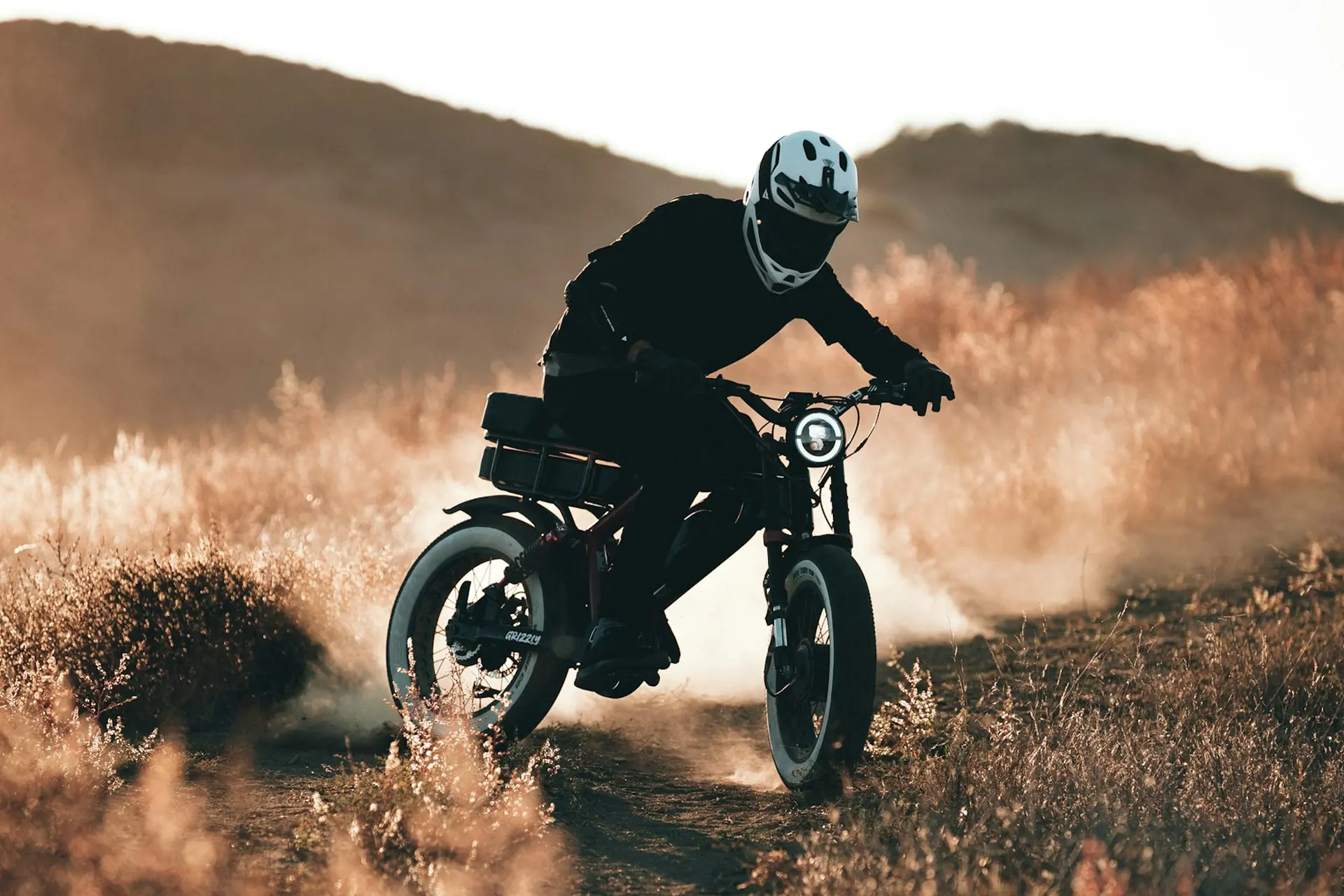
A legal e-bike is the only one of the two that a child can ride on California streets. An e-bike that meets Vehicle Code § 312.5 (working pedals, a motor of 750 watts or less, and motor assistance that stops at 20 or 28 miles per hour depending on its class) is treated as a bicycle and needs no license, registration, or insurance. An e-moto is a motor vehicle. Many e-motos marketed to families are off-highway electric motorcycles. They cannot be made street legal at any age, and a child can ride one legally only off the highway, where off-highway vehicles are allowed.
The choice also changes what happens after a crash. Hulburt Law Firm represents people seriously hurt in e-bike accidents and motorcycle crashes in San Diego and across California. Conor Hulburt’s first step on any new case is finding every source of insurance coverage. For an electric two-wheeler, the vehicle’s legal classification decides which of those sources exist. It also decides whether a parent shares legal responsibility and whether an injured child can recover anything for pain and suffering.
E-Bike vs. E-Moto Rules at a Glance
Four categories cover nearly every electric two-wheeler a family is likely to consider. The table compares them; the sections below explain each one.
E-Bikes, Mopeds, and E-Motos Under California Law
What each category needs before a child or teen can ride it, as the Vehicle Code and the California DMV describe it in 2026.
| Vehicle | Where it can ride | License | Registration | Insurance |
|---|---|---|---|---|
| Class 1, 2, or 3 e-bike | Streets and bike lanes, subject to class and local rules | None | None | Not required |
| Moped | Streets; kept off bike paths and trails unless next to a roadway or allowed locally | M1 or M2, age 16 or older | Yes, special moped plate | DMV does not require it to register |
| Street-legal electric motorcycle | Streets and highways | M1 | Yes, standard plate | Financial responsibility required |
| Off-highway electric motorcycle (e-moto) | Private land with permission or open off-highway areas; never public streets | Not street legal under any license | Off-highway ID plate or sticker | Cannot be made street legal by insuring it |
Sources: Vehicle Code §§ 312.5, 24016, 406, 400, 436.1, 4000, 5030, 12500, 16020, 21207.5, and 38010; California DMV, Motorcycles, Mopeds, and Scooters. Local ordinances can add limits, and SB 1167 changes several definitions on January 1, 2027.
What Makes an E-Bike an E-Bike
Vehicle Code § 312.5 defines an electric bicycle as a bicycle with fully operable pedals and an electric motor that does not exceed 750 watts. It sorts e-bikes into three classes:
- Class 1: the motor helps only while the rider pedals and stops helping at 20 miles per hour.
- Class 2: the motor can move the bike by throttle alone, but provides no assistance at 20 miles per hour or faster.
- Class 3: the motor helps only while the rider pedals, stops helping at 28 miles per hour, and the bike must have a speedometer.
Manufacturers must attach a permanent label showing the class number, top assisted speed, and motor wattage. Check that label before you buy, and keep a photo of it.
Under Vehicle Code § 24016(b), an e-bike that fits one of the three classes is not a motor vehicle, and its rider is exempt from the rules on financial responsibility, driver’s licenses, registration, and license plates. Children still face rules: riders under 18 must wear a helmet, no one under 16 may ride a Class 3, and several San Diego County cities restrict children under 12 on Classes 1 and 2. Our guide to California e-bike laws covers those age, helmet, and local rules.
A bike stops being an e-bike when it is modified to go faster than 20 miles per hour on motor power alone, modified to exceed 750 watts, or modified to remove its pedals. The same is true of a vehicle the manufacturer built to be modifiable past those limits. Tampering with an e-bike in a way that takes it outside its class, or selling a product or app that does so, is prohibited by § 24016(d) and (e). An “off-road mode” that a teenager unlocks in an app can turn a legal Class 2 into an illegal vehicle.
What Is an E-Moto?
“E-moto” is a marketing term, not one legal category. When a vehicle sold as an e-moto (or as a high-power “e-bike”) fails the § 312.5 test, the Vehicle Code places it in one of three groups.
Moped
Under Vehicle Code § 406, a moped (also called a motorized bicycle) is a two- or three-wheeled device with an automatic transmission and a motor producing less than 4 gross brake horsepower, capable of no more than 30 miles per hour on level ground. It may have pedals, or none at all if it runs solely on electricity. A moped can use the street, but Vehicle Code § 21207.5 keeps it off bike paths, bikeways, bike lanes, and recreational trails unless the path is within or next to a roadway or local rules allow it.
Electric motorcycle
A motorcycle under Vehicle Code § 400 is a motor vehicle with a seat or saddle, designed to travel on no more than three wheels. An electric two-wheeler that exceeds the moped limits is a motorcycle. One built and certified by its manufacturer for road use can be registered and ridden on the street like any other motorcycle.
Off-highway electric motorcycle
Since January 1, 2026, Vehicle Code § 436.1 has defined an off-highway electric motorcycle, “commonly referred to as an eMoto.” It is designed by the manufacturer mainly for off-highway use, runs on an electric motor, has handlebars, a straddle seat, and two wheels, and came from the factory without pedals. Many electric dirt bikes marketed to families fit this definition. It is an off-highway vehicle, regulated like a gas dirt bike, not a bicycle.
Can Kids Ride an E-Moto Legally?
Yes, but only off the highway. Vehicle Code § 4000 prohibits driving any motor vehicle on a highway unless it is registered, and California law defines a highway to include ordinary public streets. An off-highway e-moto displays an identification plate or sticker under Vehicle Code § 38010 precisely because it is not registered for road use. With that plate, the bike can be ridden on public land open to off-highway vehicles, and it can be ridden on private land with the owner’s permission. Nothing allows it on streets, sidewalks, or bike lanes, at any age.
The San Diego Police Department states on its e-bike safety page that e-motorcycles are not authorized to be ridden anywhere within the City of San Diego, and that the City has no authorized off-highway areas for them. Families in the City will need to trailer the bike to a designated riding area.
Where riding is allowed, these rules apply to a child:
- The child must fit the bike. Vehicle Code § 38304 requires every off-highway operator to be able to reach and operate all the controls needed to ride safely. Under Vehicle Code § 38304.1, a parent who knowingly lets a child under 14 ride in violation of that rule can be fined.
- Each riding area sets its own rules. Under Vehicle Code § 38301, it is unlawful to ride in violation of the special regulations of the agency that manages the land, which can include helmet, supervision, and equipment rules. Check them before the trip.
- No statewide minimum age. California’s safety-certificate and supervision rules for young riders apply to all-terrain vehicles, not to off-highway motorcycles. A bill that would have required an operator card for off-highway riders 16 and older, and adult supervision for younger riders, was held in committee in 2026.
- More rules start in 2027. SB 1167 bars riding an off-highway electric motorcycle on forest-, brush-, or grass-covered land unless the bike meets new safety standards, and requires its battery to meet a safety standard before it is sold.
The street-legal path for a teenager runs through a road-certified moped or electric motorcycle. At 16, a teen can qualify for a motorcycle license, but the DMV’s motorcycle license page explains that anyone under 21 must hold an instruction permit for at least six months and complete a California Motorcyclist Training Course first. The bike must be registered, and the teen must be covered by a motorcycle policy.
Licenses, Plates, and Insurance
- E-bike: no license, no registration, and no insurance requirement (Veh. Code § 24016(b)).
- Moped: Vehicle Code § 12500(b) requires a license for that class, and the California DMV says a moped rider needs an M1 or M2 license and must be at least 16. A moped must display a special license plate under Vehicle Code § 5030. The DMV says registering a moped does not require insurance. Vehicle Code § 27803 requires a motorcycle-standard helmet for every moped rider and passenger.
- Electric motorcycle: an M1 license, standard registration and plates under § 4000, and the ability to show financial responsibility (usually a liability policy) under Vehicle Code § 16020. The same helmet rule applies.
- Off-highway e-moto: an off-highway ID plate or sticker. No license, plate, or insurance policy makes it legal on a public street.
Insuring an e-moto
Parents can buy coverage. Insurers sell off-road or dirt bike policies, often written as motorcycle policies, with bodily injury liability, property damage, and medical payments coverage. Because a minor generally cannot buy a policy, the bike is usually insured on a parent’s policy, with the child as a covered rider. A homeowner’s policy is a poor substitute: one that covers an off-road vehicle at all often stops at the edge of the insured’s own property.
Before relying on a policy, get these answers in writing: the bike is listed by make and VIN or serial number, a named minor rider is covered, coverage applies on public off-highway land, and the policy has no exclusion for unlicensed or underage operators. The Legislature already requires moped makers to warn buyers in capital letters that existing policies may not cover the vehicle (Veh. Code § 406(b)), and that warning is worth taking literally for any electric two-wheeler.
An off-road policy does not make street riding legal, and as the next section explains, a child hurt riding an e-moto on a street can lose the right to recover pain and suffering.
What Happens After a Crash
The vehicle’s category does not decide who caused a crash. It does decide which insurance applies, whether the rider can recover for pain and suffering, who else may share responsibility, and what arguments the other side can make.
When a driver hits your child
A negligent driver is responsible for the harm the driver causes, whether the child was on a Class 1 e-bike or an unregistered e-moto. If the child’s own conduct contributed to the crash, the recovery is reduced by the child’s share of fault. Under CACI No. 405, the jury assigns each side a percentage of responsibility and reduces the award accordingly. Our article on comparative negligence in bike crashes walks through how that math works.
A violation also does not automatically count as negligence. CACI No. 418 lets a jury presume negligence from a statutory violation only if the violation was a substantial factor in causing the harm, the harm was the kind the law was meant to prevent, and the injured person was in the group the law protects. Riding without a license, for example, does not by itself show the rider caused the crash. The causation question turns on what actually happened: speed, visibility, and where the rider was.
For an uninsured e-moto rider, a second rule can cut much deeper.
Can an e-moto rider recover pain and suffering?
Often not, if the rider had no qualifying insurance. Civil Code § 3333.4, adopted by voters in 1996 as Proposition 213, bars recovery of non-economic losses (pain, suffering, inconvenience, physical impairment, disfigurement, and other nonpecuniary damages) in a case arising out of the operation or use of a motor vehicle when any of these applies to the injured person:
- Drunk or drugged driving. The injured person was operating the vehicle in violation of Vehicle Code § 23152 or § 23153 and was convicted of that offense.
- Uninsured owner. The injured person owned a vehicle involved in the accident, and it was not insured as the financial responsibility laws require.
- Uninsured operator. The injured person was operating a vehicle involved in the accident and cannot establish financial responsibility as those laws require.
The same section says a liability or uninsured motorist insurer is not liable to pay those non-economic losses. A barred rider can still recover economic losses: medical bills, lost earnings, and the cost of future care, reduced by the rider’s own share of fault.
This rule is the sharpest legal difference between the two vehicles. A rider on a legal e-bike is exempt from the financial responsibility laws under Vehicle Code § 24016(b), so the uninsured owner and operator rules should not apply. An e-moto rider is driving a motor vehicle, and Vehicle Code § 16020 requires every driver of a motor vehicle to be able to establish financial responsibility. An off-highway e-moto rarely has a policy that does that. Many personal auto policies exclude vehicles with fewer than four wheels or vehicles designed mainly for off-road use. The same problem applies to an uninsured moped or motorcycle.
- Fault does not change the rule. The bar applies even when the other driver caused the crash. That driver’s insurer still owes the rider’s economic losses.
- No exception for minors. The statute contains no exception for a rider under 16 who could not legally get a license or a policy. Families should plan as though it applies.
- Ownership is a separate question. The uninsured owner rule asks who actually owned the vehicle. If a parent bought and controls the bike, that rule may point at the parent rather than the child, but the operator rule can still reach the child.
- The drunk-driver exception is narrow. Section 3333.4(c) restores non-economic damages to an uninsured owner who was hit by a driver convicted of DUI. It does not mention the uninsured operator rule.
- Read every household policy. An off-road policy, or an endorsement that lists the bike, may supply the financial responsibility the statute asks about. Get the full policy forms and endorsements, not just the declarations pages.
Your own auto policy
Uninsured and underinsured motorist coverage on a family’s auto policy usually protects household members hit by an uninsured or underinsured driver while on a bicycle. Riding an e-moto the family owns can change that. Insurance Code § 11580.2(c)(6) does not require uninsured motorist coverage for injuries suffered “while occupying a motor vehicle owned by an insured” unless that vehicle is insured under the policy, and for that paragraph it defines “motor vehicle” as “any self-propelled vehicle.” An e-moto the family owns but has not listed on a policy fits that description, and many policies contain a matching exclusion. Medical payments coverage often excludes injuries on a motorized vehicle with fewer than four wheels as well.
The e-bike question is less settled. Vehicle Code § 24016(b) says an e-bike is not a motor vehicle, but a throttle-capable e-bike is arguably “self-propelled.” Whether an exclusion reaches it depends on the policy’s exact wording, so read the definitions section before accepting a denial.
When your child hurts someone
Because an e-moto is a motor vehicle and an e-bike is not, the first three rules below reach the parents and owners of an e-moto but not an e-bike. The last applies to both.
- Parents of minors: Vehicle Code § 17708 makes parents jointly liable for a minor’s negligent driving of a motor vehicle on a highway when the minor drove with the parents’ express or implied permission, licensed or not. Vehicle Code § 17709 caps that liability at $15,000 for one person’s injury or death and $30,000 per accident.
- Owners who lend the vehicle: under Vehicle Code § 17150, the owner of a motor vehicle is liable for injuries caused by anyone driving it with permission, subject to similar caps in § 17151.
- Negligent entrustment: under CACI No. 724, an owner who lets someone use a vehicle while knowing, or having reason to know, the person is incompetent or unfit to drive it can be liable, without those caps, if that unfitness was a substantial factor in the harm.
- Willful misconduct: Civil Code § 1714.1 imputes a minor’s willful misconduct to the parent with custody and control, up to a statutory limit, regardless of what the child was riding.
The caps limit what the parent or owner owes under those statutes; they do not limit the rider’s own liability or claims against other defendants. And because off-highway e-motos rarely carry liability insurance, the person your child hurts may have to turn to their own coverage. Section 11580.2 excludes from “uninsured motor vehicle” any vehicle designed or modified for use primarily off public roads, “except while actually upon public roads,” so an off-road e-moto that hits someone on a street can trigger that person’s uninsured motorist coverage, while the same crash on a trail may not.
Mislabeled vehicles and defects
Current law already prohibits selling an out-of-class vehicle as an e-bike, and SB 1167 widens that rule. When a family bought what was sold as an e-bike and it turns out to be an e-moto, the advertising, labels, receipts, and app settings show what the seller represented, which is evidence in a claim against the seller or manufacturer. The same goes for a battery, brake, or frame failure. Keep the vehicle, the charger, the packaging, and screenshots of the listing, and see our article on bicycle product defect lawsuits.
What Changes on January 1, 2027
Senate Bill 1167 (Chapter 846, Statutes of 2026) tightens the line between e-bikes and e-motos. Most of it takes effect January 1, 2027, so a bike bought now will be judged under the new rules next year.
- A tighter e-bike label. No vehicle can be sold or labeled as an “e-bike” if it exceeds 750 watts, can go faster than 20 miles per hour on motor power alone, assists above 28 miles per hour, is built to be modified past those limits, or lacks working pedals.
- Road-legal mopeds and small motorcycles need a VIN. Mopeds (under 3,000 watts and no faster than 30 miles per hour) and small electric motorcycles (3,750 watts or less) must meet federal safety standards and carry a 17-digit VIN and a safety certification label.
- No unclassified fast devices on public roads. Amended Vehicle Code § 23135 bars riding an electric two- or three-wheeler that can exceed 20 miles per hour on motor power alone on a highway or public right-of-way unless it fits a road-legal vehicle class. Officers may remove it.
- Clearer marketing. Sellers of electric mopeds, motor-driven cycles, and off-highway e-motos must state in all advertising, including social media, that these are motor vehicles subject to registration, license, and insurance rules.
- Better crash reports. New Vehicle Code § 21065 requires a police crash report to record an e-bike’s brand, class, top assisted speed, and wattage, or to note that no label was available.
The practical effect: after January 1, 2027, a pedal-less electric bike without a VIN fits no road-legal category, and if it can top 20 miles per hour on the motor alone, riding it on a street is a violation in its own right.
E-Bike or E-Moto for Your Child?
Putting the rules together, here is how the two choices compare for a family.
A legal e-bike
- Where: streets and bike lanes, subject to class, age, and local rules.
- Paperwork: no license, registration, or insurance required.
- After a crash: the child is treated like any bicyclist. The Proposition 213 bar on pain and suffering should not apply, and the owned-vehicle exclusions in auto policies are less likely to reach an e-bike than an e-moto.
- Watch for: no required liability coverage if your child injures someone, so ask your homeowner’s or renter’s insurer whether it covers the e-bike. Also watch for bikes whose app or settings unlock speeds beyond their class.
An off-highway e-moto
- Where: private land with permission and designated off-highway areas only.
- Paperwork: off-highway ID plate or sticker; insurance is optional but available.
- After a crash on a street: the rider can be cited and the bike towed. An uninsured child can lose the right to recover pain and suffering, and parents and owners can share liability for harm the child causes.
- Watch for: the speed and power that separate an e-moto from an e-bike are also what keep it off public streets.
Questions to settle before you buy:
- Does it have working pedals and a class label, and does the label match the speed and wattage in the listing?
- If it is sold as a moped or motorcycle, does it have a VIN and a federal safety certification label?
- How fast does it go on throttle alone, in every mode and with every app setting?
- Where will your child actually ride, and which city and county rules apply there?
- If it is an e-moto, where is the nearest legal riding area, and how will the bike get there?
- What does your insurer say in writing about liability and medical coverage for this vehicle and this rider?
Hulburt Law Firm
If your child or someone you love was seriously hurt in a crash involving an e-bike or e-moto in San Diego, Hulburt Law Firm can help. Call (619) 821-0500 or message us through our contact form for a free, confidential case review.
Related Resources
Request a Free Case Review
Simply fill out the form or call 619.821.0500 to receive a free case review. We’ll evaluate what happened, your injuries, and potential defendants to determine how we can best help you.

Hulburt Law Firm handles serious personal injury and wrongful death cases throughout San Diego County.


