A defective product can cause devastating injuries even when it is used as intended. Unsafe appliances, tools, batteries, electronics, furniture, children’s products, vehicle components, and other everyday items can cause burns, electrical injuries, crushing injuries, permanent disability, or death.
Hulburt Law Firm represents people and families after serious injuries and deaths caused by defective products. We preserve the evidence, investigate what failed and why, and identify the manufacturers, component suppliers, distributors, retailers, and other companies that may be responsible.
Injured by a defective product? Get help today.

Defective products can cause serious injuries in many different ways. Some products depart from their intended design during manufacturing, while others are unsafe by design or are sold without adequate warnings or instructions.
Hulburt Law Firm represents people and families seriously injured by defective consumer products, equipment, batteries, appliances, vehicle components, and other products throughout San Diego County.
A manufacturing defect occurs when something goes wrong while a product is being made, assembled, or inspected. The product that caused the injury differs from the intended design or from other units that were manufactured correctly.
Examples may include an incomplete weld, improperly tightened fastener, contaminated material, faulty wiring, missing safety component, or defective batch of parts. These cases often require comparing the failed product with the manufacturer’s specifications and properly manufactured examples.
Important evidence may include the product itself, lot or serial numbers, quality-control records, inspection documents, supplier information, and expert testing of the failed component.
A design defect exists when a product is manufactured as intended, but the design itself makes every unit unreasonably dangerous.
Examples may include furniture that can tip over, equipment sold without a feasible guard or shutoff, a vehicle component that fails during foreseeable use, or a consumer product whose risks outweigh its benefits.
These cases often focus on whether the product performed as safely as an ordinary consumer would expect and whether a practical, safer design was available when the product was sold. Important evidence may include engineering files, testing data, internal risk assessments, prior incidents, and other products already using the safer design.
A product can be designed and manufactured correctly but still be unreasonably dangerous if it is sold without adequate warnings or instructions about a risk that is not obvious to an ordinary user.
These cases may involve household chemicals, batteries, medications, tools, appliances, or equipment that becomes dangerous under certain conditions. A warning may be inadequate because it is missing, unclear, difficult to find, or fails to explain how serious the danger is or how to avoid it.
Important evidence may include the labels, packaging, and manuals provided with the product, internal safety reviews, customer complaints, regulatory communications, prior incidents, and warnings used by the same company on similar products or in other markets.
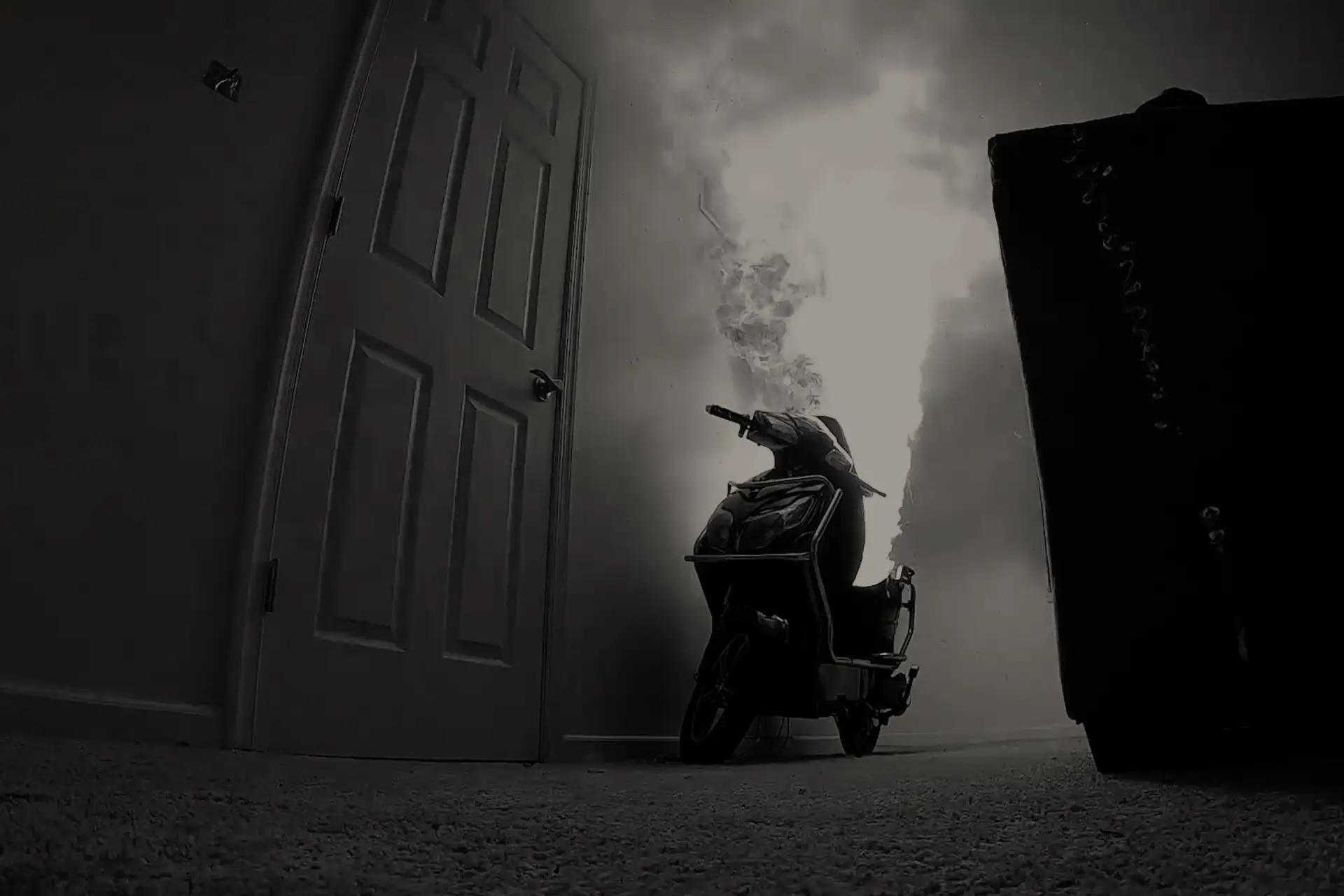
Lithium-ion batteries in e-bikes, scooters, power tools, portable chargers, hoverboards, and other consumer products can fail suddenly and violently. When a damaged or defective battery enters thermal runaway, it can produce an intense, fast-spreading fire that is difficult to extinguish and may cause severe burns, smoke inhalation, property damage, or death.
Battery failures may result from defective cells, inadequate battery-management systems, unsafe charging designs, poor ventilation, or incompatible or counterfeit chargers. Responsibility may extend to the battery manufacturer, device manufacturer, component supplier, importer, distributor, or retailer.
Preserving the device, battery pack, charger, packaging, and fire scene can be critical because the physical evidence may reveal where and why the failure occurred. We also handle e-bike accident claims involving defective batteries or other components.
Defective appliances and electronics can cause fires, electrical shocks, burns, carbon monoxide exposure, crushing injuries, and other serious harm. These cases may involve refrigerators, ovens, heaters, washing machines, dryers, power strips, chargers, televisions, and other products used in the home.
The failure may result from faulty wiring, overheating components, inadequate insulation, defective switches, unsafe battery systems, missing guards, or poor instructions. Important evidence may include the product itself, installation and repair records, photographs of the scene, electrical or fire investigation findings, recall history, and testing by qualified experts.
Defective children’s products can cause serious injuries through tip-overs, choking, strangulation, entrapment, falls, burns, and other hazards. These cases may involve toys, cribs, bassinets, strollers, high chairs, furniture, car seats, and products containing small parts or unsafe batteries.
Children often use products in ways that are predictable even if not perfectly intended. Manufacturers must account for foreseeable behavior, provide age-appropriate designs and warnings, and avoid hazards that children or caregivers may not recognize.
Important evidence may include the product itself, packaging and age recommendations, warnings, recall history, prior complaints, testing records, and expert evaluation of whether the product met applicable safety standards.
Defective products can cause thermal burns, chemical burns, smoke inhalation, and serious scarring. These cases may involve appliances or electronics that ignite, gas equipment that leaks or backfires, pressurized containers that rupture, unsafe chemicals, or consumer products that fail to meet applicable flammability standards.
Fire and explosion cases often require a prompt cause-and-origin investigation before the scene is cleared or the product is moved, repaired, or discarded. Important evidence may include the failed product, fire debris, photographs and video, installation or maintenance records, electrical data, witness accounts, recall history, and testing by qualified experts.
Our burn injury practice explains how severe burn injuries, future treatment, scarring, and long-term effects may be documented in a personal injury claim.
A product does not have to be recalled for it to be defective. Many dangerous products cause injuries before a recall is issued, and some are never recalled at all.
When a recall does exist, its timing may provide important evidence about what the manufacturer knew and when it knew it. Prior complaints, similar incidents, adverse-event reports, regulatory filings, and internal investigations may show that the company was aware of the danger before taking public action.
Important questions include when the first similar failure was reported, how the company responded, whether warnings were updated, and whether the product continued to be sold after the risk became known.
Product liability cases require more than showing that an injury occurred while someone was using a product. The case may depend on preserving and testing the product, understanding how it was designed and manufactured, examining warnings and instructions, and obtaining technical records controlled by manufacturers and suppliers.
Conor focuses on uncovering what failed and presenting complex engineering and medical evidence clearly. He has taken on Ford, Johnson & Johnson, Chrysler, Dodge, Jeep, Continental Tires, and other Fortune 500 companies in product liability cases. His experience includes a $25.36 million recovery involving a sudden tire failure and a $5 million recovery involving a defective passenger seatback.
Leslie brings extensive experience in arbitrations, mediations, trials, and appeals. Her background in journalism and education helps her identify the important facts, organize technical records, and explain complicated evidence in a way that is understandable and persuasive.

Our experienced attorneys have a proven track record of achieving extraordinary results in product liability cases.
A sudden tire failure caused an SUV to fishtail and crash into a tree on the side of a San Diego County highway, killing a beloved husband and father.
A defective airplane engine ignition component caused a deadly crash in San Diego.
A passenger seatback collapsed in a rear-end collision, causing the occupant life-changing spinal injuries and paralysis.
The driver's head restraint broke off when he was rear-ended at high speed on the 15 freeway, causing the driver to suffer a spinal cord injury and paralysis.
A defective front driveshaft broke apart and ripped a hole in the underbody of a truck, causing a vehicle fire. The driver suffered catastrophic third-degree burns.
A lithium-ion battery exploded in a man’s pocket, severely burning his leg.
During your free case review, we listen to what happened, what injuries you are facing, and why you believe a product failure or inadequate warning played a role. We review any information you already have, including photographs, video, medical records, purchase details, packaging, manuals, and insurance letters, and give you an honest assessment of whether a California product liability claim may be available.
If you decide to work with us, protecting the evidence is the first priority. That may include preserving the product in its post-incident condition, along with its packaging, labels, instructions, receipts, chargers, replacement parts, and photographs of the scene.
The product should not be repaired, altered, returned, discarded, or subjected to destructive testing before the evidence is properly documented and the interested parties have an opportunity to inspect it.
Next, we investigate what failed and why. Depending on the product, qualified experts may inspect and test it, evaluate its design and manufacturing, review the warnings and instructions, and consider whether a practical, safer design was available.
We may also investigate recalls, prior incidents, consumer complaints, regulatory records, and similar product failures to determine whether the danger was already known.
Product liability cases may involve several companies in the chain of distribution. We identify the finished-product manufacturer, component suppliers, importers, distributors, retailers, and others who may be responsible.
We also evaluate whether negligent installation, repair, maintenance, or conduct by another party contributed to the injury and identify all potentially available insurance coverage.
We work with clients, medical providers, experts, and family members to document the full impact of the injury, including medical treatment, future care, lost income, pain, physical limitations, and changes to daily life. Once the evidence is sufficiently developed, we present the liability and damages claims to the responsible companies and insurers, challenge efforts to blame the user or minimize the injuries, and keep the client informed about settlement offers and options.
If the responsible companies and insurers are unwilling to resolve the case fairly, we are prepared to file a lawsuit. Litigation may involve corporate records, product inspections, expert testing, written discovery, depositions, motions, mediation, and trial preparation.
At trial, we use testimony, documents, physical evidence, expert analysis, and visual presentations to explain what failed, why the product was not reasonably safe, and how the injury affected the client and family.
California product liability law allows injured consumers to hold manufacturers, distributors, retailers, and other companies responsible when an unsafe product causes harm. The overview below explains the principal legal issues that may arise in a serious product liability case.
Product liability is the area of law that applies when an unsafe product causes injury or death. Depending on the facts, a claim may be brought against companies that designed, manufactured, supplied, distributed, imported, or sold the product.
California applies strict liability to defective products. That means an injured person generally does not have to prove that the manufacturer was careless. Rather, a manufacturer or seller may be strictly liable when a design defect, manufacturing defect, or inadequate warning makes the product unreasonably dangerous and causes injury during intended or reasonably foreseeable use.
California product liability claims generally involve one or more of three defect theories:
More than one theory may apply to the same product. For example, a device may have an unsafe design and also lack adequate warnings about the danger.
The precise requirements depend on the type of defect, but a product liability case generally requires evidence that:
Manufacturers and sellers may argue that the product was altered, improperly maintained, or used in an unforeseeable way, or that something other than the product caused the injury. Preserving the product and developing qualified expert evidence can be critical to addressing those defenses.
Responsibility for a defective product may extend throughout the chain of distribution. Depending on the facts, potentially responsible parties may include:
Other parties may also share responsibility. A repair company may have performed negligent work, a contractor may have installed the product incorrectly, or another person or company may have altered or maintained the product in a way that contributed to the injury.
Identifying every responsible party is especially important in serious product liability cases because different companies may control different evidence, have separate insurance coverage, and bear responsibility for different parts of the product’s design, manufacture, sale, installation, or maintenance.
The compensation available depends on the injuries, the long-term effects of the product failure, and the responsible parties and insurance coverage involved.
In a serious product liability case, damages may include emergency care, hospitalization, surgery, rehabilitation, future medical treatment, lost income, reduced earning capacity, pain, physical limitations, emotional distress, loss of enjoyment of life, and other out-of-pocket losses caused by the injury.
When a defective product causes permanent disability, severe burns, brain or spinal injury, or death, it is important to understand both the immediate losses and the future impact on the injured person and family. Certain surviving family members may also have wrongful death claims, and the estate may have a separate survival claim.
In cases involving particularly egregious conduct, punitive damages may also be available against some private defendants.
California product liability claims are subject to strict deadlines. In many cases involving personal injury or wrongful death, the general deadline is two years. The time may begin when the injury occurs, although different accrual or discovery rules can apply when the defect or its connection to the injury is not immediately apparent.
Different deadlines may apply to property damage claims, toxic-exposure cases, claims involving minors, and other unusual circumstances. If a public entity played a role, a written government claim may also be required within six months.
Product liability cases also have practical evidence deadlines. The product may be repaired, returned, discarded, altered, or destroyed, and surveillance footage, purchase records, packaging, and electronic data may disappear. Prompt investigation can help protect both the legal claim and the evidence needed to prove what failed.
We preserve and examine the product, packaging, warnings, records, prior incidents, and other evidence needed to understand what failed and why.
Product cases often involve engineering, testing, medical evidence, and complex timelines. We use technology and visual presentation to make that evidence clear.
Defense attorneys and insurance companies know us and respect us. We assess the full extent of your damages and pursue all responsible parties in order to maximize the compensation you deserve.
Our attorneys have taken on Ford, Johnson & Johnson, Chrysler, Dodge, Jeep, Continental Tires, and other Fortune 500 companies in serious product liability cases.
A serious product injury can overwhelm a person or family. We keep clients informed, prepare carefully, and take the time to understand how the injury has affected their health, work, family, and future.
Get medical care first. If you can do so safely, take photographs or video of the product, the scene, and your injuries.
Preserve the product exactly as it is. Do not repair it, return it, discard it, or allow anyone to alter or test it without first documenting the evidence. Save the packaging, labels, manuals, receipts, chargers, replacement parts, and any communications with the seller or manufacturer.
Because the product and related evidence may be lost quickly, prompt investigation can be important.
You may have a claim if a product was unsafe because of a design defect, manufacturing defect, or inadequate warning, and that defect was a substantial factor in causing your injury.
The defect may not be obvious. Product liability cases often require inspection by qualified experts, comparison with design or manufacturing specifications, and investigation into prior incidents, complaints, recalls, or safer alternative designs. A lawyer can evaluate the available evidence and determine which legal theories and responsible parties may apply.
Strict liability allows an injured person to hold certain manufacturers, distributors, and sellers responsible for harm caused by a defective product without proving that the company acted negligently.
The focus is generally on whether the product had a design defect, manufacturing defect, or inadequate warning when it left the defendant’s control, and whether that defect was a substantial factor in causing the injury. The precise requirements depend on the type of defect and the facts of the case.
Most California product liability cases involve one or more of these categories:
For more detail on how these theories work, see the California product liability law section above.
Important evidence may include the product itself, packaging, labels, warnings, instructions, receipts, photographs, video, maintenance or repair records, medical records, and communications with the manufacturer or seller.
Depending on the case, the investigation may also involve design documents, manufacturing records, quality-control data, testing results, prior complaints, recalls, regulatory records, and expert inspection of the failed product. Preserving the product in its post-incident condition is often the most important first step.
Losing the product can make a product liability case more difficult, but it does not always end the claim. Other evidence may still exist, including photographs, video, purchase records, repair documents, packaging, witness accounts, recall information, and evidence of similar failures.
If you still have the product or any of its parts, preserve them exactly as they are. If the product was returned to a retailer, manufacturer, employer, landlord, or insurer, prompt action may help identify who has possession of it and prevent further alteration or destruction.
A recall can be important evidence that a product presented a safety risk, but it does not automatically prove every element of a product liability claim. The timing of the recall, the reason it was issued, and whether it involved the same failure may all matter.
A product does not need to have been recalled for a claim to exist. Many defective products cause injuries before a recall is issued, and some are never recalled at all. Other evidence may include expert analysis, prior complaints, similar incidents, regulatory records, internal documents, and whether the danger was foreseeable and reasonably preventable.
The compensation available depends on the injuries, the long-term effects of the product failure, and the responsible parties and insurance coverage involved.
Damages may include medical expenses, future treatment and care, lost income, reduced earning capacity, pain, physical limitations, emotional distress, loss of enjoyment of life, and other out-of-pocket losses. In fatal cases, certain surviving family members may also have wrongful death claims, and the estate may have a separate survival claim.
In some cases involving particularly egregious corporate conduct, punitive damages may also be available.
Possibly. Product liability may still apply when the use was reasonably foreseeable, even if it was not exactly what the manufacturer intended.
The manufacturer may argue that misuse, alteration, poor maintenance, or failure to follow instructions caused the injury. Those issues do not automatically defeat a claim. The key questions are whether the use was foreseeable, whether the product was still defective, and how much each factor contributed to the injury.
California product liability claims are subject to strict deadlines. In many personal injury and wrongful death cases, the general deadline is two years, although different rules may apply depending on when the injury and its connection to the product were discovered.
Different deadlines may also apply to property damage, toxic exposure, minors, or claims involving a public entity. Because the product and related evidence may be lost, altered, returned, or destroyed, it is important to investigate the claim promptly rather than wait until the legal deadline approaches.
Product liability cases are handled on a contingency fee basis. That means there is no attorney fee unless we recover compensation for you.
The initial case review is free, and we explain the fee agreement and case expenses before you decide whether to move forward.
Hulburt Law Firm represents people and families after serious injuries caused by defective products across San Diego County, including San Diego, Chula Vista, National City, La Mesa, El Cajon, Santee, Poway, Escondido, Oceanside, Carlsbad, Encinitas, and surrounding communities.

Simply fill out the form or call 619.821.0500 to receive a free case review. We’ll evaluate what happened, your injuries, and potential defendants to determine how we can best help you.