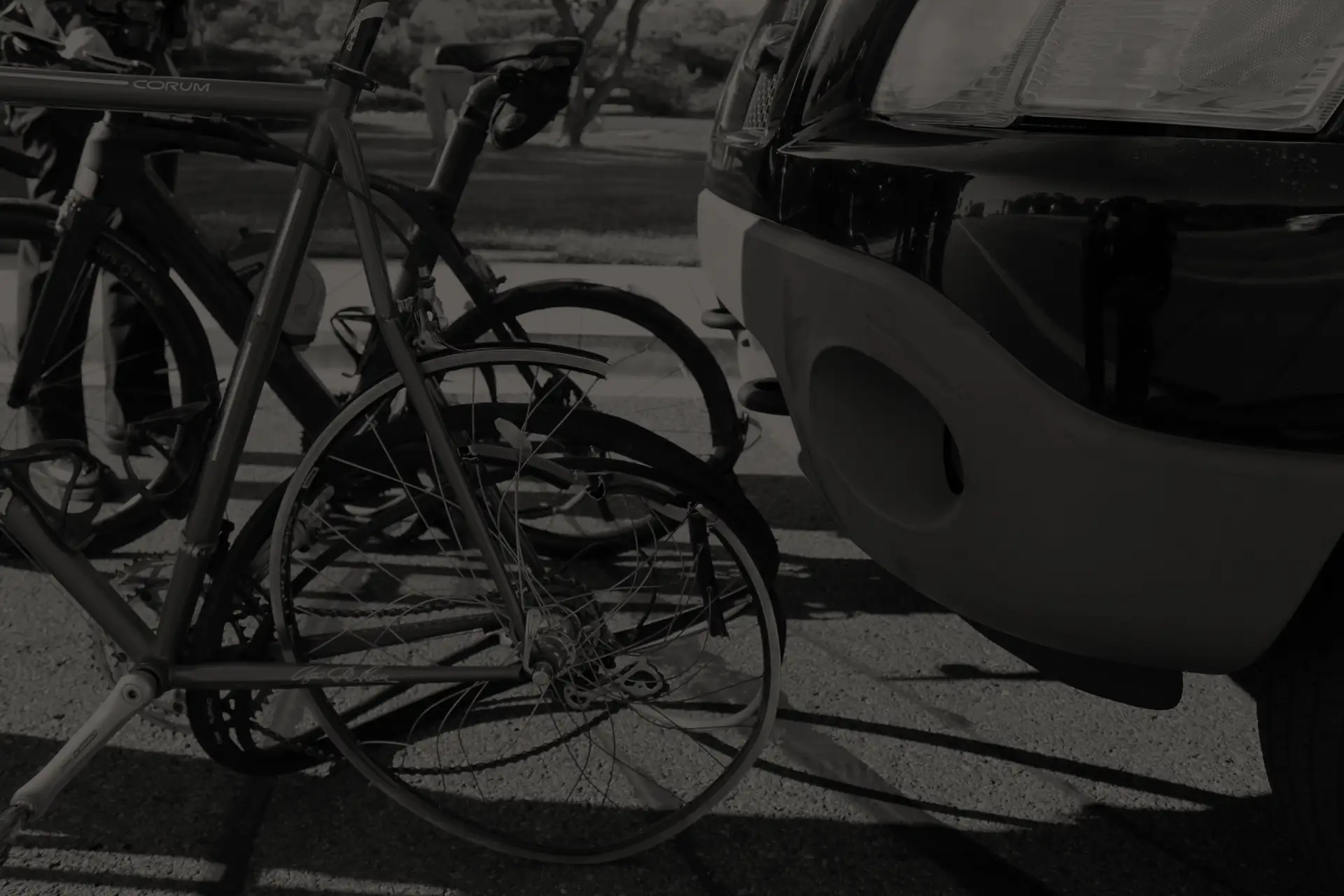
The Hulburt Law Firm represents injured cyclists and their families after serious and fatal bicycle crashes throughout San Diego County. We focus on the cases that change lives: brain injuries, spinal injuries, severe fractures, disabilities, and wrongful death.
We move quickly to preserve evidence, investigate the driver, inspect the roadway, and identify all available insurance coverage. Our attorneys have recovered more than $150 million for personal injury clients, including multi-million dollar results in bicycle cases involving negligent drivers, commercial vehicles, unsafe bike lanes, and dangerous road conditions.
Injured in a San Diego bicycle accident? Talk with a lawyer today.

Hulburt Law Firm handles all types of bicycle cases. We represent injured cyclists against negligent drivers, commercial vehicle operators, product manufacturers, property owners, contractors, and public entities responsible for unsafe roads.
Many bicycle crashes happen because a driver fails to see, yield to, or safely pass a cyclist. These cases include unsafe passing, drifting into a bike lane, rear-end impacts, dooring incidents, failure to keep a proper lookout, and drivers who claim the cyclist “came out of nowhere” despite having a duty to share the road safely.
Intersections are especially dangerous for cyclists because drivers may turn left across an oncoming rider, turn right across a bike lane, fail to yield from a driveway, or misjudge a cyclist’s speed and right of way. These cases often involve disputed signal timing, turn movements, lane positioning, visibility, and who entered the intersection first.
Speeding, texting, impairment, and aggressive driving greatly increase the risk that a bicycle crash will cause catastrophic injuries. A driver who is looking at a phone, driving too fast for conditions, under the influence, or acting aggressively may have too little time to see a cyclist, react, and avoid a collision.
Hit-and-run bicycle crashes require immediate attention because video footage, witness information, and physical evidence can disappear quickly. Even when the driver is never identified, the cyclist’s own auto insurance may provide uninsured motorist coverage for injuries suffered while riding a bicycle.
Learn more about hit-and-run bicycle accidents in San Diego and the legal steps cyclists should take when the driver flees.
E-bike crashes can involve the same driver-negligence issues as traditional bicycle cases, but they may also raise questions about speed, e-bike classification, helmet rules, roadway use, and whether a mechanical or electrical defect contributed to the crash. These cases can involve Class 1, Class 2, or Class 3 e-bikes, depending on the facts.
Crashes involving Uber, Lyft, DoorDash, Amazon, delivery vans, work trucks, buses, and other commercial vehicles can raise complicated insurance and responsibility issues. The available coverage may depend on whether the driver was working, logged into an app, making a delivery, carrying a passenger, or acting within the course and scope of employment.
Some bicycle crashes are caused or worsened by unsafe road conditions rather than driver negligence alone. Potholes, uneven pavement, broken asphalt, poor lighting, missing signs, unsafe bike lanes, obstructed sight lines, construction debris, defective drainage grates, and confusing intersection designs can all create serious hazards for cyclists.
When a cyclist is killed, surviving family members may have a wrongful death claim, and a survival action may also be available depending on the circumstances. Fatal bicycle cases often require careful review of the crash scene, vehicle movement, roadway conditions, insurance coverage, public entity involvement, and every person or company that may share responsibility.
For families navigating a fatal crash, see our guide to fatal bicycle accident claims in California.
Conor and Leslie Hulburt founded Hulburt Law Firm to help injured people uncover the truth and acheive justice. Bicycle cases often require more than proving that a driver made a mistake. The best cases are built by preserving evidence early, challenging unfair assumptions about cyclists, identifying every responsible party, and showing the full human impact of the injury or loss.
Conor has recovered more than $150 million for injured clients and grieving families, including multi-million-dollar results for cyclists struck by negligent drivers, commercial vehicles, and dangerous public roadways. His advocacy has earned recognition from Best Lawyers, Super Lawyers, Best of the Bar, and Martindale-Hubbell.
Together, Conor and Leslie make sure each client receives direct attorney attention throughout the case. The firm accepts a limited number of cases so each one can be carefully investigated, prepared with the right experts, and positioned for the best possible result.

Our attorneys have recovered significant results for cyclists and other catastrophically injured clients in cases involving negligent drivers, dangerous public roads, commercial vehicles, and defective products.
Jury verdict against Caltrans for a 13-year-old boy who was hit by a car while using a dangerous crosswalk.
A sudden tire failure caused an SUV to fishtail and crash into a tree on the side of a San Diego County highway, killing a beloved husband and father.
A massive, improperly installed gate collapsed on a subcontracted worker who was asked by the general contractor to paint it, causing his tragic death.
A negligent driver rear-ended a cyclist in Carlsbad who was lawfully using the bike lane, causing a severe spine injury.
A commercial truck driver drifted off the road and struck and killed a San Diego bicyclist lawfully riding on the shoulder.
A negligent driver swerved across multiple lanes and struck a North San Diego County cyclist from behind, causing a serious head and brain injury.
During your free case review, we listen to what happened, how your injuries are affecting your life, and what questions you have. We review any photographs, police reports, medical records, insurance letters, or witness information you already have. We will give you an honest assessment of the potential case, including the strengths, challenges, likely next steps, and any urgent deadlines that may apply.
Once you decide to move forward, our team begins a focused investigation. In bicycle cases, that can include examining the crash scene, inspecting your bike and safety gear, reviewing police and traffic collision reports, obtaining dash-cam or traffic-camera footage when available, and interviewing witnesses. We work to secure key evidence early, before it’s lost or overwritten.
To fully explain what happened and how it has affected you, we collaborate with carefully selected experts. Depending on the case, that may include accident reconstructionists, medical specialists, life-care planners, and economists. They help us analyze how the collision occurred, document the nature and extent of your injuries, and calculate the financial impact on you and your family.
With the evidence and expert input in hand, we build the strategy and the demand package. That means demonstrating liability and damages in a single persuasive presentation. A well-built demand package is often the most important document in a bicycle case because it is the carrier's first look at what trial will cost them.
We handle all communications with the insurance carriers and defense lawyers so you can focus on your recovery. The lawyer handling your case is the lawyer at the table, presenting the evidence, explaining the medicine, and walking the carrier through the trial exposure they face. Throughout negotiations, we keep you informed, explain every offer, and tell you plainly what we think it is worth.
If the carrier will not pay a fair number, we file suit and prepare the case for trial. Litigation involves written discovery, depositions, expert reports, and pretrial motions, and the case can resolve at any point along the way. If it does not, we present your case to the jury through your testimony, witnesses, experts, and exhibits built to make the full impact of the crash unmistakable.
California law gives bicyclists many of the same rights and responsibilities as drivers. A cyclist generally has the right to use the road, and drivers must treat cyclists with reasonable care. When a driver breaks the rules and causes a serious crash, the injured cyclist may have a claim for compensation.
Cyclists in California have the same rights as drivers of motor vehicles and the same responsibilities. Vehicle Code §21200 places riders under the same rules of the road as motorists, which means cyclists are entitled to use public roads and are also required to obey traffic signals, signs, and lane discipline.
Vehicle Code §21202 generally requires a cyclist riding slower than traffic to stay as close to the right edge of the road as practicable, but that rule has important exceptions. A rider is allowed to take the full lane when passing other vehicles, preparing for a left turn, avoiding a hazard, or when the lane is too narrow to safely share with a car. In each of those situations, riding in the middle of the lane is exactly what the law expects.
Cyclists must also follow lighting and helmet rules. Vehicle Code §21201 requires a front white light, rear red reflector, and side reflectors after dark. Vehicle Code §21212 requires helmets for riders under 18 and Class 3 e-bike riders of any age. Violating one of these rules does not automatically defeat a claim, but it can become part of the comparative-fault analysis a jury performs.
To learn more, see the California DMV’s official bicyclist and pedestrian safety guide or Explore more bicycle laws and regulations in San Diego.
California law imposes specific duties on drivers around cyclists, and violations of those duties are routinely the central issue in a serious bike case.
The Three Feet for Safety Act (Vehicle Code §21760) requires a motorist to give a cyclist at least three feet of clearance when passing. When three feet is not possible because of road conditions, the driver must slow to a safe speed and only pass when oncoming traffic does not put the rider in danger. Vehicle Code §22107 prohibits unsafe lane changes around cyclists. Vehicle Code §22517 prohibits opening a vehicle door into traffic, the rule designed to prevent dooring. Vehicle Code §21717 requires a driver turning right to merge into the bike lane before turning, the rule designed to prevent right-hook collisions.
When a driver violates one of these duties and causes a crash, the violation can be powerful evidence of negligence. In many cases it qualifies as negligence per se under California Evidence Code §669, which shifts the legal analysis from whether the driver was careless to whether the violation caused the rider's injuries. That is a meaningful procedural advantage for an injured cyclist.
To learn more, see the California DMV's official bicyclist and pedestrian safety guide.
California is an at-fault state, which means the person or entity whose negligence caused the crash is responsible for the resulting harm. Negligence in a bike case can include speeding, distracted driving, running a red light, opening a car door into a rider's path, or failing to maintain a reasonably safe roadway.
California also follows pure comparative fault. If more than one person or entity contributed to the crash, including the cyclist, each is assigned a percentage of responsibility, and the cyclist's recovery is reduced by that percentage. The rule comes from the California Supreme Court's 1975 decision in Li v. Yellow Cab Co., which replaced the older all-or-nothing contributory negligence rule. Today a cyclist found 50% responsible can still recover 50% of their damages, and a cyclist found 90% responsible can still recover 10%. There is no fault threshold that wipes out a claim.
That said, insurance companies routinely try to inflate a cyclist's share of fault. Anchoring the comparative-fault analysis with strong evidence early in the case (the scene reconstruction, the dash-cam or surveillance footage, the witness statements) is one of the most important things a serious bike case requires.
Learn more about driver negligence as a cause of bicycle crashes.
Responsibility for a bicycle crash is rarely limited to the driver who made contact with the rider. Depending on the facts, the potentially liable parties include:
Identifying every potentially responsible party is one of the most important steps in a serious bicycle case, especially when injuries are catastrophic and multiple insurance policies may apply.
Uncover more potential defendants after a bike crash.
When a pothole, defective bike lane, missing sign, or unsafe construction zone contributes to a bicycle crash, the responsible public agency can be held liable for the resulting injuries. California Government Code §835 makes a public entity liable for a "dangerous condition of public property" when the entity created the condition or had actual or constructive notice of it and failed to fix it within a reasonable time.
The procedure to pursue a public agency is different from a regular negligence case. Before filing a lawsuit, an injured cyclist must file a written claim with the responsible agency under Government Code §910, and the claim must be filed within six months of the crash under §911.2. Missing that six-month deadline almost always bars the case, even when the dangerous condition is well documented and the agency's notice is clear. A typical San Diego case may involve a claim against the City of San Diego or San Diego County, but Caltrans claims (for state highways and freeway approaches) are also common when a bike lane disappears at a freeway on-ramp or bridge.
Public-entity cases turn on documenting the agency's notice. Prior complaint records, prior crash data at the same location, internal maintenance reports, and 311 service requests are all part of the evidence that establishes the agency knew or should have known about the hazard.
For a deeper look at the procedure and pitfalls, see our guide to suing a public agency for a bicycle accident in California.
The compensation available after a bicycle crash depends on the injuries, how the crash happened, and the insurance coverage available. California law generally allows recovery in five categories:
In a small but important category of bike cases, California Civil Code §3294 also allows punitive damages. Punitive damages are available when a driver acted with malice, oppression, or fraud, which in practice means driving under the influence, fleeing the scene, or driving with extreme recklessness. They are separate from compensatory damages and are designed to punish the wrongdoer and deter similar conduct. They are not capped by the driver's insurance policy, and they can substantially increase the value of a case.
When a bicycle crash is fatal, California law authorizes two related claims. A wrongful death claim under Code of Civil Procedure §377.60 allows certain surviving family members to recover funeral and burial expenses, the loss of the decedent's financial support, and the loss of love, companionship, society, and guidance. A survival action under §377.30 allows the decedent's estate to recover the damages the cyclist sustained between the crash and the moment of death, which can be substantial in catastrophic injury cases that did not resolve immediately. The two claims are often filed together and serve different purposes.
Read more about bicycle accident damages.
There is almost always more than one source of insurance coverage in a serious bike case. The order in which they are pursued matters.
The first place to look is the at-fault driver's liability insurance. California requires a minimum of $30,000 per person and $60,000 per accident under Insurance Code §11580.1b, but many drivers carry much more, and a commercial or rideshare driver's policy is typically far higher.
The cyclist's own auto policy is often the next layer, even though the cyclist was on a bike rather than in a car. Uninsured motorist (UM) and underinsured motorist (UIM) coverage under Insurance Code §11580.2 pays when the at-fault driver has no insurance, fled the scene, or carried less coverage than the cyclist's injuries are worth. Many cyclists do not realize their auto policy protects them on a bike, but it does.
MedPay coverage on the cyclist's auto policy can also pay medical expenses regardless of fault, up to the policy limit. MedPay is no-fault first-dollar coverage that is often available even when liability is contested, which makes it useful for paying co-pays and out-of-pocket costs while the larger claim is pending.
When a rideshare or delivery driver is involved, California's Transportation Network Company rules at Public Utilities Code §5430 et seq. require the company to carry at least $1 million in liability coverage when the driver is en route to a passenger or has one on board. Coverage drops significantly when the driver is logged in but has not yet accepted a ride, and it disappears when the app is off. The driver's app records will determine which policy applies.
When a commercial vehicle is involved, the company carrying the trucker, the delivery van, or the work vehicle typically has substantially higher liability coverage than a personal auto policy. Commercial policies also frequently have additional layers (excess and umbrella coverage) that may not appear on the initial claim and need to be specifically requested.
When a public entity is on the hook, recovery is bounded by the agency's self-insurance pool or insurance program, which functions similarly to a commercial carrier but with the Government Claims Act procedural requirements layered on top.
Locating every applicable policy, understanding the order in which they pay, and pursuing the right ones in the right sequence is often what separates a competent recovery from a maximum recovery.
California sets strict statutes of limitations for bicycle accident claims, and missing one almost always ends the case, no matter how strong the underlying facts.
Because the public-entity six-month deadline is so much shorter than the two-year deadlines that govern everything else, and because most cyclists do not initially realize a public agency may share fault, the safest course after a serious crash is to talk to a lawyer as soon as possible.
Learn more about your time limit to sue after a bike crash.
We treat a serious bicycle case the way an investigator would: scene reconstruction, dash-cam recovery, witness work, and physical inspection of the bike and the vehicle.
We use scene photography, drone footage, 3D reconstruction, and biomechanical animation to show a jury what happened.
Defense attorneys and insurance companies know us and respect us. We assess the full extent of your damages, and we identify every party that shares fault.
Catastrophic injury and wrongful death cases are rarely simple. We have taken on the largest corporations, insurance companies, and defense firms in the country and won.
We don’t just talk the talk, we walk the walk. From providing regular case updates to achieving life-changing results, we genuinely care about each and every one of our clients.
Your health comes first. Call 911, accept paramedic evaluation even if you feel okay (adrenaline routinely masks serious injuries), and get to a hospital or urgent care the same day. Once you are safe, document the scene if you can: photos of the road, the vehicle, the license plate, your bike, your gear, and your injuries. Get names and contact information for every witness. California Vehicle Code §20008 requires the driver to report any injury crash to law enforcement, but the responsibility often falls on the cyclist, so call the police and request a copy of the report once it is available. Do not give a recorded statement to any insurance company before talking to a lawyer.
Read more about what to do after a San Diego bicycle accident.
Yes. California requires helmets only for riders under 18 and for Class 3 e-bike riders. For an adult on a regular bicycle, helmet use is voluntary. Even when a helmet would have been required and the rider was not wearing one, the question is whether the helmet would actually have prevented or reduced the specific injuries claimed. Insurance companies routinely raise the helmet issue to push for a comparative-fault reduction, but the argument only succeeds when the defense can prove the helmet would have made a measurable difference to the injuries in this case.
Not automatically, but the driver is at fault in the majority of bike crashes because the duties drivers owe cyclists (three feet of clearance, safe lane changes, yielding at intersections, not opening doors into traffic) are clearly defined. California uses pure comparative fault: if more than one person contributed to the crash, each is assigned a percentage of responsibility and the cyclist's recovery is reduced by that percentage. There is no fault threshold that wipes out a claim. A cyclist found 50% responsible still recovers 50% of their damages.
California Vehicle Code §21760, often called the Three Feet for Safety Act, requires a driver passing a cyclist in the same direction to allow at least three feet of clearance. When three feet is not possible because of road conditions, the driver must slow to a safe speed and only pass when oncoming traffic does not put the rider in danger. A violation of §21760 can support a finding of negligence per se under California Evidence Code §669, which is a meaningful procedural advantage in a serious bike case.
A hit-and-run is a crime under Vehicle Code §20001 and triggers an immediate police investigation, which can sometimes produce video evidence or witnesses that identify the driver. Even if the driver is never found, you may still have a path to recovery through the uninsured motorist (UM) coverage on your own auto policy. UM coverage applies even when you were on a bike at the time of the crash. Report the crash to law enforcement and your auto insurer as soon as possible, because UM claims have strict notice requirements.
Explore more options when the driver is uninsured or underinsured.
San Diego County has several corridors with a documented history of bicycle-vehicle collisions. According to crash data tracked by SANDAG and bicycle advocacy organizations like BikeSD and Calbike, the highest-frequency areas include:
See the full breakdown in our roundup of San Diego bicycle accident statistics and high-risk areas.
Most bicycle injury claims must be filed within two years of the crash under California Code of Civil Procedure §335.1. A wrongful death claim must be filed within two years of the date of death. Claims against a public entity (the City of San Diego, San Diego County, Caltrans) are different: under Government Code §911.2, a written claim must be filed within six months of the crash, or the case is barred. The six-month deadline is the shortest on the timeline and the one most often missed.
Read more about the bicycle accident statute of limitations in San Diego.
Yes, with some differences depending on the e-bike's classification. California Vehicle Code §312.5 recognizes three classes: Class 1 (pedal-assist up to 20 mph), Class 2 (throttle-assisted up to 20 mph), and Class 3 (pedal-assist up to 28 mph). Class 1 and Class 2 e-bikes are treated like regular bicycles. Class 3 e-bikes are restricted to riders 16 and older, require a helmet at any age, and are not permitted on most paths and trails. Classification can affect liability, which safety standards apply, and which insurance coverages respond.
When a defective component (a failed brake, a defective e-bike battery, a blown tire, a defective steering or wheel assembly) contributed to the crash, the manufacturer can be held liable under California product liability law in addition to any at-fault driver. Product liability claims do not require proof that the manufacturer was negligent, only that the product was defective and that the defect caused the injury. These claims are usually pursued in parallel with a negligence claim against the driver, and they often add a significant additional layer of coverage.
Yes, when a dangerous condition of public property (a pothole, a defective bike lane, missing signage, an unsafe construction zone) contributed to the crash. California Government Code §835 makes a public agency liable when it created the hazard or had notice of it and failed to fix it. The catch is the six-month deadline under §911.2: a formal written claim must be filed with the responsible agency within six months of the crash. Miss that window and the case is barred, no matter how clear the agency's notice. These claims need to be evaluated immediately.
Learn more about road hazards and bicycle accidents in San Diego.
Children's bicycle injury cases follow the same rules as adult cases, with two important differences. First, California Code of Civil Procedure §352 tolls the statute of limitations until the child turns 18, which means the deadline to file extends well beyond two years from the crash. Second, any settlement involving a minor requires court approval through a Minor's Compromise process designed to protect the child's interests. We handle every step of that process and work to ensure the child's recovery is preserved for their future medical and educational needs.
California Code of Civil Procedure §377.60 gives surviving spouses, registered domestic partners, children, and certain other family members the right to file a wrongful death claim. Recoverable damages include funeral and burial expenses, the loss of the decedent's financial support, and the loss of love, companionship, society, and guidance. A separate survival action under §377.30 allows the estate to recover the damages the cyclist sustained between the crash and the time of death. Fatal bicycle cases deserve the most thorough investigation a firm can give, and we treat them that way.
Crashes involving rideshare and delivery drivers (Uber, Lyft, DoorDash, Amazon Flex) usually trigger higher insurance limits than a personal auto policy, but coverage depends on what the driver was doing at the moment of the crash. Under California Public Utilities Code §5430 et seq., rideshare companies must carry at least $1 million in liability coverage when a driver is en route to a passenger or has one on board. Coverage drops significantly when the driver is logged in but has not accepted a ride, and it disappears when the app is off. Establishing which phase the driver was in usually requires subpoenaed records from the platform.
Several sources of coverage can pay for medical care before the case resolves. Your health insurance is usually the first source. MedPay coverage on your auto policy can pay medical bills regardless of fault, up to the policy limit. Some specialists work on a lien basis, which means they treat you now and get paid from the settlement at the end of the case. We help our clients coordinate these sources so they receive the care they need without going into financial freefall while the case is pending.
Most bicycle cases resolve through negotiation, with or without a lawsuit being filed. The timeline depends on the severity of the injuries (you generally do not want to settle until your treatment is complete or you have a reliable prognosis), the complexity of liability, and the position the insurance carrier takes. Straightforward cases may resolve in nine to eighteen months. Cases involving catastrophic injuries, public entity claims, or multiple defendants typically take longer, and some go to trial. The reason carriers pay seriously injured cyclists is that they know we are prepared to try the case if they do not.
For a deeper walkthrough, see our guides to the process and timeline for San Diego bicycle accidents and bicycle accident settlements.
Common causes of bicycle accidents in California include:
Delve deeper into the common causes of San Diego bike accidents.
We focus on serious injury and wrongful death bicycle cases. In practice, that usually means traumatic brain injury, spinal cord injury, multiple fractures requiring surgery, amputation, permanent disability, or a fatal crash. We do not take minor injury cases or property-damage-only claims, because the depth of investigation and trial preparation we put into every file is built for catastrophic cases. If your case is smaller and you need a referral to a firm that handles routine claims, we are happy to point you in the right direction.
We handle catastrophic injury and wrongful death cases exclusively, and we take a small number of serious cases at a time so each one gets the depth of investigation it deserves. Conor has recovered over $150 million for injured clients and grieving families, including multi-million-dollar results for cyclists. The lawyer handling your case is the lawyer you reach when you call, not a paralegal or case manager, and we are prepared to try your case to verdict when the carrier will not pay a fair number. Schedule a free, no-obligation case review and we will give you an honest read on the strengths and challenges of your case.
For a broader view of what legal help looks like after a serious bicycle crash, see our overview.
Hulburt Law Firm proudly serves cyclists and their families throughout San Diego County, providing experienced legal guidance, compassionate support, and aggressive advocacy to help clients recover maximum compensation for injuries, medical expenses, lost wages, and long-term impacts.

Simply fill out the form or call 619.821.0500 to receive a free case review. We’ll evaluate what happened, your injuries, and potential defendants to determine how we can best help you.