
Most Dangerous Intersections for Pedestrians in San Diego
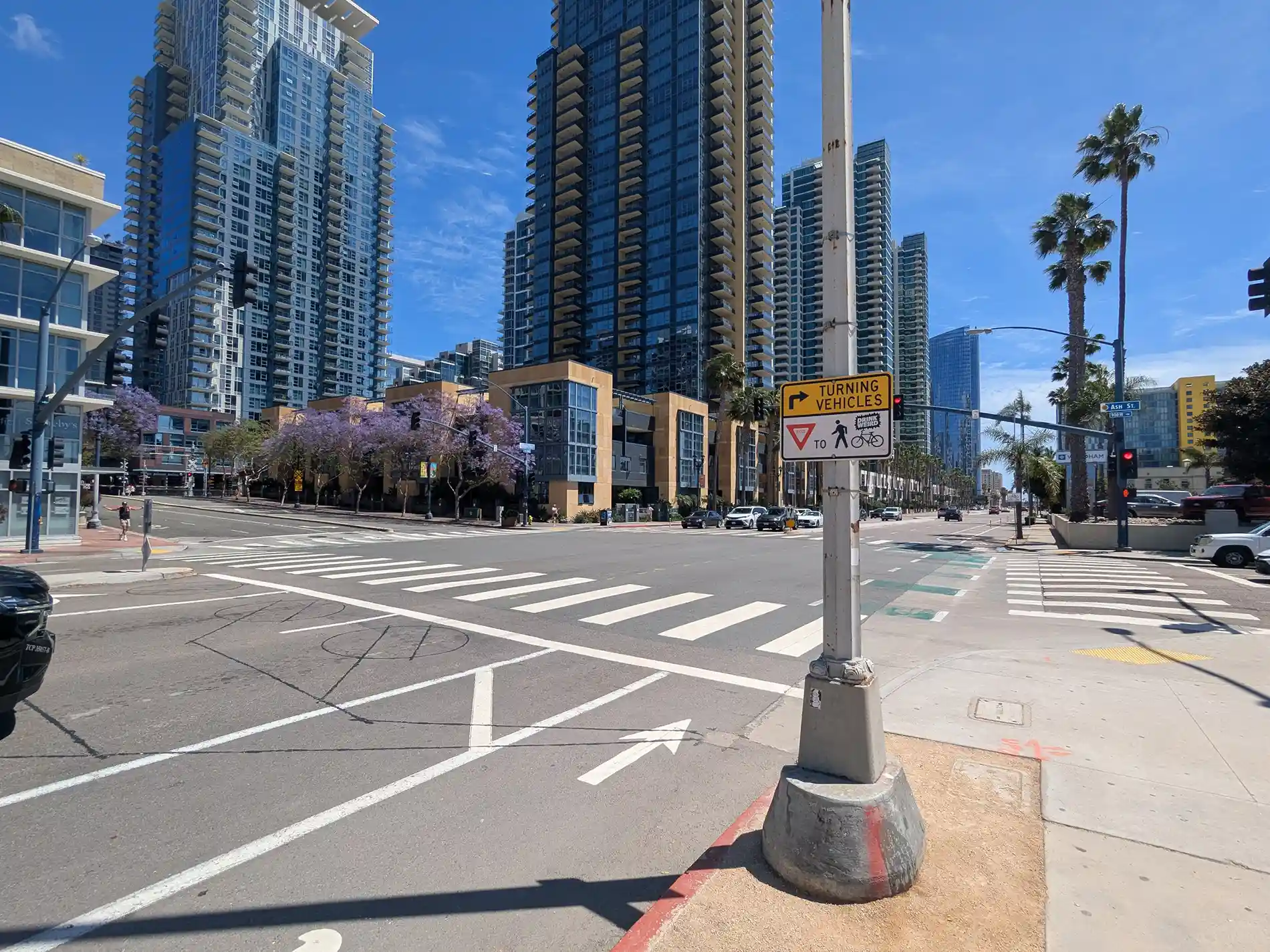
When an intersection is dangerous for pedestrians, it is rarely an accident. It was designed, built, or maintained that way, and that fact can put a government agency on the hook for a crash, not just the driver.
This guide explains where pedestrian crashes concentrate in San Diego, what makes specific intersections dangerous, and when a city, county, or state agency can be held responsible for a poorly designed crossing. If you walk the city’s busier corridors, you already know which crossings feel unsafe. That instinct is usually right, and it is often the starting point of a real case. A San Diego pedestrian accident attorney can help you find out who is actually at fault.
Overview
If you only have a minute, here is what matters most about San Diego’s most dangerous pedestrian intersections:
- Crashes concentrate in a few corridors. Downtown, El Cajon Boulevard, and University Avenue see a large share of San Diego’s pedestrian crashes.
- Dangerous intersections are usually built that way. Poor signal timing, multi-lane high-speed crosswalks, and blocked sight lines turn an ordinary crossing into a hazard.
- San Diego is getting more dangerous, not less. Rapid growth and a car-first street design mean more conflict between vehicles and people on foot.
- A government agency can be liable. If a known design defect caused the crash, the city, county, or state may share responsibility.
- Government claims have a six-month deadline. The window to act against a public agency is far shorter than for an ordinary injury claim.
Where Pedestrian Crashes Concentrate in San Diego
Pedestrian crashes are not spread evenly across the city. They cluster in a handful of busy, congested corridors where heavy foot traffic meets fast-moving vehicles. In our experience, San Diego pedestrian cases concentrate in three areas above all others:
- Downtown San Diego. The dense street grid, constant turning traffic, and heavy mix of pedestrians, buses, and cars produce a steady stream of crashes.
- El Cajon Boulevard. This long, straight, multi-lane corridor runs through several mid-city neighborhoods and combines high speeds with inconsistent crossings and dense foot traffic.
- University Avenue. Running parallel through Hillcrest, North Park, and City Heights, University Avenue has a similar profile: a busy commercial street where people walk constantly.
The same pattern holds anywhere in San Diego that is heavily congested. The City of San Diego tracks pedestrian crashes through its Vision Zero program and has identified a network of high-injury corridors that account for a disproportionate share of severe and fatal crashes. If a street feels dangerous to cross, the data usually agrees. For the bigger picture, see our guide to the common causes of pedestrian accidents in California.
Why San Diego Has Become More Dangerous for Pedestrians
It is tempting to treat a dangerous intersection as bad luck. The honest picture is different. San Diego has generally become more dangerous for pedestrians over the past decade, and the cause is growth.
The city has grown rapidly, and more people means more cars. San Diego is also, fundamentally, a car-friendly city rather than a pedestrian-friendly one. Its streets were designed to move vehicles, not to protect people on foot. Combine a car-first design with a steadily rising number of cars, and bad interactions between vehicles and pedestrians become close to a statistical certainty.
San Diego was built for cars, not for people on foot. Add a decade of rapid growth and far more vehicles, and serious pedestrian crashes stop being bad luck and start being a statistical certainty.
Buses are a specific and growing part of the picture. San Diego sees a large and varied fleet: transit buses, charter buses, tour buses, and trolley shuttles. Operating heavy buses around dense crowds makes collisions a statistical inevitability over time. Left-turning buses are especially dangerous, because the thick windshield pillar beside the driver can hide a person in a crosswalk for the critical second it takes to complete the turn. We cover that pattern in our guide to MTS bus accidents in San Diego.
What Makes an Intersection Dangerous
When we investigate a pedestrian crash, one of the first questions is whether the intersection itself contributed. A dangerous intersection is usually dangerous because of how it was designed, built, or maintained, and a few specific defects come up again and again.
Faded Crosswalk Markings and Missing Signs
A crossing only works if a driver can tell it is there. Faded or worn-away crosswalk paint, a missing pedestrian-crossing sign, and a broken or non-functioning pedestrian signal all quietly tell a driver that no one needs to slow down. These are straightforward maintenance failures. When an agency lets the markings and signals at a busy crossing decay, it has removed the very cues that warn a driver to expect people on foot.
Poor Signal Timing
Signal timing is one of the least visible defects. A walk phase too short to cross a wide street leaves a pedestrian stranded in live traffic. A signal sequence that releases turning vehicles into the crosswalk at the same moment people are walking through it puts the two on a collision course. Most people never think about signal timing until it fails them. Even where the timing is poor, drivers still must yield to people on foot under California’s pedestrian right-of-way laws.
Crosswalks Across Multiple High-Speed Lanes
One of the most dangerous configurations in California is a crosswalk striped across several lanes of high-speed traffic with no median or pedestrian refuge island. A person crossing has to clear every lane in a single attempt, judging gaps in fast-moving traffic the entire way. When this kind of crossing connects places people genuinely need to reach, such as a school and the neighborhood across the street, a serious crash becomes close to inevitable. Our guide to crosswalk accidents in San Diego explains how liability works in these cases.
Blocked or Overgrown Sight Lines
A driver and a pedestrian both need to see each other in time to react. Overgrown trees and bushes, poorly placed signs, and other visual obstructions can hide a warning sign, a traffic signal, or a turning vehicle until it is too late. When a public agency lets vegetation or clutter block a clear sight line at a crossing, that neglected maintenance can itself be the cause of a crash.
The Danger Generally Has to Be Something You Can See
One principle runs through every one of these defects. For an intersection hazard to support a legal claim, it has to be something an average person can recognize as unsafe, not something only an expert can explain.
In a dangerous-condition case, the hazard has to be something an average person can see for themselves. If a jury needs an expert to explain why a place is dangerous, the defense will simply hire its own expert to say it is safe. The strongest cases are the ones where the danger is obvious the moment you show it to a jury.
This works in your favor as a reader, too. Jurors spend their whole lives driving and walking these same streets, and they can tell when a crossing is unsafe. So can you. If an intersection feels dangerous, that instinct is meaningful, and it is often the starting point of a real case.
When a Government Agency Is Responsible for a Dangerous Intersection
When a roadway design or maintenance defect causes a pedestrian crash, the responsible party may not be only the driver. It may also be the public agency that built and maintains the intersection, whether that is the City of San Diego, the County, Caltrans, or a regional agency.
California law lets an injured person hold a public entity responsible for a dangerous condition of public property under California Government Code section 835. These cases are demanding, and they turn on one concept above all others: notice.
The Notice Requirement
A public agency is not automatically responsible just because an intersection was dangerous. Under section 835, the agency is liable only if it had notice of the dangerous condition and a reasonable opportunity to fix it. Proving that notice is the heart of the case.
Notice generally comes from two sources. The first is prior complaints from the public: a record of residents reporting the same hazard, again and again, shows the agency knew. The second is the agency’s own internal documents, including traffic studies, design memos, maintenance records, work orders, and prior incident reports. An agency that flagged a hazard in its own paperwork and did nothing cannot credibly claim it was unaware. Importantly, notice does not require a previous crash at the exact spot. Internal awareness of that type of danger can be enough.
How a Dangerous-Condition Case Gets Built
Because notice is so central, building a case against a public agency follows a specific sequence:
- Document the intersection immediately. Conditions change fast. Vegetation gets trimmed, striping gets repainted, signals get retimed. Thorough photographs, video, and sometimes drone footage preserve the scene before it is altered.
- Send a California Public Records Act request. The California Public Records Act gives the public a right to government records. A well-targeted request asks for every citizen complaint, internal complaint, maintenance record, work order, prior incident report, and traffic study tied to that specific intersection.
- Build the notice element. The records that come back are what prove the agency knew about the danger and had a real chance to fix it.
- File a government claim on time. Everything gathered goes into a formal government claim, which must be filed within the strict deadline discussed below.
The Six-Month Government Claim Deadline
A claim against a public entity is governed by a far shorter deadline than an ordinary injury claim. Under Government Code section 911.2, you generally must file a formal claim with the public agency within six months of the crash. Miss that deadline and the claim against the agency can be lost before a lawsuit is ever filed. An ordinary claim against a driver usually has a longer window, generally two years, as explained in our guide to the personal injury statute of limitations in San Diego.
There is one more hurdle worth knowing about. Public agencies often raise design immunity under Government Code section 830.6, arguing that an approved roadway design shields them from liability. That immunity is not absolute. It can erode when conditions on the ground change after the design was approved, such as a new school, new housing, or heavier traffic that the original design never accounted for.
Why a Roadway-Design Case Is a Fallback, Not a Bonus
A case against the city for a dangerous intersection is not a bonus stacked on top of the case against the driver. It is a fallback, and an honest firm will tell you when it is, and is not, worth pursuing.
A dangerous-condition case against a public entity is always harder than the case against the at-fault driver. It is harder to prove, because of the notice and design-immunity hurdles. It is more expensive, because it requires experts and extensive records discovery. And it is slower, because public agencies tend to litigate toward trial rather than settle early. So if the at-fault driver carries enough insurance to fairly compensate a serious injury, there is usually no reason to pursue the city at all. The driver’s case is the cleaner path.
A dangerous-condition case against the city is not a bonus on top of the driver’s case. It is a fallback. You take on that fight when an underinsured driver cannot come close to covering a catastrophic injury, and the public entity is the only path to the case’s real value.
The roadway-design case matters most in one specific situation: a catastrophic injury caused by a driver whose insurance comes nowhere near the true value of the harm. There, the public agency may be the only defendant with the resources to make the injured person whole, and the difficulty of the case becomes worth taking on. It does not boost an already-strong case. It rescues a catastrophic one that would otherwise be capped by a thin policy. How that case value is measured is covered in our guide to compensation for pedestrian accident victims in San Diego.
What to Do If You Are Hurt at a Dangerous Intersection
If a vehicle struck you at a San Diego intersection, the steps that protect your health also protect any future claim:
- Get medical care right away. Your health comes first, and the medical record created in the days after the crash is the foundation of any claim.
- Report the crash to the police. An official report starts the investigation and documents the basic facts.
- Do not assume the crash was your fault. A confusing or poorly designed intersection is often the real problem. What feels like your mistake may be a design defect.
- Act quickly if a public agency may be involved. The six-month government claim deadline runs from the date of the crash, and the evidence at the intersection changes fast.
- Talk to an attorney early. A lawyer can document the intersection, send the records requests, and identify every responsible party before deadlines pass.
For a fuller walkthrough, see our guide on the steps to take after a pedestrian accident in San Diego.
Investigating a Dangerous Intersection
When a pedestrian is hurt at a dangerous intersection, our first job is to figure out why the intersection failed. We treat the crash site as evidence. We photograph and document the intersection early, before the agency trims the vegetation or repaints the lines, and where it matters we send an expert to inspect and preserve the conditions.
Then we go after the paper. A California Public Records Act request to the responsible agency can surface years of accident history, citizen complaints, internal studies, and maintenance records. That paper trail is what proves a public agency knew an intersection was dangerous and chose not to fix it.
We are also honest with clients about when a government case is worth bringing. These cases are hard, slow, and expensive. We pursue them when a catastrophic injury would otherwise be left undercompensated by a driver who simply does not carry enough insurance. In that situation, holding the agency accountable is not just a legal strategy. It is the only way to make the injured person whole. A dangerous-intersection case is won or lost on early investigation, public records, and expert work, so if you have to choose a lawyer for one, choose carefully.
Talk to a San Diego Pedestrian Accident Attorney
If you or someone you love was struck by a vehicle at a dangerous San Diego intersection, the cause may be more than one driver’s mistake. A poorly designed or poorly maintained crossing can make a public agency responsible too, and identifying that early can change everything about your case.
At Hulburt Law Firm, attorney Conor Hulburt and his team handle catastrophic injury and wrongful death cases throughout San Diego County. We investigate the intersection itself, pursue the records that prove what a public agency knew, and hold every responsible party accountable. You pay nothing unless we recover compensation for you.
Call us at (619) 821-0500 or contact us for a free, no-obligation consultation about your pedestrian accident case.
Request a Free Case Review
Simply fill out the form or call 619.821.0500 to receive a free case review. We’ll evaluate what happened, your injuries, and potential defendants to determine how we can best help you.

Hulburt Law Firm handles serious personal injury and wrongful death cases throughout San Diego County.


