
Crosswalk Accidents in San Diego: Liability & Options
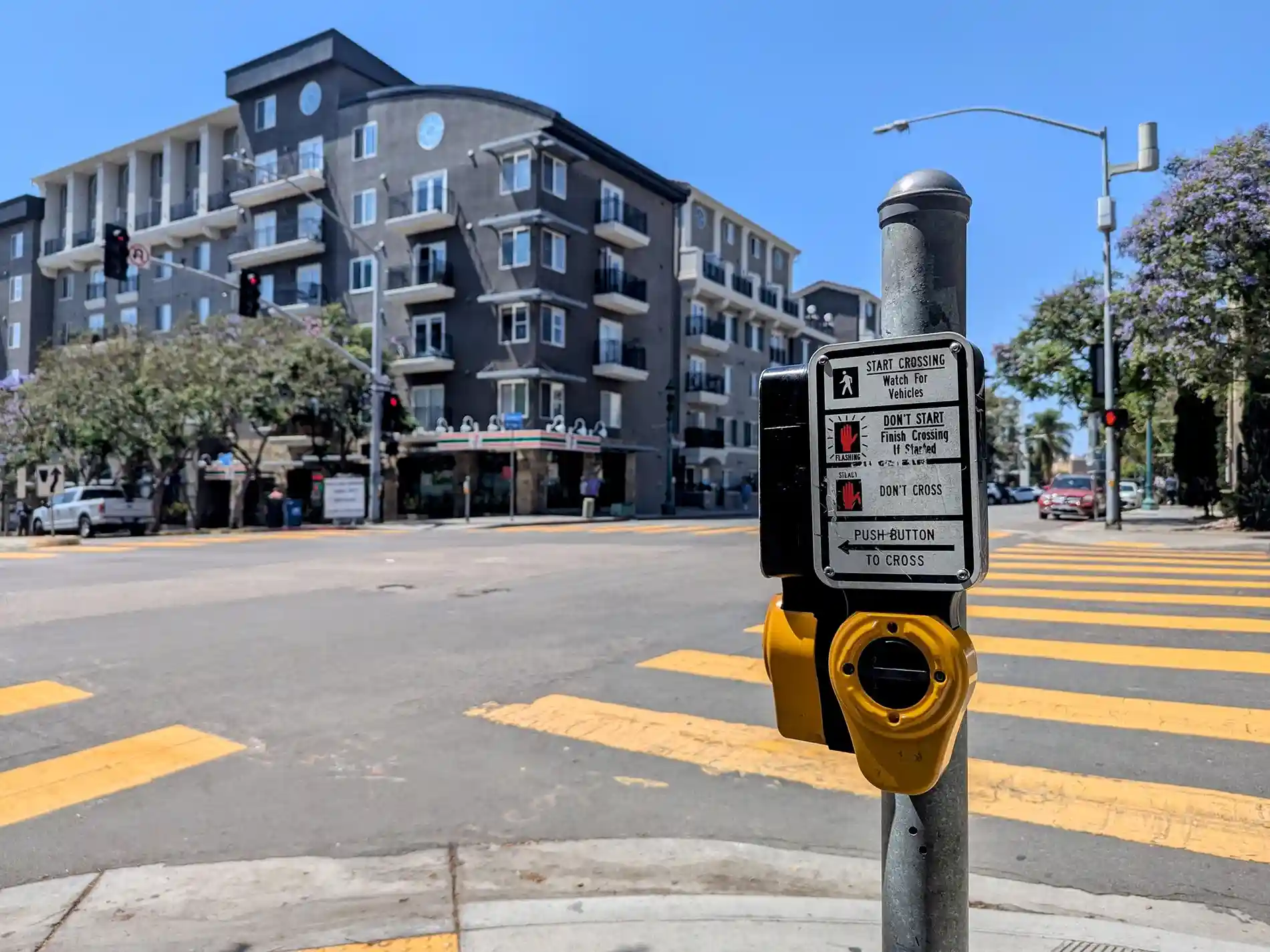
The fight in almost every crosswalk case is not whether a driver hit you. It is where you were standing when they did.
Insurers know that a pedestrian inside the crosswalk lines almost always has the right of way, so they work to place you outside them. Winning a crosswalk case usually means proving your position, and that is harder than it sounds, because where a pedestrian comes to rest after a crash is not where they were hit. This guide explains how crosswalk accidents and liability work in San Diego: the types of crosswalk crashes, the California laws that protect pedestrians, how the fight over your position plays out, and who can be held responsible. A San Diego pedestrian accident attorney can apply all of it to your case.
A Quick Summary
If you only have a minute, here is what matters most after a San Diego crosswalk accident:
- Drivers must yield in every crosswalk, marked or unmarked.
- Every intersection has a crosswalk. Even with no painted lines, the law treats the spot where two streets meet as a legal crosswalk.
- Turning drivers cause many crosswalk crashes. A driver turning right often looks left for traffic and never looks right for the pedestrian.
- The whole case can turn on where you were standing. Accident reconstruction can place you inside the lines even when the driver says otherwise.
- Partial fault does not end your claim. California reduces compensation by your share of fault; it does not erase the claim.
- A claim against a city moves fast. You may have only six months to file, so do not wait.
The Most Common Types of Crosswalk Crashes
Crosswalk accidents take different forms depending on the location and the traffic controls, and the circumstances matter because they shape who is liable.
Marked and Unmarked Crosswalk Collisions
A marked crosswalk has painted lines or pavement markings. When a driver strikes a pedestrian in one, liability usually falls on the driver. But many drivers and pedestrians do not realize that every intersection in California has a legal crosswalk, even with no paint. Under California Vehicle Code section 275, an unmarked crosswalk exists at any ordinary intersection, and drivers must yield to pedestrians there just as they would at a painted crossing. Crashes at unmarked crosswalks often turn into a dispute over whether the pedestrian was inside the crossing, which makes evidence collection critical.
Turning-Vehicle Collisions
Turning vehicles cause a large share of crosswalk accidents, for a simple reason: a turning driver is usually looking for a gap in vehicle traffic, not for a person on foot. A driver turning right tends to look left toward oncoming cars, and if that driver is in a hurry, they may accelerate into the turn without ever looking right toward the crosswalk. Left-turning drivers face a related problem, because the windshield pillar beside the driver can hide a pedestrian for a critical second or two.
A driver turning right will often look left for oncoming traffic and never look right for the pedestrian. If the driver is in a hurry, they may hit the gas while turning without ever checking the crosswalk.
In these cases, a human factors expert can examine the vehicle and show that the pedestrian was clearly visible from multiple angles in the seconds before impact. That analysis is often what proves a turning driver simply failed to look.
The Multi-Lane “Passing a Stopped Car” Crash
One of the deadliest crosswalk crashes happens when a car in one lane stops for a pedestrian and a driver in the next lane speeds past without stopping. The passing driver cannot see the pedestrian hidden behind the stopped car, and the pedestrian gets no warning at all. The result is often a high-speed impact and catastrophic injuries.
Uncontrolled Crosswalks on Busy Streets
An uncontrolled crosswalk has no traffic signal and no stop sign to halt traffic for the pedestrian. When one crosses a busy, multi-lane street, it can be one of the most dangerous places for a person on foot. A pedestrian may step out expecting drivers to stop, while drivers approach at full speed and may not register the crosswalk at all.
Uncontrolled crosswalks across busy streets are among the most dangerous places for a pedestrian. A pedestrian-activated beacon or a traffic signal can make an enormous difference.
Safety upgrades such as pedestrian-activated flashing beacons, traffic signals, and pedestrian refuge islands make these crossings far safer. When a city knows a crosswalk has a history of crashes and fails to add these protections, that failure can become part of a claim.
Signal-Controlled Intersections
At intersections with pedestrian signals, both drivers and pedestrians have specific duties under the Vehicle Code. A pedestrian may start crossing on a steady WALK signal, and a pedestrian already in the crosswalk when the signal changes still has the right to finish crossing. Crashes here often raise questions about signal timing and whether the pedestrian lawfully entered the crosswalk.
California Laws That Protect Pedestrians in Crosswalks
California has some of the strongest pedestrian protection laws in the country, and knowing them helps you understand why a crosswalk claim can be strong even when the insurer says otherwise.
The cornerstone is Vehicle Code section 21950, which requires every driver to yield the right of way to a pedestrian crossing within any marked or unmarked crosswalk, and to slow down and use due care to keep that person safe. The same statute, in subsection (b), reminds pedestrians that they too must use due care and may not suddenly leave a curb into the path of a car that is too close to stop. That pedestrian duty does not cancel the driver’s duty to yield, but it can factor into a comparative-fault analysis.
Two more sections matter often. Vehicle Code section 21951 makes it illegal to pass a vehicle that has stopped at a crosswalk to let a pedestrian cross, the exact conduct behind the multi-lane crash described above. And Vehicle Code section 21954 says a pedestrian crossing outside a crosswalk must yield to vehicles, but the driver still must use due care to avoid hitting them. Insurers sometimes argue a crash happened outside a crosswalk to shift blame, even when the pedestrian was lawfully inside an unmarked crosswalk. Our guide to pedestrian right-of-way laws in California covers each of these in depth.
AB 413: California’s Daylighting Law
California Assembly Bill 413, the daylighting law, took effect on January 1, 2024. It added a subdivision to Vehicle Code section 22500 making it illegal to stop or park within 20 feet of the approach side of any crosswalk, marked or unmarked, anywhere in California, or within 15 feet where a curb extension is present. Citations began on January 1, 2025, after a first-year education period.
The goal is to improve sight lines so drivers and pedestrians can see each other. This matters in San Diego, where many older neighborhoods allow parking that extends close to intersections and blocks a driver’s view of a pedestrian stepping off the curb. A driver who parks in violation of the daylighting law and helps cause a crosswalk crash may share liability for the injuries.
Proving Where You Were: The “Outside the Crosswalk” Defense
The single most common dispute in a crosswalk case is whether the pedestrian was actually inside the crosswalk. If the driver and the insurer convince a jury you were outside the lines, they can cut or even defeat your claim.
Why Insurers Fight Over Your Position
Adjusters know that the pedestrian’s location changes everything. A pedestrian inside a crosswalk almost always has the right of way; a pedestrian outside one may share fault. So adjusters look for any reason to argue you were a few feet off, crossing mid-block, or stepping out against a signal. They will point to the police report, but a report is not the final word. Officers usually arrive after the crash, did not see it happen, and sometimes record only the driver’s version, because the injured pedestrian was taken to the hospital and never gave a statement.
How Accident Reconstruction Works Backwards
Where a pedestrian ends up after a crash is not where they were hit. It is not uncommon for a pedestrian to be thrown a long distance by the force of a collision. Accident reconstruction experts work backwards from the point of rest to find the point of impact, studying the vehicle’s speed, the location and shape of the vehicle damage, the pedestrian’s height and weight, skid marks, and objects left in the road, such as shoes knocked off on impact or items the pedestrian was carrying. Put together, that evidence can place a pedestrian squarely inside a crosswalk even when the driver claims otherwise.
It is not uncommon for a pedestrian to be thrown many feet by the force of a crash. We have handled cases where a pedestrian was thrown 60 feet. Investigators work backwards from where the pedestrian came to rest to determine where they actually were when the vehicle struck them.
Video and Other Evidence
Some of the strongest evidence in a crosswalk case is video. Many crosswalks sit near businesses, homes, and traffic cameras, and that footage can show exactly where you were standing and whether the driver yielded. It is often deleted within days or weeks, so it has to be found and preserved quickly. Other useful evidence includes traffic signal timing records, independent witness statements, and the physical marks left at the scene.
Who Is Liable for a Crosswalk Accident
Liability depends on the specific facts, and more than one party may share responsibility.
The most common basis for a claim is driver negligence: distracted driving, failing to yield, speeding through an intersection, running a red light, driving under the influence, or simply failing to check the crosswalk before a turn. When a driver breaks a traffic law and that violation causes injury, the doctrine of negligence per se can apply. Under California Evidence Code section 669, a driver’s violation of section 21950, the failure to yield to a pedestrian in a crosswalk, creates a presumption that the driver was negligent. You still must prove the violation caused your injuries, but the burden of proving carelessness is far lighter. It is one of the strongest tools in a crosswalk case.
Other parties can share fault. If a commercial driver strikes a pedestrian while working, the driver’s employer may be responsible under the doctrine of respondeat superior, which also opens the employer’s larger insurance coverage. If a vehicle defect such as brake failure played a role, the manufacturer may face product liability. If construction or utility work blocked the crosswalk and forced a pedestrian into a dangerous path, the contractor may share responsibility. Our guide to proving liability in a pedestrian accident case explains how this evidence comes together.
When a City or Caltrans Shares the Blame
Not every crosswalk accident is caused only by a negligent driver. The City of San Diego, the County, and Caltrans have a duty to design and maintain safe roads, sidewalks, crosswalks, and traffic controls. When a crash is caused or made worse by a dangerous condition, such as faded crosswalk paint, a broken pedestrian signal, poor lighting, a missing curb ramp, or bad intersection design, a claim against the responsible agency may be appropriate.
This is a live issue in San Diego. The city adopted its Vision Zero initiative in 2015 with the goal of eliminating pedestrian and cyclist traffic deaths by 2025, and a decade later that goal has not been met. If you were injured at a location with a known history of pedestrian crashes, that pattern can strengthen a claim by showing the agency had notice of the danger and failed to fix it. Our guide to the most dangerous intersections for pedestrians in San Diego explains when a roadway-design case is worth pursuing.
A claim against a public agency runs on a much shorter clock. You must present a formal written claim to the agency within six months of the crash, under Government Code section 911.2. That is far shorter than the general two-year deadline to file a lawsuit set by Code of Civil Procedure section 335.1. Missing the six-month deadline can end the case before it starts, so see our guide to the personal injury statute of limitations in San Diego and speak with an attorney quickly.
Comparative Fault: Being Partly to Blame Does Not End Your Claim
California follows pure comparative negligence, under Civil Code section 1714. An injured pedestrian can recover compensation even when they were partly at fault; the recovery is simply reduced by their share. If you were crossing in a crosswalk but looking at your phone and a jury assigns you 20 percent of the fault, you still recover 80 percent of your damages. Being partly at fault does not mean you have no case.
Insurers lean hard on comparative negligence to cut crosswalk claims, arguing that you were outside the crosswalk, entered against a DON’T WALK signal, were distracted by a phone or headphones, or wore dark clothing at night. Each argument can be answered with hard evidence, including surveillance footage, traffic signal data, witness testimony, and accident reconstruction. What a crosswalk case is ultimately worth, and how comparative fault factors into it, is covered in our guide to compensation for pedestrian accident victims in San Diego.
Talk to a San Diego Pedestrian Accident Attorney
Crosswalk cases get complicated fast, especially when the insurer disputes where you were standing, a government agency is involved, or more than one party shares fault. Knowing the law is useful, but an attorney is what preserves the evidence, retains the right experts, and answers the comparative-fault attack.
At Hulburt Law Firm, attorney Conor Hulburt and his team represent pedestrian accident victims across San Diego County. The firm focuses on catastrophic injury and wrongful death cases, and you pay nothing unless we recover compensation for you. If you are weighing what comes next, our guide to the steps to take after a pedestrian accident is a good place to start.
Call us at (619) 821-0500 or contact us for a free, no-obligation consultation about your crosswalk accident case.
Request a Free Case Review
Simply fill out the form or call 619.821.0500 to receive a free case review. We’ll evaluate what happened, your injuries, and potential defendants to determine how we can best help you.

Hulburt Law Firm handles serious personal injury and wrongful death cases throughout San Diego County.


