
Pedestrian Right-of-Way Laws in California Explained
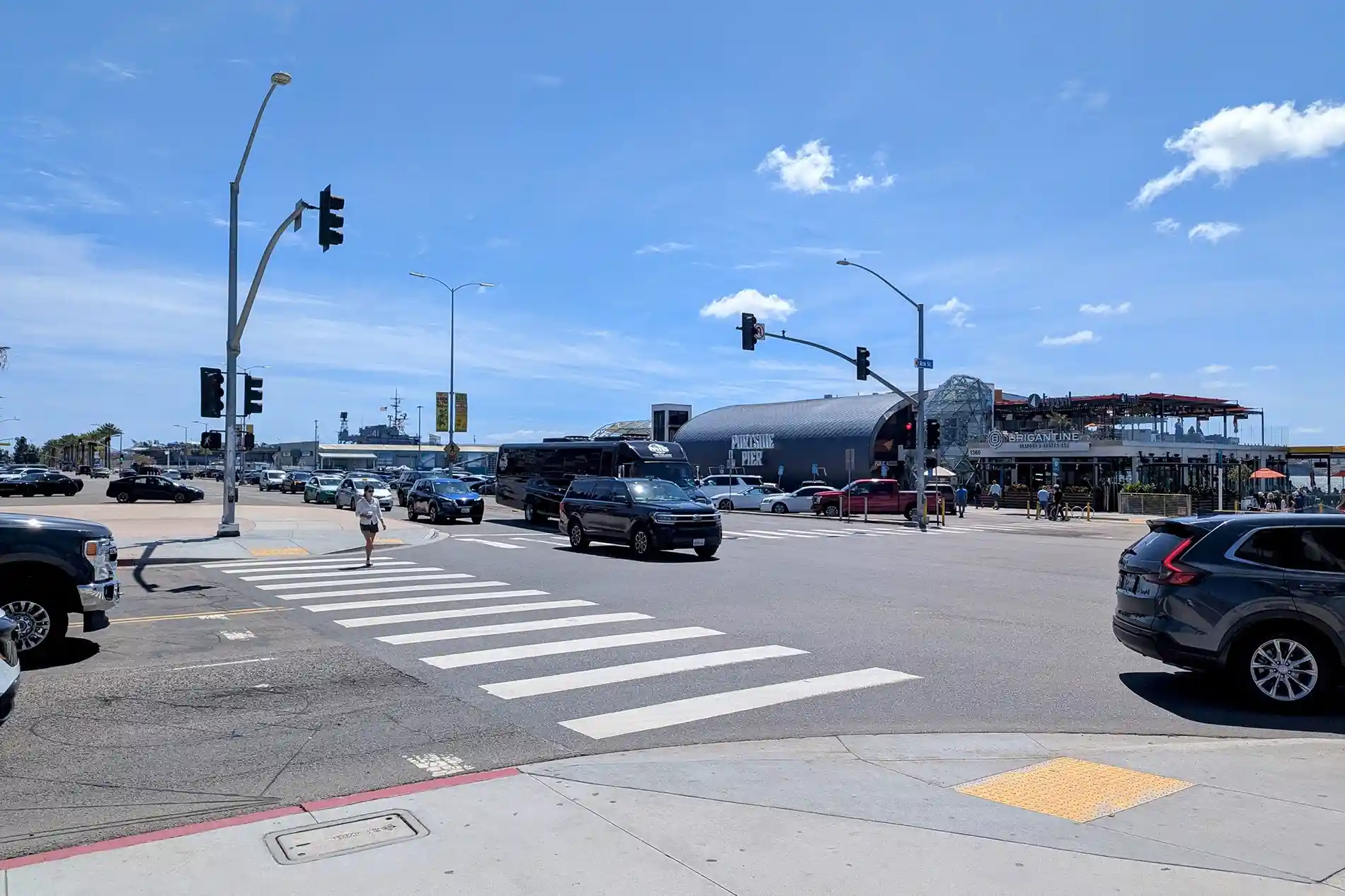
If you or someone you love was struck by a vehicle while walking, it’s helpful to understand California’s pedestrian right-of-way laws. These laws decide who had the duty to yield, and who may be at fault for the collision.
In this article, we explain the California statutes that govern pedestrian right of way. We’ll cover crosswalks, crossing outside a crosswalk, traffic signals, the Freedom to Walk Act, and how all of it shapes a personal injury claim. San Diego pedestrian accident victims should understand these rules to better understand their case.
California Pedestrian Right-of-Way: The Short Version
Here are the key points this guide explains in detail below.
- Drivers must yield to pedestrians in crosswalks, marked or unmarked. Every intersection with sidewalks has crosswalks, even with no painted lines.
- Pedestrians have duties too. They cannot suddenly step into the path of a car that is too close to stop.
- Crossing outside a crosswalk does not end your case. The pedestrian must yield, but the driver still has a legal duty to avoid hitting them.
- Jaywalking is mostly decriminalized. The Freedom to Walk Act stopped most jaywalking tickets, though crossing outside a crosswalk can still affect civil fault.
- Partial fault does not bar recovery. California’s pure comparative negligence rule reduces compensation by your share of fault, but it does not eliminate it.
- Deadlines are short. Generally two years to file a lawsuit, and only six months to file a claim if a government agency is involved.
When Pedestrians Have the Right of Way at Crosswalks
California Vehicle Code Section 21950 is the foundation of pedestrian right-of-way law. It requires every driver to yield to a pedestrian crossing the roadway within any marked crosswalk, or within any unmarked crosswalk at an intersection.
The statute does more than say “stop.” It requires a driver approaching a pedestrian in a crosswalk to slow down and take whatever action is needed to keep that person safe. This is a heightened duty of care, and it applies even when the driver has a green light.
Marked and Unmarked Crosswalks
One of the most misunderstood parts of California law is the unmarked crosswalk. Under California Vehicle Code Section 275, a crosswalk includes both the painted lines most people picture and the unmarked extension of any sidewalk across an intersection.
In plain terms: every intersection with sidewalks has crosswalks, whether or not the city painted them.
This matters in San Diego, where many older and residential neighborhoods have intersections with no painted crosswalks. After a crash, drivers and insurers often claim there was “no crosswalk.” The law says otherwise. A pedestrian crossing at an ordinary intersection is protected even with no paint on the road.
What “Due Care” Means for Drivers
Section 21950 puts a duty of due care on drivers near crosswalks, and California courts read it broadly. A driver must stay alert for pedestrians, slow down near crosswalks, and take real action to avoid a collision. “I didn’t see them” is not a defense, because the law requires the driver to look.
This duty matters most when something blocks the driver’s view. Here is a common and deadly example: a car in one lane stops for a pedestrian, and a driver in the next lane speeds past without stopping. California Vehicle Code Section 21951 forbids exactly that, because the passing driver gives the pedestrian no warning at all. It is one of the most frequent causes of pedestrian accidents in California.
Pedestrian Duties and Responsibilities
California law protects pedestrians, but it also expects them to use care. This matters because a pedestrian’s own violation can reduce their compensation under the state’s comparative negligence rule.
The Pedestrian’s Own Duty of Due Care
Section 21950(b) says the right-of-way protection in a crosswalk does not relieve a pedestrian of the duty to use due care. A pedestrian may not suddenly leave a curb and step into the path of a vehicle that is so close it cannot stop. A pedestrian also may not needlessly stop or delay traffic while in a crosswalk.
This does not erase the pedestrian’s right of way. It runs alongside it. Even a pedestrian who technically has the right of way can have their recovery reduced if they darted out from between parked cars or stepped off the curb directly in front of a car.
Crossing Outside a Crosswalk
When a pedestrian crosses somewhere other than a crosswalk, California Vehicle Code Section 21954 requires them to yield to vehicles close enough to be an immediate hazard. This is the rule most people call jaywalking.
But the statute does not stop there. Section 21954(b) adds the part defense lawyers rarely mention: it states that the section does not relieve a driver of the duty to use due care for the safety of any pedestrian on the road. A driver who sees a pedestrian, or who should have seen one, still has a legal duty to try to avoid the collision.
Picture a pedestrian crossing a wide, fast commercial street outside a crosswalk. The defense will say the pedestrian had no right of way. Section 21954(b) is the answer: the driver still had to watch the road and avoid a person in plain view.
Outside a crosswalk, a pedestrian has to yield. But yielding the right of way and losing the case are not the same thing. A driver’s duty to avoid hitting a person who is in plain view never disappears.
Driver Duties and Responsibilities
Pedestrians have responsibilities, but so do drivers. California law requires more than simply obeying traffic signals or stopping when a pedestrian is directly in front of a car. Drivers must keep a proper lookout, control their speed, yield when required, and take reasonable steps to avoid hitting a pedestrian.
Drivers Must Exercise Due Care
California Vehicle Code Section 21950 requires a driver approaching a pedestrian in a marked or unmarked crosswalk to exercise due care. The driver must reduce speed or take whatever other action is reasonably necessary to protect the pedestrian.
That means a driver cannot simply say, “I had the right of way” or “I didn’t see them.” Drivers have an independent duty to watch the road ahead and respond to hazards they can reasonably see.
This duty becomes especially important at night, in bad weather, around parked cars, near schools, and anywhere pedestrians may be difficult to see. Under California’s Basic Speed Law, even driving at the posted speed limit may be unsafe if visibility or roadway conditions require a slower speed.
Drivers Must Try to Avoid a Collision
A pedestrian does not have to be in a crosswalk before a driver has a duty to use care. Even when a pedestrian is crossing outside a crosswalk and must yield to traffic, California law does not relieve the driver of the duty to exercise due care for that pedestrian’s safety.
That distinction matters after a crash. A pedestrian may have crossed where they should not have, but the question does not end there. If an attentive driver had enough time and distance to see the pedestrian, slow down, brake, or steer away, the driver may still share responsibility for the collision.
Do Not Pass a Vehicle Stopped for a Pedestrian
California Vehicle Code Section 21951 prohibits a driver from passing another vehicle that has stopped at a crosswalk to allow a pedestrian to cross.
The reason is simple. The stopped vehicle may block the approaching driver’s view of the pedestrian. Passing it can put the pedestrian directly in the path of a vehicle they cannot see.
When one vehicle stops at a crosswalk, drivers approaching from behind should assume there may be a pedestrian in front of it and stop rather than drive around.
The Freedom to Walk Act: How California Changed Jaywalking Enforcement
On January 1, 2023, California’s Freedom to Walk Act changed how jaywalking is enforced. A police officer may no longer stop a pedestrian for crossing outside a crosswalk under Section 21954, or for crossing between controlled intersections under California Vehicle Code Section 21955, unless a reasonably careful person would see an immediate danger of a collision.
The law was passed because jaywalking tickets fell disproportionately on communities of color and low-income neighborhoods.
Although the Freedom to Walk Act did not change civil liability, it undercuts the defense that “jaywalking” was to blame, because California now formally recognizes that crossing outside a crosswalk, done safely, is a normal and lawful thing to do.
Traffic Signal Rules for Pedestrians
California Vehicle Code Section 21456 governs how pedestrians use intersections with signals.
On a steady WALK signal, a pedestrian may cross in the direction of the signal and has the right of way over vehicles.
On a flashing DON’T WALK or a countdown, a pedestrian who has not started crossing should not step out. But a pedestrian who already started crossing on the WALK signal may finish, and keeps the right of way while doing so. Drivers must yield to a pedestrian lawfully finishing a crossing.
A common San Diego crash involves a driver turning right on red while a pedestrian crosses on a WALK signal. Under California Vehicle Code Section 21453, a driver turning right on red must yield to pedestrians in the crosswalk. Failing to do so is both a traffic violation and strong evidence of negligence.
Special Protections for Vulnerable Pedestrians
Blind and Visually Impaired Pedestrians
California gives extra protection to blind and visually impaired pedestrians. Under California Vehicle Code Section 21963, a blind or partially blind pedestrian using a predominantly white cane or a guide dog has the right of way at all times, regardless of signals or crosswalks. It is one of the few absolute right-of-way rules in the Vehicle Code.
California Vehicle Code Section 21964 bars anyone who is not blind from carrying a white cane on the road, because the cane is a universal signal to drivers. Under California Vehicle Code Section 21965, a driver approaching a pedestrian with a white cane or guide dog must take all reasonably necessary precautions to avoid injuring them. Failing to do so is a misdemeanor, not just an infraction.
Children and Older Pedestrians
California has no separate statute giving children or older pedestrians extra right of way. But the general due-care standard does that work. A driver must adjust to what they can see. Passing through an empty crosswalk at normal speed may be fine. Doing the same near a school zone or a senior community, where slower or less predictable pedestrians are foreseeable, can be negligent. Areas near schools, Balboa Park, and senior communities call for extra caution.
Sidewalk and Driveway Right-of-Way
Not every pedestrian is hit in the road. Many are struck on a sidewalk by a vehicle entering or leaving a driveway, alley, or parking lot. These cases follow their own rules, and most online guides skip them.
Two statutes control. California Vehicle Code Section 21952 requires a driver crossing a sidewalk to yield to any pedestrian on that sidewalk. California Vehicle Code Section 21804 requires a driver entering the road from private property to yield to traffic and pedestrians until it is safe to proceed.
The firm has handled exactly this kind of case. A driver leaving a shopping-center driveway looked left for oncoming car traffic, then pulled forward across the sidewalk without looking right, and struck a pedestrian who was lawfully walking past. The driver had a clear duty to yield. Looking only for cars, and never for people on the sidewalk, is a failure of that duty.
A driver crossing a sidewalk to leave a driveway has to yield to the people already on that sidewalk. Looking left for cars and then rolling forward is not looking. It is a failure to yield.
If you were hit on a sidewalk or in a parking lot, you may have a strong claim even though you were never in a crosswalk and never in the road.
Other California Laws That Protect Pedestrians
Several more Vehicle Code sections work alongside the right-of-way rules:
- Section 21970, no blocking crosswalks. A driver may not stop in a marked or unmarked crosswalk, even in heavy traffic. A blocked crosswalk forces pedestrians into traffic lanes.
- Section 21966, pedestrians and bike lanes. A pedestrian may not walk in a bike lane when a usable sidewalk is available, though they may cross a bike lane to reach a building or a vehicle.
How Right-of-Way Laws Affect Pedestrian Accident Claims in San Diego
In almost every pedestrian case, the right-of-way analysis is the starting point for fault. When a driver hits a pedestrian who had the right of way in a crosswalk, the driver’s violation of Section 21950 creates a strong presumption of negligence. Under California Evidence Code Section 669, breaking a safety statute that was meant to prevent exactly this kind of harm creates a presumption of negligence. Lawyers call this negligence per se.
Comparative Negligence and Pedestrian Fault
California uses pure comparative negligence, under Civil Code Section 1714 and the California Supreme Court’s decision in Li v. Yellow Cab Co. (1975). A pedestrian can recover compensation even if they were partly at fault. The recovery is just reduced by their share of fault.
For example, if a pedestrian crossed against a signal but the driver was also speeding and not watching the road, a jury might assign 30% of the fault to the pedestrian and 70% to the driver. The pedestrian still recovers 70% of their damages.
Comparative fault is the single biggest battleground in pedestrian cases. Insurers push hard to pin a share of blame on the pedestrian, because every percentage point lowers what they pay. The argument gets stronger when it was dark or foggy, and stronger still if the pedestrian had been drinking. Jurors are drivers themselves, and they tend to sympathize with how hard it can be to see a person at night. None of this bars a claim, but it is why having an attorney who plans for the comparative fault attack from day one matters so much.
Common Right-of-Way Arguments Insurers Make
Insurance companies challenge right-of-way claims with a familiar set of arguments. They may say the pedestrian was outside any crosswalk, ignoring unmarked crosswalks. They may say the pedestrian darted out. They may say the pedestrian crossed against the signal, or wore dark clothing at night and could not be seen.
Each of these can be answered with evidence. One caution about the police report: it is a starting point, not the last word. In pedestrian cases the investigation is often thin, because the injured person is in the hospital and the officer hears only the driver’s account. A report that assigns fault to the pedestrian can still be challenged and overcome with a careful, independent investigation.
Proving a Right-of-Way Violation
Proving a pedestrian case means showing four things: the pedestrian was somewhere the Vehicle Code protected, the driver had a duty to yield or to use due care, the driver failed that duty, and the failure caused the injuries.
Evidence That Builds the Case
Evidence that proves a right-of-way violation includes:
- The police report and any citation issued to the driver
- Surveillance or dashcam video showing where the pedestrian was at impact
- Witness statements placing the pedestrian in the crosswalk
- Traffic signal timing data from the city
- Vehicle damage showing the point and angle of impact
Video is often the most powerful evidence, and the best sources are everyday businesses near the scene: gas stations, apartment complexes, gyms, and storefronts. Their cameras point at their own property, but they often capture the street and intersection in the background. This footage is fragile and is frequently recorded over within days, so it has to be found and preserved fast.
Accident Reconstruction and Human Factors Experts
In a contested right-of-way case, the most important evidence is often expert testimony. An accident reconstruction expert and a human factors expert work together to answer the question a jury actually cares about: could an alert, reasonable driver have avoided this crash?
These experts can piece together when an average driver should have recognized the pedestrian as a hazard, and how much time and distance it would have taken to stop or steer clear. That analysis turns a vague “the pedestrian came out of nowhere” defense into a measurable question of speed, sightlines, and reaction time. This testimony is often essential to proving driver fault, especially when the defense claims the pedestrian had no right of way.
The real question in most right-of-way cases is not who had the right of way. It is whether an attentive driver could have seen the danger and stopped in time. The right experts answer that with time and distance, not guesswork.
Compensation After a Right-of-Way Violation
When a driver violates a pedestrian’s right of way and causes injury, the pedestrian may recover both economic and non-economic damages.
Economic damages cover hard costs: emergency care, surgery, hospitalization, rehabilitation, future medical treatment, lost wages, and lost earning capacity.
Non-economic damages cover pain and suffering, emotional distress, loss of enjoyment of life, and permanent disability or disfigurement. California does not cap non-economic damages in an ordinary injury case, so there is no statutory limit on pain and suffering for a pedestrian accident victim.
Pedestrian injuries tend to be severe, because the body has no protection against a vehicle. What a case is ultimately worth depends on the severity and permanence of the injuries, how clear the liability is, how much insurance coverage is available, and the long-term effect on the person’s life. Our related guide explains compensation for personal injury victims in San Diego in more detail.
Deadlines matter. Under California Code of Civil Procedure Section 335.1, you generally have two years from the date of the crash to file a lawsuit. But if a government agency shares responsibility, you must file a formal claim within six months under California Government Code Section 911.2. Missing that six-month deadline can end the case before it starts.
Related Resources
These related guides from Hulburt Law Firm cover other parts of a pedestrian accident claim:
- Steps to Take After a Pedestrian Accident in San Diego
- Proving Liability in Personal Injury Cases in San Diego
Talk to a San Diego Pedestrian Accident Attorney
Pedestrian right-of-way law is more complicated than it looks, and insurance companies use every ambiguity to pay less. If a driver failed to yield and you were hurt, you deserve an attorney who will hold the at-fault party accountable.
At Hulburt Law Firm, attorney Conor Hulburt represents pedestrian accident victims across San Diego County. The firm focuses on catastrophic injury and wrongful death cases, and brings the resources, experience, and courtroom readiness to take on insurers and negligent drivers. Every consultation is free and confidential, and you pay nothing unless the firm recovers compensation for you. Call (619) 821-0500 or visit hulburtlaw.com/contact-us to discuss your pedestrian accident case.
Request a Free Case Review
Simply fill out the form or call 619.821.0500 to receive a free case review. We’ll evaluate what happened, your injuries, and potential defendants to determine how we can best help you.

Hulburt Law Firm handles serious personal injury and wrongful death cases throughout San Diego County.


