
MTS Bus Accidents in San Diego: Liability and Proof
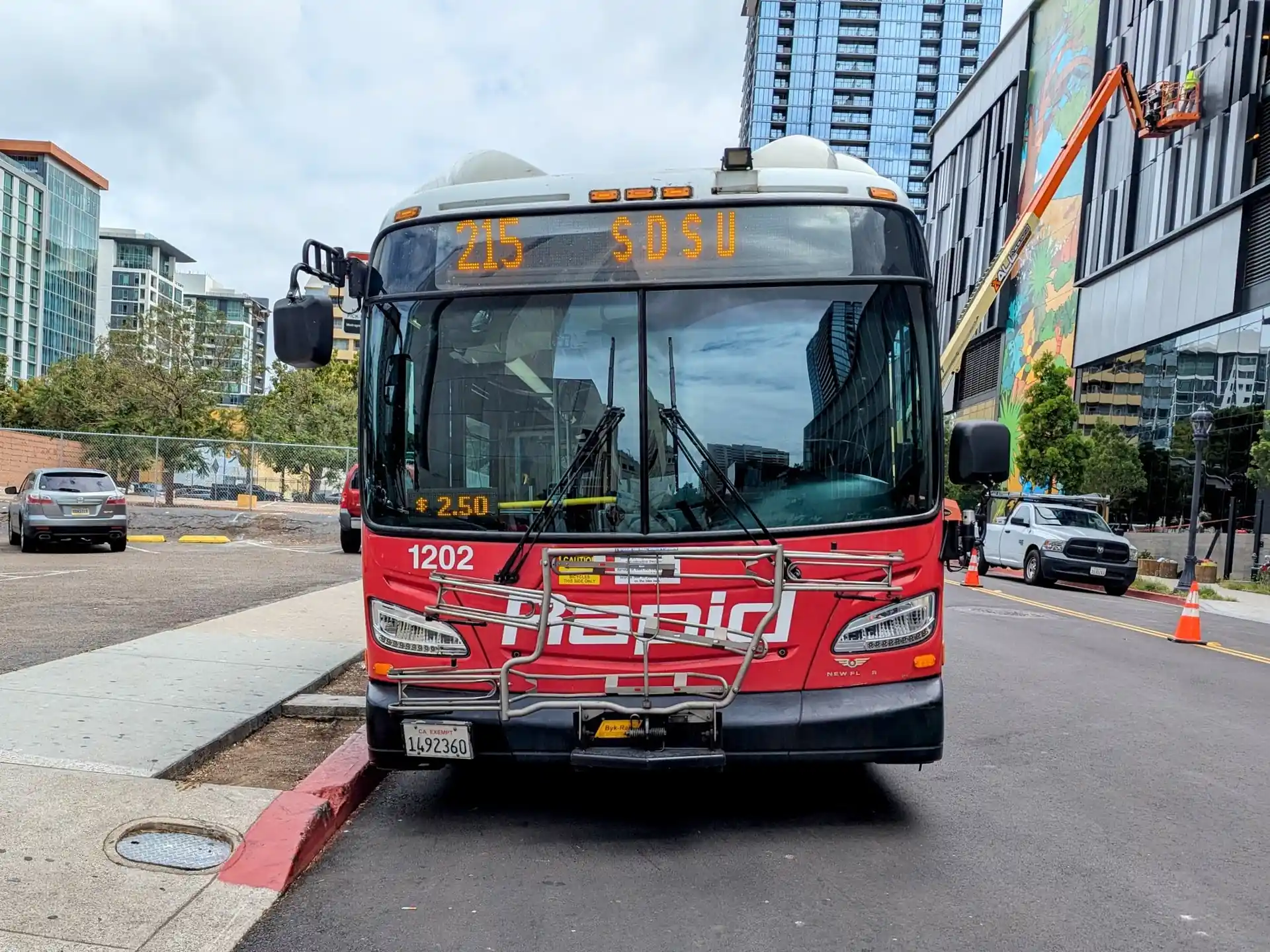
A serious accident involving a San Diego MTS bus can leave riders, pedestrians, cyclists, and families facing painful injuries, confusing paperwork, and strict legal deadlines. These cases are not handled like ordinary car crashes. Because MTS is a public transit agency and a common carrier, special California rules govern who may be liable, how claims must be filed, and what evidence must be preserved.
This article explains how liability is evaluated, how to prove what happened, and what steps to take so you can make informed decisions about your rights after an MTS bus accident in San Diego.
Understanding MTS bus accidents in San Diego
Metropolitan Transit System (MTS) bus accidents in San Diego cover a wide range of incidents. These cases can involve crashes with cars, trucks, or motorcycles, as well as impacts with pedestrians and cyclists at intersections, bus stops, or crosswalks. Injuries can also occur inside the bus from sudden braking, swerving, or rear‑end impacts that throw riders from their seats or knock standing passengers to the floor.
Other common scenarios include people being hurt while boarding or exiting due to bus movement, closing doors, or uneven curbs, and wheelchair users being injured when tie‑downs or ramps are not properly used. Each of these can qualify as an “MTS bus accident” if negligence by a driver, contractor, or agency contributed to the harm.
Public entity and contractor complications
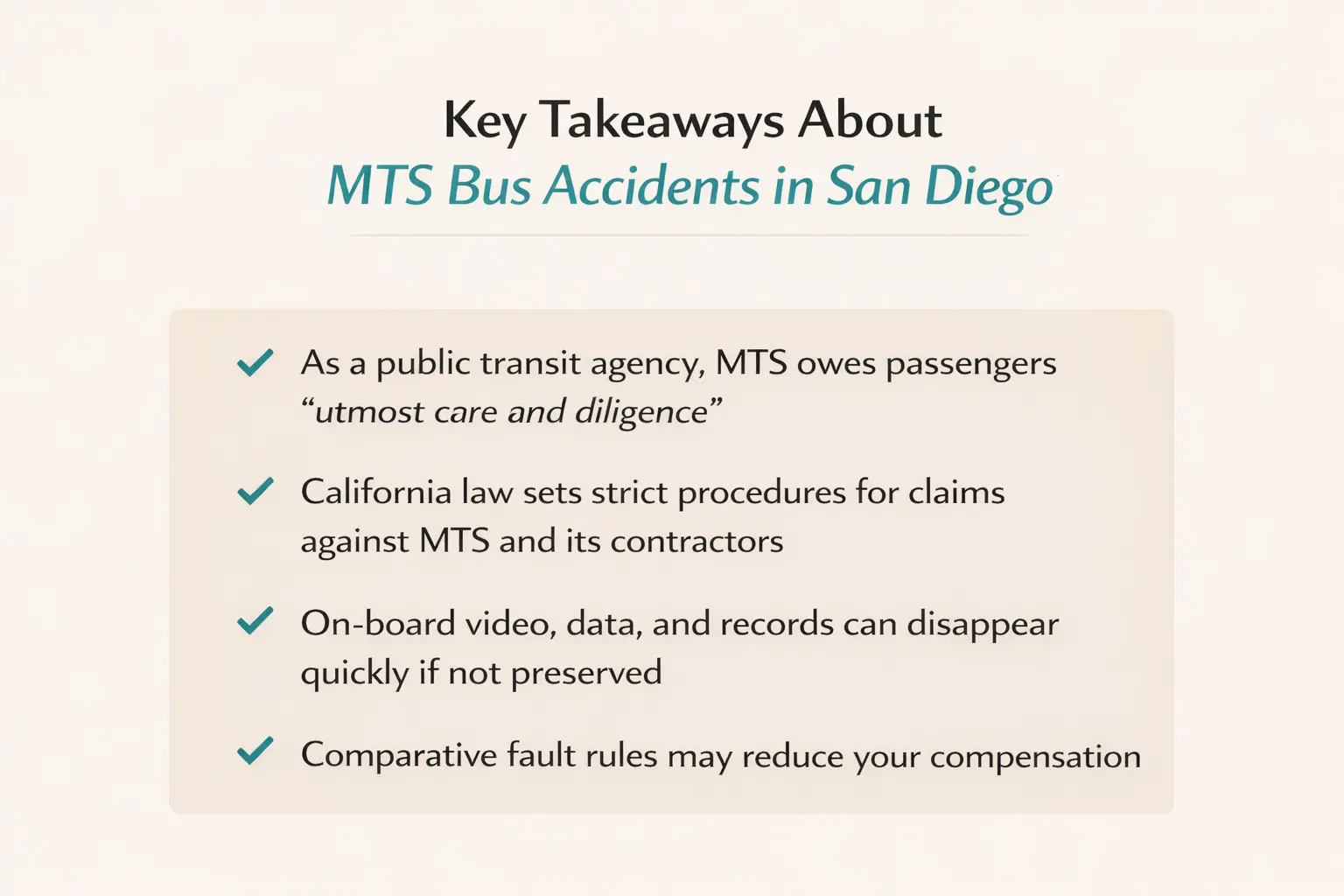
MTS is a public entity, and many routes are run by private companies under contract. Different rules may apply depending on whether the negligent party is MTS itself, one of its employees, or a private operator or driver. Because MTS is a common carrier, it owes passengers the “utmost care and diligence” under California Civil Code § 2100.
Claims involving MTS often trigger the California Government Claims Act, which requires a written claim to the agency within 6 months of the injury. (Gov. Code §§ 910, 911.2, 945.4.) Some cases involve a “dangerous condition of public property,” such as unsafe bus stops or depot layouts. (Gov. Code §§ 830, 835.) Fault may also be divided among multiple parties under comparative negligence rules, which can reduce but not necessarily eliminate an injured person’s recovery. An experienced attorney helps identify the correct defendants, meet strict deadlines, and navigate these overlapping legal issues.
Who can be liable after an MTS bus accident
Public entities and bus drivers
In many San Diego bus crashes, MTS itself can be liable if one of its employees was negligent while doing their job. Under California Government Code § 815.2(a), a public entity is responsible for injuries caused by its employees acting within the scope of employment. If an MTS bus driver runs a red light, follows too closely, or fails to secure a passenger, both the driver and MTS can be named in the claim.
If part of the transit operation is handled by a private contractor under agreement with MTS, that contractor can share responsibility. Determining who employed or controlled the driver often requires reviewing service contracts and operating agreements.
Other potentially responsible parties
Several additional parties may bear fault:
- Other negligent motorists, bicyclists, or pedestrians
- Vehicle or parts manufacturers, if a defect in brakes, steering, or other systems contributed
- Maintenance contractors that performed substandard inspections or repairs
- Public entities responsible for dangerous roadways or bus stops, such as the City of San Diego or Caltrans
California’s pure comparative negligence system allows fault to be divided among multiple defendants, including non‑bus drivers, with each paying in proportion to their responsibility. (Li v. Yellow Cab Co. (1975) 13 Cal.3d 804.)
Identifying all liable parties and claims
An attorney will analyze police reports, onboard video, witness statements, MTS and contractor records, maintenance logs, and insurance policies to uncover every viable defendant and coverage. Separate government claims may be required against each public entity, each with its own deadline under the Government Claims Act, so careful early investigation is critical to avoid missing sources of recovery.
The special duty of common carriers in California
Under California law, city buses that carry passengers for a fare are treated as “common carriers.” California Civil Code § 2100 requires common carriers to use the “utmost care and diligence” for passengers’ safety and to do all that human care and foresight reasonably can do under the circumstances. This is a higher standard than ordinary negligence and is reflected in jury instructions such as CACI No. 902.
How the heightened duty applies to bus crashes
The utmost‑care standard affects many routine bus situations, including:
- Sudden stops and maneuvers: Drivers must avoid unnecessary hard braking or sharp turns when it is reasonably safe to do so, and must anticipate traffic conditions to minimize risk to standing or seated passengers.
- Boarding and exiting: Operators must allow passengers a reasonable opportunity to get on and off safely, including properly deploying ramps and avoiding premature movement of the bus.
- Wheelchair and mobility device securement: Failure to properly secure a wheelchair or offer required assistance can violate the common carrier duty if injuries result.
- Protection from foreseeable third‑party harm: Common carriers must take reasonable steps to protect passengers from foreseeable assaults or dangers created by other riders, not just from collisions. See Lopez v. S. Cal. Rapid Transit Dist. (1985) 40 Cal.3d 780.
An experienced bus accident attorney can invoke Civil Code § 2100, related CACI instructions, and evidence such as internal policies, surveillance video, driver training records, and prior safety complaints to show the carrier failed to meet its heightened obligations.
Government Claims Act deadlines and procedures
In California, claims against public entities such as MTS, the City of San Diego, or Caltrans are controlled by the Government Claims Act. For most personal injury and wrongful death cases, you must first file a written government claim within six months of the date of injury or death. (Gov. Code § 911.2.) If you do not timely present a proper claim, you are usually barred from later filing a lawsuit (Gov. Code § 945.4; State of California v. Superior Court (Bodde) (2004) 32 Cal.4th 1234).
What the claim must include and how to serve it
A government claim must substantially comply with Government Code § 910, including:
- Claimant’s name and address
- Date, place, and circumstances of the accident
- Description of the injury or damage
- Names of public employees involved, if known
- Amount claimed, if under $10,000, or a statement that it exceeds $10,000
It is critical to correctly identify and deliver the claim to the proper public entity and its designated agent. Misdelivery, such as sending a claim only to the wrong department, may be ineffective. (DiCampli‑Mintz v. County of Santa Clara (2012) 55 Cal.4th 983.)
Rejection, lawsuit deadlines, and late‑claim options
If the entity mails a written rejection, you have six months from the date the notice is mailed to file a lawsuit; if no written rejection is ever mailed, the deadline is two years from the date of injury. (Gov. Code § 945.6.) Limited procedures exist to apply for permission to present a late claim (Gov. Code § 911.4) and, if denied, to ask the court for relief (Gov. Code § 946.6). An experienced attorney tracks these overlapping deadlines, prepares detailed claims, and coordinates filings when multiple agencies may share responsibility for a bus crash.
Key evidence after a city bus crash and how to preserve it
Time is critical after a San Diego MTS bus crash because key electronic data is often recorded over in normal operations. Many systems keep data only for days or weeks unless someone demands that it be saved.
Important evidence can include:
- Onboard and exterior bus video
- GPS / automatic vehicle location and telematics data
- Event data recorder information on speed, braking, and steering
- Dispatch, incident, and driver route/time logs
- Radio communications between the driver, dispatch, and supervisors
- Maintenance and inspection records
- Post‑accident drug and alcohol test results required under 49 C.F.R. Part 655 and Part 40
- 911 audio, CHP or police collision reports, and witness statements
- Nearby business, traffic, and residential camera footage
Transit agencies and their contractors may routinely overwrite video and electronic data. A lawyer can immediately send written preservation or “spoliation” letters instructing MTS and any private contractors not to delete or alter specified materials. If they ignore those letters and evidence is destroyed, a court may impose sanctions or give the jury a spoliation instruction allowing it to infer the missing evidence was unfavorable. See, for example, California Evidence Code § 413 and CACI No. 204.
An attorney can also use the California Public Records Act, Gov. Code § 7920.000 et seq., to request dispatch logs, policies, and other government‑held records, and can work with forensic and engineering experts to download, interpret, and present the technical data in a clear way.
Dangerous bus stops, roads, and sudden stop injuries
Dangerous condition of public property
In California, a public entity such as a city, county, or transit agency can be liable when a “dangerous condition of public property” substantially contributes to an injury. Government Code §§ 830 and 835 allow claims where public property creates a substantial risk of injury when used with due care, and the entity either created the danger or failed to fix it after notice.
For bus‑related injuries, this can include:
- Bus stops placed in unsafe locations, such as next to high‑speed traffic without protection or safe crossing routes
- Poor lighting or blocked sight lines that make it hard for drivers to see pedestrians or buses
- Lack of sidewalks, crosswalks, or ramps that forces riders into the roadway
- Broken pavement, potholes, or uneven surfaces at the stop or along bus routes
- Hazardous roadway design that increases the risk of foreseeable collisions
Cases such as Bonanno v. Central Contra Costa Transit Authority (2003) 30 Cal.4th 139 and Cordova v. City of Los Angeles (2015) 5 Cal.5th 989 show that an unsafe location or roadway design can be a legal cause of an injury even if another driver also acts negligently.
Attorneys often work with engineers and safety experts to review design plans, prior complaints, and crash histories, and to address “design immunity” defenses under Government Code § 830.6.
Sudden stops and unusual bus movements
Not every jerk, lurch, or hard brake by a bus is negligent. To recover for a fall or injury from a sudden stop or movement, passengers generally must prove that the motion was unusual or unnecessary compared with normal bus operation.
Evidence may include:
- Witness testimony describing how violent or out of the ordinary the movement felt
- Surveillance or onboard video showing the maneuver and passenger reactions
- Expert analysis comparing the bus’s speed, braking, or turning to accepted transit safety standards
An attorney can coordinate preservation of video and electronic data, obtain driver records, and work with transit safety experts to show that an abrupt stop or maneuver went beyond what a reasonably careful bus operator would do and was a substantial factor in causing the injury.
How fault and compensation work in MTS bus cases
Types of compensation available
In an MTS bus injury case, California law allows recovery of both economic and noneconomic damages when you prove negligence. (Civ. Code § 3333.) Economic damages cover the financial impact of the crash, such as:
- Past and future medical bills, rehabilitation, and medical devices
- Lost wages and loss of future earning capacity
- Out‑of‑pocket expenses, including transportation to medical care and home care needs
Noneconomic damages compensate for the human impact of an injury, including pain, emotional distress, loss of enjoyment of life, and in serious cases, disfigurement or disability.
In a wrongful death case, surviving family members may seek additional categories, including loss of financial support, loss of love, companionship, and guidance, and certain burial and funeral expenses. (Code Civ. Proc. § 377.60.)
Fault, comparative negligence, and shared responsibility
California follows “pure comparative negligence,” meaning your compensation is reduced by your percentage of fault. For example, a jury might assign partial fault if a rider ignored posted safety instructions, failed to use a handhold, or a pedestrian was distracted while walking near a bus.
When multiple defendants are at fault, economic damages are joint and several, so any defendant can be responsible for the full amount of your medical bills and lost earnings. Noneconomic damages are several only, so each defendant pays only their percentage of fault for pain and suffering. (Civ. Code § 1431.2.)
Punitive damages cannot be recovered against MTS or other public entities (Gov. Code § 818), but may be available against private defendants in cases of oppression, fraud, or malice. (Civ. Code § 3294.) An attorney evaluates all potential defendants, structures claims to reach available insurance coverage, and negotiates with health insurers, Medi‑Cal, Medicare, or ERISA plans to reduce lien paybacks so more of the recovery goes to the injured person or family.
What to do after an MTS bus accident in San Diego
Protect your health and document injuries
Your first priority is medical care. Call 911 if needed or request paramedics at the scene. Even if you feel “okay,” get evaluated the same day at an emergency room, urgent care, or by your doctor. Many bus‑related injuries, including concussions and soft‑tissue trauma, worsen over 24–72 hours.
Describe all symptoms, not just the most painful ones. Ask that your complaints be written in your medical records, and keep copies of:
- Visit summaries and discharge instructions
- Imaging reports and prescriptions
- Work‑restriction or off‑work notes
Preserve physical evidence such as torn clothing, broken glasses, damaged phones, walkers, or wheelchairs. Store these items, unwashed and unrepaired, in a safe place.
Report the incident and gather evidence
If you can do so safely:
- Report the incident to the MTS driver or supervisor and ask how to obtain an incident or claim number
- Take photos of the bus, any other vehicles, the interior (including handrails, steps, or wet floors), and visible injuries
- Collect names and contact information for witnesses
Under California law, evidence like surveillance video can be recorded over quickly. Early action helps an attorney send preservation letters to MTS and any contractors to secure video, onboard data, and maintenance records.
Be cautious with insurers and public entities
Because MTS is a public entity, California Government Code §§ 905 and 911.2 generally require a government claim within 6 months of the injury. Claims adjusters may ask for detailed or recorded statements. Do not provide such statements or sign medical releases before speaking with a lawyer, as inconsistent wording or broad authorizations can be used to minimize your claim. An experienced attorney can handle communications, calculate deadlines, and guide you to avoid mistakes that weaken your case. For a broader overview of the claims process, see our San Diego bus accident claims guide.
How attorneys build and coordinate complex bus claims
Investigating fault and legal violations
Attorneys begin by dissecting how the crash happened under California’s traffic and evidence rules. They look for negligence per se under Evidence Code § 669 when a driver violates safety statutes such as:
- Basic speed law (Veh. Code § 22350)
- Unsafe turning (Veh. Code § 22107)
- Following too closely (Veh. Code § 21703)
- Crosswalk and pedestrian right‑of‑way (Veh. Code § 21950)
- Handheld device use and texting (Veh. Code § 23123.5)
- Driving excessive hours (Veh. Code § 21702)
Lawyers obtain training records, route schedules, and hours‑of‑service logs to see whether the MTS driver was fatigued, undertrained, or pressured to stay on schedule. When liability is disputed, they may retain accident reconstruction experts to analyze video, black‑box data, scene measurements, and witness statements.
Countering public entity defenses
Public entities often argue design immunity under Government Code § 830.6, discretionary act immunity, or that the driver faced a sudden emergency. An experienced attorney uses targeted discovery to undermine these defenses by obtaining:
- Prior complaints and collision histories for the same route or stop
- Engineering plans, traffic studies, and any rejected safety improvements
- Internal safety policies, audits, and training materials
Experts in human factors, roadway design, or fleet safety can explain why the crash was foreseeable and preventable, even within government guidelines.
Coordinating multiple claims and damages proof
Bus cases often involve overlapping claims against MTS, other public entities, and private drivers or companies. The attorney tracks separate liability theories and insurance policies while keeping medical records, bills, and expert causation reports organized for each injured person.
They prepare for settlement or trial using California CACI jury instructions to structure evidence on negligence, comparative fault, and damages. Special procedures for minors and wrongful death claims are followed, including court approval of minor’s compromises and careful documentation of lost support, companionship, and future care needs.
Pedestrian, cyclist, and standing passenger injury claims
Pedestrians and cyclists hit by a bus
When an MTS bus strikes a pedestrian or cyclist, fault is not automatic. Lawyers examine whether the driver violated California traffic laws or internal MTS safety rules. Key questions include speed relative to conditions, use of mirrors and signals, and whether the driver kept a proper lookout in crowded San Diego corridors.
California Vehicle Code § 21950 requires drivers to yield to pedestrians in marked and unmarked crosswalks, including at intersections. If a bus enters a crosswalk too fast, fails to stop, or passes another stopped vehicle at a crosswalk, that often points to negligence. For cyclists, attorneys look at bike lanes, door zones, and whether the bus encroached into the cyclist’s space.
Visibility and lighting conditions are critical. Nighttime, glare, rain, or visual obstructions can affect how fault is shared under California’s comparative negligence system. The injured person’s actions, such as crossing against a signal, may reduce but usually do not erase recovery.
Attorneys also evaluate route design, bus stop placement, and pedestrian access to argue that dangerous layouts contributed to the collision.
Standing and moving passengers inside the bus
Passengers who are standing or walking inside the bus are still owed a heightened duty of care because a common carrier must use “the utmost care and diligence” for passenger safety. (Civ. Code § 2100.)
Falls frequently occur when:
- The driver accelerates or brakes abruptly
- The bus makes sharp turns or sudden lane changes
- The driver pulls away before passengers, including seniors or disabled riders, are seated or stable
Lawyers analyze surveillance video, driver training records, and incident reports to determine whether maneuvers were reasonably smooth in light of known standing passengers, especially those using canes, walkers, or wheelchairs. Comparative fault may be argued if a rider ignored available handholds, but counsel works to show the primary cause was unsafe operation given the driver’s knowledge of vulnerable passengers.
How the Hulburt Law Firm can help
MTS bus accidents involve a mix of public entity rules, common carrier duties, and technical evidence that can be difficult to untangle on your own. Acting quickly can make the difference in preserving video, electronic data, and your ability to file a valid claim. Hulburt Law Firm focuses on serious injury and wrongful death cases arising from bus and public transit crashes in the San Diego area.
If you or a loved one has been hurt in an MTS bus accident, you can learn more about your options by visiting our San Diego bus accident resource page. To discuss your potential claim and next steps, contact attorney Conor Hulburt and the Hulburt Law Firm to request a confidential consultation.
Read More
Request a Free Case Review
Simply fill out the form or call 619.821.0500 to receive a free case review. We’ll evaluate what happened, your injuries, and potential defendants to determine how we can best help you.

Hulburt Law Firm handles serious personal injury and wrongful death cases throughout San Diego County.


