
The Privette Doctrine in California and Its Exceptions

California’s Privette doctrine presumes that a hirer delegates jobsite safety to its independent contractor, which generally bars the contractor’s workers from suing the hirer for their injuries. The presumption has two recognized exceptions, retained control and concealed hazards. The doctrine is often the central defense when an injured worker brings a third-party construction accident claim against a property owner or general contractor.
What Is the Privette Doctrine?
Under California law, the Privette doctrine establishes a presumption that a person or entity hiring an independent contractor delegates responsibility for performing the contracted work safely to that contractor. Consequently, a hirer is generally not liable for on-the-job injuries sustained by the independent contractor or its workers. Gonzalez v. Mathis (2021) 12 Cal.5th 29, 37-38; Sandoval v. Qualcomm Incorporated (2021) 12 Cal.5th 256, 269-271.
The rationale is that the hirer delegates control over the work to the contractor, and with it the responsibility for performing the work safely. Courts further reason that it would be inequitable to impose tort liability on the hirer for the contractor’s negligence while the contractor’s own liability is limited by workers’ compensation. Privette v. Superior Court (1993) 5 Cal.4th 689, 698-700; Sandoval, supra, 12 Cal.5th at pp. 269-270.
Scope of Liability Protections
Privette reaches several theories of liability, including:
- Peculiar Risk: The peculiar-risk doctrine does not permit a contractor’s employees to recover from the hirer for injuries caused by the contractor’s negligence in performing inherently dangerous work. Privette, supra, 5 Cal.4th 689; Gonzalez, supra, 12 Cal.5th 29.
- Direct Liability and Negligent Hiring: Labeling a claim “direct negligence” does not itself avoid Privette. The doctrine bars negligent-hiring claims by a contractor’s employee and claims that merely repackage the hirer’s failure to ensure the contractor performs safely. It does not eliminate liability for the hirer’s own negligent exercise of retained control under Hooker. Camargo v. Tjaarda Dairy (2001) 25 Cal.4th 1235, 1241; Sandoval, supra, 12 Cal.5th at pp. 270-271.
- Statutory and Regulatory Violations: The presumptive delegation includes tort duties arising from Cal/OSHA requirements concerning the workplace that is the subject of the contract, including duties to identify and address missing safeguards. A regulatory violation does not, by itself, defeat Privette. SeaBright Ins. Co. v. US Airways, Inc. (2011) 52 Cal.4th 590, 594, 600-603.
- Solo Contractors: The doctrine also applies to independent contractors who have no employees and have declined to obtain workers’ compensation insurance. Gonzalez, supra, 12 Cal.5th 29.
Exceptions to the Doctrine
California courts recognize two primary exceptions to the Privette doctrine:
- Retained Control: A hirer may be held liable if it retains control over any part of the independent contractor’s work and negligently exercises that retained control in a manner that affirmatively contributes to the worker’s injuries. Hooker v. Department of Transportation (2002) 27 Cal.4th 198, 202.
- Concealed Hazards (Landowner Liability): A landowner who hires an independent contractor may face liability if the landowner knew, or should have known, of a concealed hazard on the property that the contractor did not know of and could not have reasonably discovered, and the landowner failed to warn the contractor of that hazard. Kinsman v. Unocal Corp. (2005) 37 Cal.4th 659, 674-675.
Courts sometimes describe a hirer’s furnishing of unsafe equipment (McKown) as a third exception, but it falls within the retained-control exception. Cordero v. Ghilotti Construction Co., Inc. (2026) 119 Cal.App.5th 1105.
When Does Privette Apply?
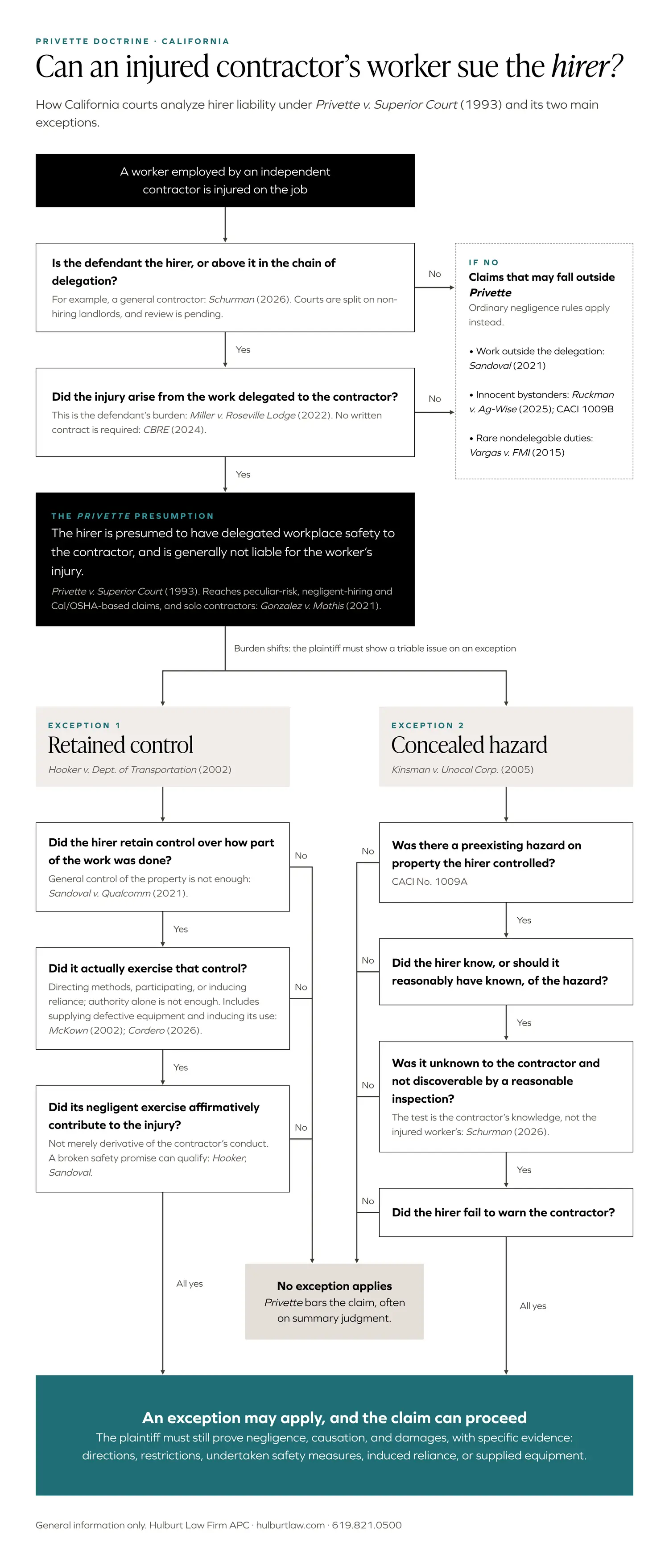
A defendant invoking Privette must establish the factual foundation for the presumption, including the independent-contractor relationship, its entitlement to rely on the delegation, and the connection between the injury and the contracted work. Once that foundation is established, the plaintiff must produce evidence raising a triable issue on an applicable exception. Miller v. Roseville Lodge No. 1293, Loyal Order of Moose, Inc. (2022) 83 Cal.App.5th 825.
A written contract is not essential. Delegation can occur before the parties execute a formal agreement. CBRE v. Superior Court (2024) 102 Cal.App.5th 639.
The Chain of Delegation
The doctrine can protect the direct hirer and higher-tier entities, including a general contractor whose subcontractor hired the injured worker’s employer. A defendant need not always have hired that employer directly. Schurman Family Company TIC v. Superior Court (2026) 122 Cal.App.5th 915.
Landowners present a disputed application of the chain-of-delegation rule. In Schurman, a tenant hired a contractor to install communications equipment on a warehouse roof, and the contractor’s employee fell through a skylight. The court held that the landlord fell within the delegation chain because the lease contemplated the work. By contrast, Ramirez v. PK I Plaza 580 SC LP (2022) 85 Cal.App.5th 252, 265-270, held that a non-hiring shopping-center landlord could not invoke Privette on the facts before it. Schurman expressly disagreed with Ramirez’s hiring-relationship requirement. Schurman, supra, 122 Cal.App.5th 915. A petition for review is pending in the California Supreme Court (No. S298954). Until the Court resolves the issue, the Courts of Appeal are divided on whether a non-hiring landlord may invoke Privette through a chain of delegation.
The chart below maps the analysis courts follow, from the presumption through the two main exceptions.
The Retained Control Exception
The retained-control exception applies when a hirer retains control over part of the independent contractor’s work and negligently exercises that control in a manner that affirmatively contributes to the worker’s injury. Hooker, supra, 27 Cal.4th at p. 202; Sandoval, supra, 12 Cal.5th at pp. 273-278. Three distinct inquiries structure the analysis:
- Retention of Control: The hirer must retain a sufficient degree of authority over the manner in which the contractor performs the entrusted work. The authority must be capable of sufficiently limiting the contractor’s freedom to perform that work in its own manner. General control of the property or of a separate operation is not necessarily control over the contracted work. Sandoval, supra, 12 Cal.5th at pp. 274-275.
- Actual Exercise of Control: The hirer must actually involve itself in the contracted work through direction, participation, induced reliance, or other conduct influencing how the work is performed. Possessing authority to intervene is insufficient without actual exercise. Sandoval, supra, 12 Cal.5th at pp. 276-277.
- Affirmative Contribution: The negligent exercise must contribute to the injury in a manner that is not merely derivative of the contractor’s contribution. Where the contractor’s conduct immediately causes the injury, ask whether the hirer induced that conduct rather than merely failed to prevent it. A hirer can also contribute independently, including through a qualifying failure to perform an undertaken safety measure. Sandoval, supra, 12 Cal.5th at pp. 277-278. The plaintiff must also establish negligence, harm, and causation; these three inquiries are not a substitute for the complete claim.
Passive tolerance of an unsafe condition does not establish affirmative contribution. But “affirmative contribution” does not require an affirmative physical act: an omission may qualify when it falls within the hirer’s retained-control duty. Sandoval, supra, 12 Cal.5th at p. 277; Hooker, supra, 27 Cal.4th at p. 212, fn. 3.
Contractual Delegation of Safety
Contract terms assigning construction means, methods, and safety procedures to the contractor support delegation, but they do not conclusively resolve whether the hirer later exercised control through directions, participation, or induced reliance. Compare the contractual allocation with what the parties actually did. See Sandoval, supra, 12 Cal.5th at pp. 274-278; Brown v. Beach House Design & Development (2022) 85 Cal.App.5th 516.
Conduct That Can Support Retained Control
Negligent Failure to Perform a Promised Safety Measure
A hirer’s promise to undertake a specific safety measure, followed by a negligent failure to perform it, can support liability. Evidence of induced reliance can show how the undertaking influenced the contractor’s work. Identify the measure undertaken, who relied on it, and how the omission contributed to the injury. Hooker, supra, 27 Cal.4th at p. 212, fn. 3; Sandoval, supra, 12 Cal.5th at pp. 276-277.
Active Involvement and Restrictions on Work Methods
Actual exercise of control may be shown by directing the manner or methods of the contractor’s work, interfering with the contractor’s safety decisions, requesting that the contractor use the hirer’s defective equipment, contractually prohibiting a necessary safety precaution, or reneging on a promise to remedy a known hazard. Gonzalez, supra, 12 Cal.5th at p. 47.
The source of the work method matters. In Alvarez v. Seaside Transportation Services LLC (2017) 13 Cal.App.5th 635, the worker inspected a shipping-container line in a particular manner because of his own habit and custom, without direction from the hirer; the court found no actual exercise of control. Conversely, plans and specifications that negligently require inherently dangerous work methods may support liability. Lopez v. C.G.M. Development, Inc. (2002) 101 Cal.App.4th 430.
Furnishing Defective or Unsafe Equipment
Supplying unsafe equipment and inducing its use can support liability; merely making equipment available may not. Compare McKown with Miller’s permissive scaffold use, discussed below.
In McKown v. Wal-Mart Stores, Inc. (2002) 27 Cal.4th 219, 223-225, Wal-Mart requested that a contractor use its forklifts whenever possible to install a sound system. The request was not a command. The supplied forklift lacked a chain securing the elevated platform, and the worker fell when the platform disengaged. The Supreme Court affirmed liability based on the hirer’s negligent provision of unsafe equipment and its affirmative contribution to the injury. The distinction from merely permitting equipment use is the hirer’s involvement in supplying and inducing use of the defective equipment. See also CACI No. 1009D.
In Browne v. Turner Construction Co. (2005) 127 Cal.App.4th 1334, 1345-1346, the court reversed summary judgment where the evidence supported a theory that the defendants supplied means and methods of work, including safety systems, then withdrew them before the work was finished, leaving the worker without a safe means to complete it. The case concerns an undertaking followed by withdrawal, rather than a general failure to furnish safer equipment.
Site Security, Access, and Logistics
In Degala v. John Stewart Co. (2023) 88 Cal.App.5th 158, the evidence showed the hirer’s involvement in weekly security discussions and site security measures, including fences, guards, and cameras, as well as directions restricting overtime, work after sundown, and where workers ate lunch. The Court of Appeal reversed summary judgment because the evidence raised triable issues about retained control and its exercise in connection with the attack on the demolition worker. It did not finally determine liability.
Conduct That Has Not Been Enough
Passive Permission and General Directions to Work
Awareness of a hazard and a general instruction to continue working do not necessarily establish affirmative contribution. In McCullar v. SMC Contracting, Inc. (2022) 83 Cal.App.5th 1005, the general contractor knew of ice and told the worker to “go back to work.” It did not instruct him to use a ladder on the ice or dictate how to address the hazard. The subcontractor remained free to choose its own precautions, and the retained-control exception did not apply.
In Hooker, Caltrans permitted construction traffic to use an overpass where the decedent operated a crane. The operator retracted the crane’s outriggers to allow traffic to pass, then attempted a lift without re-extending them. The Supreme Court held that Caltrans’s awareness of the practice and failure to stop it did not establish affirmative contribution: Caltrans had not directed the crane operation. Hooker, supra, 27 Cal.4th at pp. 202-203, 214-215.
The Hirer’s Own Work Affecting Site Conditions
In Cordero, the general contractor’s crew dewatered the area before a rebar subcontractor’s worker climbed a column, and the worker slipped on mud. The court affirmed summary judgment for the general contractor: there was no evidence it directed how the subcontractor performed its work, and at most it permitted an unsafe condition. Cordero, supra, 119 Cal.App.5th 1105.
Permitting Use of the Hirer’s Equipment
Permission to use equipment differs from directing or inducing its use. In Miller, the owner allowed the contractor to use an unsafe scaffold but did not ask, direct, or require it to do so. That permission did not establish actual exercise of control. Miller, supra, 83 Cal.App.5th 825. Compare the hirer-supplied equipment in McKown, discussed above.
Known Premises Hazards
Knowledge of a premises hazard does not itself shift responsibility back to the landowner. Gonzalez held that the contractor’s responsibility to perform safely encompassed known roof hazards, even where reasonable precautions could not protect against them. The landowner’s failure to remedy the condition did not itself establish negligent exercise of retained control. Gonzalez, supra, 12 Cal.5th 29.
Failing to Equip a Building with Safety Hardware
Missing safety hardware does not alone establish affirmative contribution. In Delgadillo v. Television Center, Inc. (2018) 20 Cal.App.5th 1078, a window washer died after rappelling from a roof without adequate structural anchors. The owner’s failure to provide statutory anchors was a passive omission; the contractor chose the work method without direction, consultation, or notice to the owner. The court rejected the retained-control theory.
Mere Possession of Keys or Authority to Move Equipment
Control over equipment is not necessarily control over the contractor’s work. In Horne v. Ahern Rentals, Inc. (2020) 50 Cal.App.5th 192, the hirer held the keys and sole authority to move a forklift. But it was never asked to move the forklift or stabilize its boom, and it did not direct the tire-changing operation. Those facts did not establish affirmative contribution.
Scheduling, Coordination, and Multiple Trades
Scheduling alone does not establish affirmative contribution. In Brannan v. Lathrop Construction Associates, Inc. (2012) 206 Cal.App.4th 1170, 1178-1180, the general contractor allowed another trade’s scaffold to remain while masonry work proceeded. It did not direct the injured worker to climb over the scaffold or dictate his route to the work area. The court affirmed summary judgment for the general contractor. The relevant distinction is between coordinating trades and directing how a contractor performs or accesses its work.
By contrast, where the project agreements or actual practices reserve trade sequencing and prerequisite inspections to the general contractor, identify precisely what it undertook and what direction it gave the next trade. A retained-control theory may connect reserved sequencing authority, an undertaking or practice of inspection, a direction to proceed, and the worker’s encounter with the hazard.
The unfinished-gate case discussed below illustrates this theory of retained control.
The Concealed Hazards Exception
The concealed-hazard exception addresses a landowner-hirer’s failure to disclose a concealed premises hazard. Kinsman, supra, 37 Cal.4th at pp. 674-675. Its central requirements are:
- The landowner knew or reasonably should have known of a preexisting hazardous condition on the property.
- The contractor neither knew nor could reasonably have discovered the hazard through an inspection appropriate to its work.
- The landowner failed to warn the contractor of the hazard.
The relevant inquiry is ordinarily whether the contractor knew or reasonably could have discovered the hazard, not whether the injured employee personally knew of it. Schurman, supra, 122 Cal.App.5th 915, fn. 3.
The plaintiff must also establish harm and causation. CACI No. 1009A addresses the defendant’s ownership, lease, occupancy, or control of the property and requires a causal connection between the defendant’s conduct and the injury. Kinsman, supra, 37 Cal.4th at pp. 674-675; CACI No. 1009A.
What “Concealed” Means
A hazard may be concealed because its physical existence is hidden or because its dangerous nature is not reasonably apparent. The question is whether the contractor knew or could reasonably discover the danger without disclosure. Kinsman, supra, 37 Cal.4th at pp. 675, 678.
Conditions That Can Qualify
Asbestos Dust Known Only to the Landowner
A visible substance can present a concealed danger. Kinsman concerned a scaffolding contractor’s employee exposed to airborne asbestos dust at a refinery. The Supreme Court explained that visible dust could qualify if its hazardous nature was known to the landowner but neither known nor reasonably apparent to the contractor. The opinion articulated the governing standard; it did not establish that every asbestos exposure satisfies it. Kinsman, supra, 37 Cal.4th 659.
Collapsing Structural Wall vs. Defective Roof Under Repair
The scope of the contractor’s work also defines the inspection expected of it. Kinsman used a hypothetical roof repair to illustrate the distinction: inspection for structural defects in the roof being repaired falls within the roofing work, while inspection for an unrelated hidden defect in a separate wall may not. Kinsman, supra, 37 Cal.4th 659.
If the worker’s ladder rests against that separate wall and the wall collapses, a defect unrelated to the roof repair and not reasonably discoverable by the contractor may support concealed-hazard liability. The hypothetical illustrates the limits of delegated inspection duties; it is not a holding about an actual wall-collapse claim. Kinsman, supra, 37 Cal.4th 659.
Conditions That Do Not Qualify
Unlocked Wheels on a Scaffold
A condition discoverable by a reasonable inspection is not concealed. In Miller, a worker fell from a wheeled scaffold in a dark room. Checking whether the scaffold moved before climbing it, or providing adequate lighting, would have revealed the unlocked wheels. The court rejected the concealed-hazard theory as a matter of law. Miller, supra, 83 Cal.App.5th 825.
Plywood Ceiling Panel in a Crawl Space
Both the landowner’s knowledge and the contractor’s ability to discover the condition matter. In Blaylock v. DMP 250 Newport Center, LLC (2023) 92 Cal.App.5th 863, a technician fell through a plywood panel in a crawl space. There was no evidence the owner knew or should have known the screwed-shut panel posed a hazard. A reasonable inspection also would have revealed that the panel was attached below the joists as a ceiling, rather than above them as a supporting surface. The court rejected the Kinsman theory.
Claims That May Fall Outside Privette
Work Outside the Delegation
The presumption concerns the work entrusted to the contractor, but the fact that a particular operation was outside the contractor’s scope does not automatically establish liability. Sandoval explained that authority over noncontract work does not create a retained-control duty unless it affects authority over the contracted work. It expressly left open the situation in which the hirer performs noncontract work while the contractor simultaneously performs the contracted work. Identify the asserted independent duty and the conduct that breached it, as well as the causal connection to the injury. Sandoval, supra, 12 Cal.5th at pp. 274-275, 279 & fn. 8.
Ray v. Silverado Constructors (2002) 98 Cal.App.4th 1120 shows how this category overlaps with retained control. The court found triable issues concerning a road-closure decision reserved to the hirer. Sandoval subsequently treated Ray as a retained-control example involving a restriction on the contractor’s ability to take a crucial safety measure. Ray therefore supports a fact-specific Hooker analysis, not a categorical exception for every safety decision the hirer keeps. Sandoval, supra, 12 Cal.5th at pp. 275, 277; Ray, supra, 98 Cal.App.4th at pp. 1133-1134.
Innocent Bystanders
Privette’s limitation exists because of the relationship among the hirer, the contractor, and the contractor’s worker. A person injured by the contractor’s work who is not in that relationship is outside it. In Ruckman v. Ag-Wise Enterprises, Inc. (2025) 117 Cal.App.5th 571, neighbors were burned when an excavation contractor struck a high-pressure gas line, and the court held that “Privette and its progeny are thus not directly applicable.” Retained-control principles still define the hirer’s duty to third parties, but “an innocent bystander need not show the hirer affirmatively contributed to their injury.” A bystander must prove that the hirer retained control over any part of the contractor’s work, failed to exercise that control with reasonable care, and was a substantial factor in causing the injury. Because CACI No. 1009B is written for a contractor’s employee, the trial court gave a special instruction on the bystander standard, and the Court of Appeal approved it.
Nondelegable Duties
SeaBright presumes delegation of statutory and regulatory duties unless the law shows an intent to preclude it. Vargas v. FMI, Inc. (2015) 233 Cal.App.4th 638 found that intent in the federal motor carrier regulations, which keep a licensed carrier responsible for the operation of leased equipment, and reversed summary judgment for a motor carrier sued by an independent-contractor team driver. That result is exceptional. Cordero shows that ordinary Cal/OSHA safety orders do not supply the same route.
Real Case Examples
Conor Hulburt represented the families of two workers killed on construction projects where the general contractor raised Privette. Both matters settled. They illustrate theories based on retained safety responsibilities and specific directions to a subcontractor’s crew.
An Unstable Wall
The first case arose on a large commercial construction project in San Diego County with a general contractor and many subcontractors. The contracts, safety plans, site plans, and other project documents retained the general contractor’s control and responsibility over the structural stability of existing structures. Homes lined the perimeter of the site, separated from it by fences and walls. One of those walls was a large masonry block wall. The general contractor inspected it and brought in a structural engineer, who advised that the wall could be unstable and recommended significant shoring. The general contractor decided not to shore the wall. Later in the job, the general contractor asked subcontractor workers already on the site to dig a trench along the wall. That trench was not part of the subcontractor’s contract. The trench undermined the wall, which collapsed onto a worker in the trench and killed him.
The plaintiff advanced two grounds for overcoming the Privette defense:
Retained control: the contracts, safety plans, site plans, and other project documents placed control and responsibility for existing structures’ stability with the general contractor. It commissioned the engineering evaluation, made the shoring decision itself, and then directed trench work along the wall. The fact that the particular trench was outside the subcontract’s stated scope sharpened the focus on the general contractor’s request and the work it directed the crew to perform. The plaintiff’s theory relied on the combination of those acts and their effect on the trenching operation, rather than the safety provision or failure to shore standing alone.
A concealed hazard: the wall was visible, but the engineer had warned the general contractor about its instability. The subcontractor did not know about that warning. The plaintiff’s theory was that the undisclosed, preexisting instability was not reasonably discoverable by the subcontractor. Because the defendant was a general contractor rather than the owner, the theory depended on its control of the site, and on separating the wall’s preexisting instability from the risk the trench itself created.
The general contractor paid a significant settlement to the worker’s family.
An Unfinished Gate
The second case arose on a commercial project where the general contractor’s prime contract with the owner and subcontract with the painter established its duties regarding trade sequencing. Deposition testimony established that safe sequencing required the general contractor to inspect the preceding trade’s work before directing the next trade to begin. One subcontractor installed a large, heavy steel gate. Before sending in the painting subcontractor, the general contractor was required to inspect the gate. It did not. An inspection, particularly one done with the subcontractor that installed the gate, would have shown that the gate was unfinished and not fully attached, a condition the painters had no reason to see. The general contractor nonetheless told the painters to pull the gate out and paint it. Acting on that instruction, they pulled the gate out, and it tipped over and killed one of the painters.
Framed solely as a failure to inspect, the claim invites the response that the general contractor merely failed to prevent harm. Brannan also supplies a defense to a theory based only on scheduling. The plaintiff’s retained-control theory instead connected three propositions:
Retained control. The prime contract and painting subcontract established the general contractor’s sequencing duties. Deposition testimony confirmed its inspection duties as part of safe sequencing.
Actual exercise. The general contractor directed the painters to pull out the gate and paint it before performing the inspection required as part of safe sequencing.
Affirmative contribution. The painters encountered the hazard because they complied with the general contractor’s specific instruction to pull out the gate and paint it. The plaintiff’s theory connected that instruction to the act that caused the gate to fall, rather than resting solely on a failure to inspect. The contractual duties and deposition testimony supplied the context for the general contractor’s direction.
The general contractor paid a significant settlement to the worker’s family.
Privette at Summary Judgment
Privette cases are frequently decided at summary judgment. Evidence that an owner or general contractor controlled the project, enforced safety rules, conducted inspections, coordinated trades, or possessed authority to stop unsafe work may establish retained control, but that alone is usually not enough. The plaintiff must identify evidence that the hirer actually exercised retained control and that its negligent exercise affirmatively contributed to the injury. Gonzalez, supra, 12 Cal.5th at p. 42; Sandoval, supra, 12 Cal.5th at pp. 276-278.
The critical evidence tends to be specific: a direction about how the work should be performed, a restriction on a safety precaution, an undertaken safety measure, induced reliance, supplied defective equipment, or some other act or omission within the hirer’s retained-control duty. The analysis should connect that conduct to the injury-producing event rather than rest on a generalized failure to supervise or keep the jobsite safe.
On summary judgment, the question is not merely whether the hirer had safety responsibilities. It is whether admissible evidence permits a reasonable inference that the hirer exercised retained control in a way that contributed to the worker’s injury.
A Practical Framework
When evaluating a third-party construction case, ask these questions in order:
- Who hired whom? Where does each defendant fit in the asserted chain of delegation?
- What work was entrusted to the contractor?
- What conduct actually caused the injury, and who directed or induced it?
- What safety responsibility accompanied that delegation?
- What authority over the contractor’s manner of work did the owner or general contractor retain?
- Did it actually exercise that authority through directions, participation, restrictions, or induced reliance?
- How did its negligent exercise of control affirmatively contribute to the injury, beyond merely failing to prevent the contractor’s conduct?
- Was there a preexisting concealed hazard, and did the defendant own, lease, occupy, or control the premises?
- Did the defendant know or have reason to know of that hazard?
- Did the contractor know of it, or could a reasonable inspection within the scope of its work have disclosed it?
- Did the defendant fail to warn, and did that failure contribute to the injury?
- What admissible evidence supports each required element, and which contrary facts and authorities must the plaintiff address?
Hulburt Law Firm: Referrals and Co-Counsel
Hulburt Law Firm works with referring and co-counsel attorneys on third-party construction injury and wrongful death cases in San Diego County, including cases where Privette is the central defense. To discuss a case, call (619) 821-0500 or use the firm’s contact form.
Request a Free Case Review
Simply fill out the form or call 619.821.0500 to receive a free case review. We’ll evaluate what happened, your injuries, and potential defendants to determine how we can best help you.

Hulburt Law Firm handles serious personal injury and wrongful death cases throughout San Diego County.


