
Proving Fault in San Diego Distracted Driving Accidents
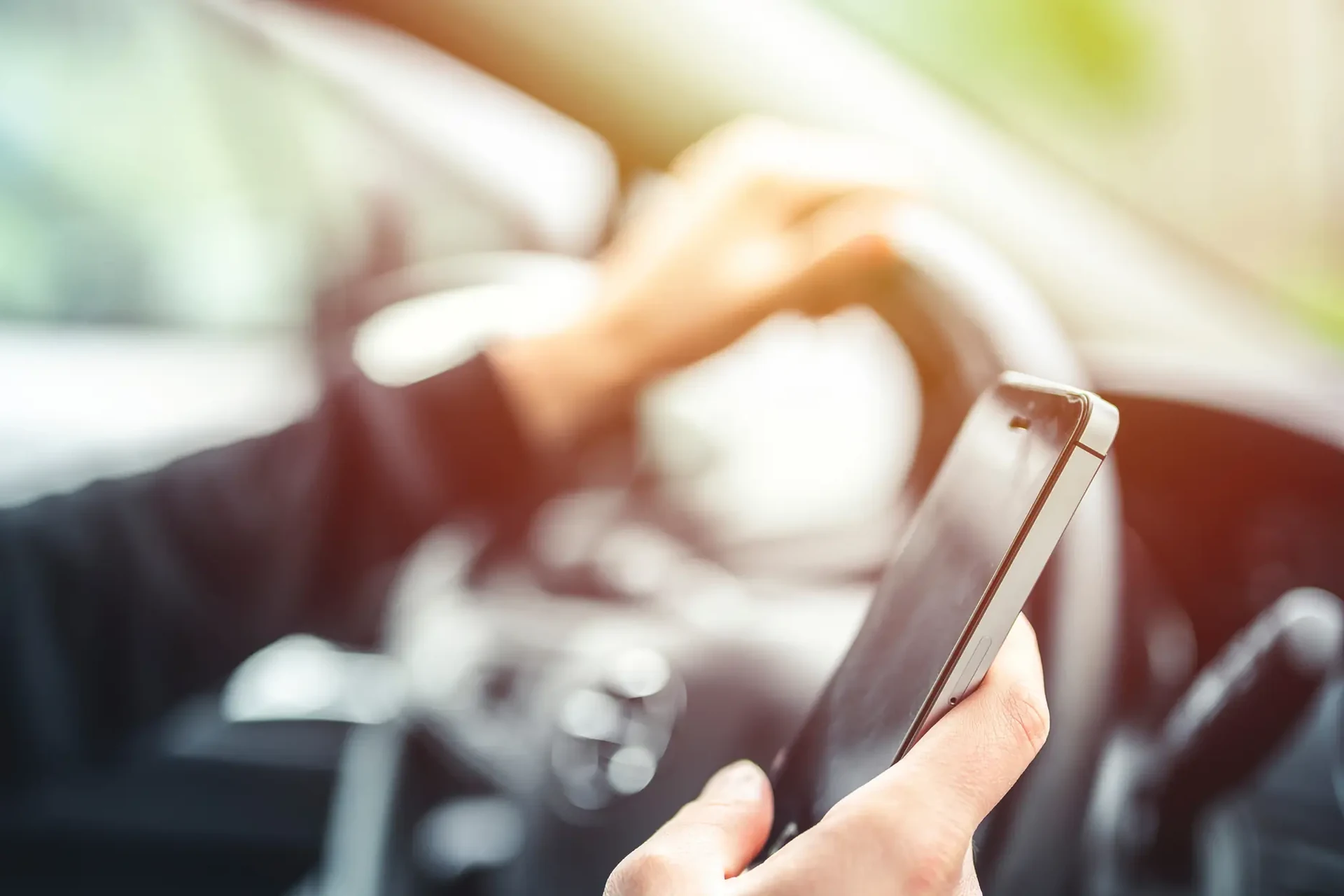
Distracted drivers rarely admit it, so a distracted-driving case is usually built from phone records, vehicle data, and witness testimony. This article explains what each source can show, how it is obtained, how California law turns proof of distraction into proof of fault, and why the evidence has to be preserved quickly.
Hulburt Law Firm represents people who suffered serious injuries in San Diego car accidents, including crashes caused by drivers on their phones. The National Highway Traffic Safety Administration reports that crashes involving distracted drivers killed 3,208 people and injured 315,167 more on U.S. roads in 2024.
What Is Distracted Driving?
Distracted driving is any activity that pulls a driver’s attention away from the road. Safety researchers group it into three types:
- Visual: eyes off the road, such as glancing at a text, a map, or a child in the back seat.
- Manual: hands off the wheel, such as holding a phone, eating, or reaching for something.
- Cognitive: mind off driving, such as a heated phone call.
Texting combines all three. Handheld calls, social media, typing a destination into a navigation app, and watching video are among the most common causes of car accidents. Unlike daydreaming or reaching for a dropped item, phone use often leaves a time-stamped record in the phone, with the carrier, and sometimes in the car, so most of this article focuses on that proof. If a distracted driver hit you while you were walking, our guide to distracted driving and pedestrian accidents covers the issues specific to pedestrians.
How to Prove Driver Distraction
Driver distraction is proven with evidence, and the strongest cases rely on several sources that point the same way. A carrier log showing a text sent at 4:12:31 p.m. means more when the car’s black box shows no braking before impact at 4:12:35 and a witness saw the driver looking down. The sections below cover the most common types of evidence and how each is obtained.
How evidence is obtained depends on who has it and whether a lawsuit has been filed:
- Before a lawsuit. The police report can be obtained. Information from the driver can be requested (such as cell phone records), but production is voluntary. The insurance company will typically make the vehicle available for inspection.
- After a lawsuit. Once a lawsuit is filed, the driver can be asked written questions and required to produce answers and documents and make the phone and the car available for inspection (Code of Civil Procedure § 2031.010). If the driver refuses, the court can be asked to order it.
- Subpoenas. Once a lawsuit is filed, records held by third parties such as a phone carrier, a business with a security camera, or a vehicle manufacturer are obtained by subpoena.
- Company witnesses. A company can be required to produce its person most qualified to testify under oath on specified topics (Code of Civil Procedure § 2025.230), such as an employer’s phone policies or what a carrier’s time stamps mean.
Cell Phone Carrier Records
Wireless carriers keep records of calls, texts, and data sessions. Depending on the carrier and the type of record, they may show the numbers called or texted, the start times and durations, and which cell tower handled the connection. Ordinary carrier usage records generally show communication activity rather than message content or call audio. The federal Stored Communications Act, 18 U.S.C. § 2702, generally restricts disclosure of stored communication content, subject to consent and other statutory exceptions.
There are three ways to get them:
- From the driver. A request for production can ask for the driver’s own call and text records for the time around the crash. Carriers generally let account holders view and download usage records through the carrier’s website or app.
- From the carrier, with the driver’s consent. In California, a subpoena for a customer’s records from a phone company that is a public utility is not valid unless it includes the customer’s signed consent (Code of Civil Procedure § 1985.3, subdivision (f)). With a signed authorization, the carrier can produce certified records. Those records may be admitted at trial if the business-records foundation under Evidence Code § 1271 and other requirements are met. Certification helps establish that foundation but does not resolve every objection.
- From the police. In a serious crash, investigators may obtain the driver’s phone records or download the phone with a warrant. That work may be described in the police report or kept in the investigation file (see Criminal Case Evidence below).
The driver can object on privacy grounds. The court then weighs the driver’s privacy against your need for the records under the test in Williams v. Superior Court (2017) 3 Cal.5th 531. A request limited to a short window around the crash is easier to justify under that test than a demand for days of records.
Carrier records also have limits the defense will point out. They show that the phone sent or received something, not who was holding it or whether the driver looked at it. Messages sent through apps such as iMessage or WhatsApp travel as data, so they may appear only as a data session, if at all. That is why carrier records are usually paired with the phone itself and other evidence.
Cell Phone Forensic Download
A forensic download (also called an extraction) copies data from the phone itself. Depending on the phone, its settings, and the tool used, it may show which app was open, when the screen was unlocked, when messages were typed, sent, and read, and whether the phone was moving with the car. That can fill gaps in the carrier records, such as activity in a messaging app the carrier log does not capture.
In a civil case, the request goes to the driver as a demand to inspect the phone under section 2031.010. Because a phone holds so much private information, a request is easier to justify when it is tailored: a neutral forensic examiner, a short window around the crash, and only data that bears on distraction. A demand for a full copy of the phone faces a harder privacy objection under Williams.
Police face their own limits. Under the California Electronic Communications Privacy Act, Penal Code § 1546.1, a government agency generally needs a warrant or the specific consent of the phone’s possessor to access data on the device. In fatal and serious-injury crashes, investigators may seek one, and their extraction report, if it can be obtained, may show what the phone was doing at the time of the crash.
Vehicle Infotainment and Black Box Data
The car itself may hold two kinds of useful records:
- Infotainment system. When a phone pairs with the car by Bluetooth, Apple CarPlay, or Android Auto, the infotainment unit may store call logs, text messages, contacts, and the times the phone connected, depending on the vehicle and settings. A forensic examination of the unit may recover some of that data even after it was deleted from the phone.
- Event data recorder. Often called the black box, the event data recorder may store speed, braking, steering, and seatbelt use in the seconds before a crash. It does not show phone use, but it can show the kind of driving that distraction explains, such as a car that never slowed or swerved before hitting something in plain view. Vehicle Code § 9951 limits who may retrieve that data; for purposes of obtaining evidence in a civil case, access generally requires the registered owner’s consent or a court order.
Both are obtained through a demand to inspect the vehicle or a court order, and both depend on the car being preserved. Some manufacturers also collect driving data remotely through connected-car services; that data is requested from the manufacturer by subpoena.
Commercial Vehicle Data
When the driver was working at the time of the crash, in a delivery van, a truck, a bus, or a company car, there is often far more data than a personal vehicle holds. Many fleets use telematics systems that record and transmit vehicle data as the vehicle moves. Depending on the company and the system, the employer may have:
- GPS tracking. Location, speed, and route history, often recorded every few seconds, along with alerts for hard braking, sharp swerves, and speeding.
- Fleet cameras. Road-facing and driver-facing cameras that save video clips automatically when they detect a hard brake or collision. Some systems are designed to flag phone use or eyes-off-the-road behavior.
- Electronic logging devices. Many interstate truck and bus drivers record their hours of service electronically, and motor carriers must keep those records for at least six months (49 C.F.R. § 395.8). The logs show whether the driver was on duty, how long they had been driving, and where the vehicle was.
- Dispatch and messaging records. Delivery apps, dispatch messages, and in-cab tablets can show whether the company was sending the driver messages or route changes when the crash happened.
This data is usually held by the company rather than the driver, so it is requested from the employer in discovery or, if the company is not a party, by subpoena, and a person-most-qualified deposition can explain what the system recorded. Telematics platforms may overwrite data on a set schedule, so the employer belongs on the preservation letter as soon as a work vehicle is identified. Federal rules also bar commercial drivers from texting or using a handheld phone while driving a commercial motor vehicle, and bar motor carriers from allowing or requiring it (49 C.F.R. § 392.80; 49 C.F.R. § 392.82). Our guide to FMCSA regulations in California truck accident cases covers those rules in more detail.
Witnesses
Witness testimony connects the records to what happened on the road:
- Eyewitnesses and passengers who saw the driver holding or looking at a phone, or saw the car drift before the crash.
- The person on the other end, identified from the carrier records, who can be deposed about the conversation and its timing.
- Responding officers, including body-worn camera footage. A driver’s own statement at the scene, such as “I just looked down for a second,” can be offered against them under Evidence Code § 1220.
Video from businesses, homes, buses, and dash cameras may show the driver’s head position or the car’s path. How these pieces fit together is part of how fault is determined in a car accident.
Criminal Case Evidence
When a distracted driver kills or seriously injures someone, a criminal investigation may run alongside the injury claim, and the investigation file may hold a phone download, carrier records, witness interviews, and a crash reconstruction. Getting it often takes time and a legal process of its own.
- The collision report comes first. Under Vehicle Code § 20012, injured people and their attorneys can obtain the collision report, including driver and witness statements.
- The investigation file is harder to get. The California Public Records Act does not require police to disclose investigation files (Government Code § 7923.600), and that exemption does not end when the investigation or prosecution ends (Williams v. Superior Court (1993) 5 Cal.4th 337). Prosecutors do not release evidence or investigation files to victims or civil plaintiffs while the criminal case is pending, so the civil case may need to wait for the criminal case to resolve. Even then, getting the file may require a subpoena or another legal process, which the agency can oppose.
- The driver may refuse to testify. A driver facing prosecution can invoke the Fifth Amendment privilege against self-incrimination at a civil deposition. In Pacers, Inc. v. Superior Court (1984) 162 Cal.App.3d 686, a San Diego case, the Court of Appeal held that the civil court should not penalize defendants for invoking the privilege and should instead consider postponing their depositions.
How the criminal case ends determines what it can prove in the civil case. A conviction for a Vehicle Code violation, such as a phone ticket, does not settle any issue in the civil case (Vehicle Code § 40834). A final judgment of conviction for a crime punishable as a felony, by contrast, may be offered in the civil case to prove the facts essential to that judgment without being barred as hearsay (Evidence Code § 1300). Waiting on the criminal case does not pause the civil filing deadline, which is covered in our guide to the deadline to file a car accident claim.
Expert Analysis
Records and witnesses show what happened; experts explain how the pieces fit together and whether the distraction caused the crash. Three kinds are common in these cases:
- Accident reconstructionist. Uses the scene evidence, vehicle damage, and black box data to determine speeds, positions, and timing in the seconds before impact.
- Digital forensic examiner. Extracts and interprets data from the phone and the car, and reconciles the time stamps. The carrier, the phone, the black box, and any video each keep their own clock, so lining them up is part of showing that the phone use and the crash happened together.
- Human factors expert. Studies how people perceive and react to what is in front of them. This expert can explain how long a driver needs to notice a hazard and respond, and whether an attentive driver in the same position would have had time to avoid the crash. That testimony goes to causation. Whether the driver was looking at the phone is shown by the phone data and the witnesses.
Expert testimony is not admitted automatically. Under Evidence Code § 801, an expert’s opinion must assist the jury on a subject beyond common experience and rest on the kind of information experts reasonably rely on, and the judge may exclude opinions that are speculative (Sargon Enterprises, Inc. v. University of Southern California (2012) 55 Cal.4th 747).
Cell Phone Laws and Negligence Per Se
Three Vehicle Code sections restrict phone use behind the wheel:
- Handheld calls: under California Vehicle Code § 23123, a driver may not use a wireless phone unless it is set up for hands-free listening and talking.
- Holding and operating any device: Vehicle Code § 23123.5 bars driving while holding and operating a phone or other electronic wireless device unless it is voice-operated and hands-free. A phone mounted on the dashboard or windshield may be used only with a single tap or swipe.
- Drivers under 18: Vehicle Code § 23124 bars drivers under 18 from using a phone while driving, even hands-free, except for emergency purposes such as a call to law enforcement, a health care provider, the fire department, or another emergency service.
In 2025 the Court of Appeal held that holding a phone to view a navigation app is “operating” it under section 23123.5, even without typing or scrolling (People v. Porter (2025) 111 Cal.App.5th 927). As a result, most handheld use while driving now violates section 23123.5.
A violation can help prove fault through a rule called negligence per se. Instead of arguing in general terms that the driver was careless, you show they broke a safety law, which can create a presumption of negligence. Under California Evidence Code § 669, the driver is presumed negligent if you prove:
- Violation. The driver violated the statute.
- Causation. The violation was a substantial factor in causing your injury.
- Type of harm. Your injury is the kind of harm the statute was designed to prevent.
- Protected class. You are among the people the statute was meant to protect.
The judge decides the last two, and for the phone laws they are rarely disputed. The contest is usually over violation and causation, which is where the evidence above comes in. Once the presumption applies (CACI No. 418), the driver can still try to rebut it by proving the violation was excused, for example because they faced an emergency they did not cause or could not obey the law despite using reasonable care (CACI No. 420).
A phone-law violation is not the only route to liability. A driver can be negligent even when their phone use was legal, such as a hands-free call that drew their attention away from traffic, because every driver must use reasonable care (CACI No. 401). CACI No. 418 preserves that path: if the jury finds no violation, or that the violation was not a substantial factor, it must still decide whether the driver was negligent under the ordinary standard. For how this fits the broader burden of proof, see how to prove liability in a California personal injury case.
Timing also affects whether the phone evidence reaches the jury. Under Evidence Code § 352, a judge may exclude evidence whose value in proving a point is substantially outweighed by the risk of undue prejudice, confusing the issues, or misleading the jury. A text sent 20 minutes before the crash says little about whether the driver was watching the road at impact, and a judge may exclude it on that basis. Activity close to the moment of impact has a stronger connection to the crash and a better chance of being admitted, though the ruling depends on the facts. Getting the records admitted also requires a proper foundation, covered in our guide to how to authenticate evidence in California.
Evidence Preservation
Much of the evidence in a distracted-driving case can disappear quickly. Carriers purge detailed records on their own schedules, phones are replaced or reset, vehicle data can be lost when a car is repaired or scrapped, and security video may record over itself within days.
A preservation letter is a written demand, sent as early as possible, telling the driver, their insurer, their employer, and the owner of the vehicle to keep specific evidence intact: the phone and its data, the account records, the vehicle and its modules, and any video. Separate letters go to businesses with cameras facing the scene, and to the insurer holding a totaled car before it goes to salvage auction.
A preservation letter documents that the recipient was told which evidence to keep. If that evidence is later lost or destroyed, the letter may help establish notice and support a request for appropriate discovery sanctions. In Victor Valley Union High School Dist. v. Superior Court (2023) 91 Cal.App.5th 1121, sanctions were available for video erased through negligence after the duty to preserve it arose.
Intentional concealment or destruction may also support an instruction allowing the jury to infer that the missing evidence would have been unfavorable (Evidence Code § 413; CACI No. 204). The available remedy depends on the circumstances.
California generally does not recognize an independent tort claim for spoliation of evidence (Cedars-Sinai Medical Center v. Superior Court (1998) 18 Cal.4th 1), so these remedies are usually pursued inside the injury case itself. Preservation is among the first steps in the car accident lawsuit process.
Hulburt Law Firm
If you or someone you love was seriously hurt by a distracted driver in San Diego, Hulburt Law Firm can send preservation demands right away, pursue the phone, vehicle, and criminal-case evidence, and build a timeline of what the driver was doing in the moments before impact. Call (619) 821-0500 or message us through our contact form for a free, confidential case review.
Request a Free Case Review
Simply fill out the form or call 619.821.0500 to receive a free case review. We’ll evaluate what happened, your injuries, and potential defendants to determine how we can best help you.

Hulburt Law Firm handles serious personal injury and wrongful death cases throughout San Diego County.


