
Distracted Driving and Pedestrian Accidents in San Diego
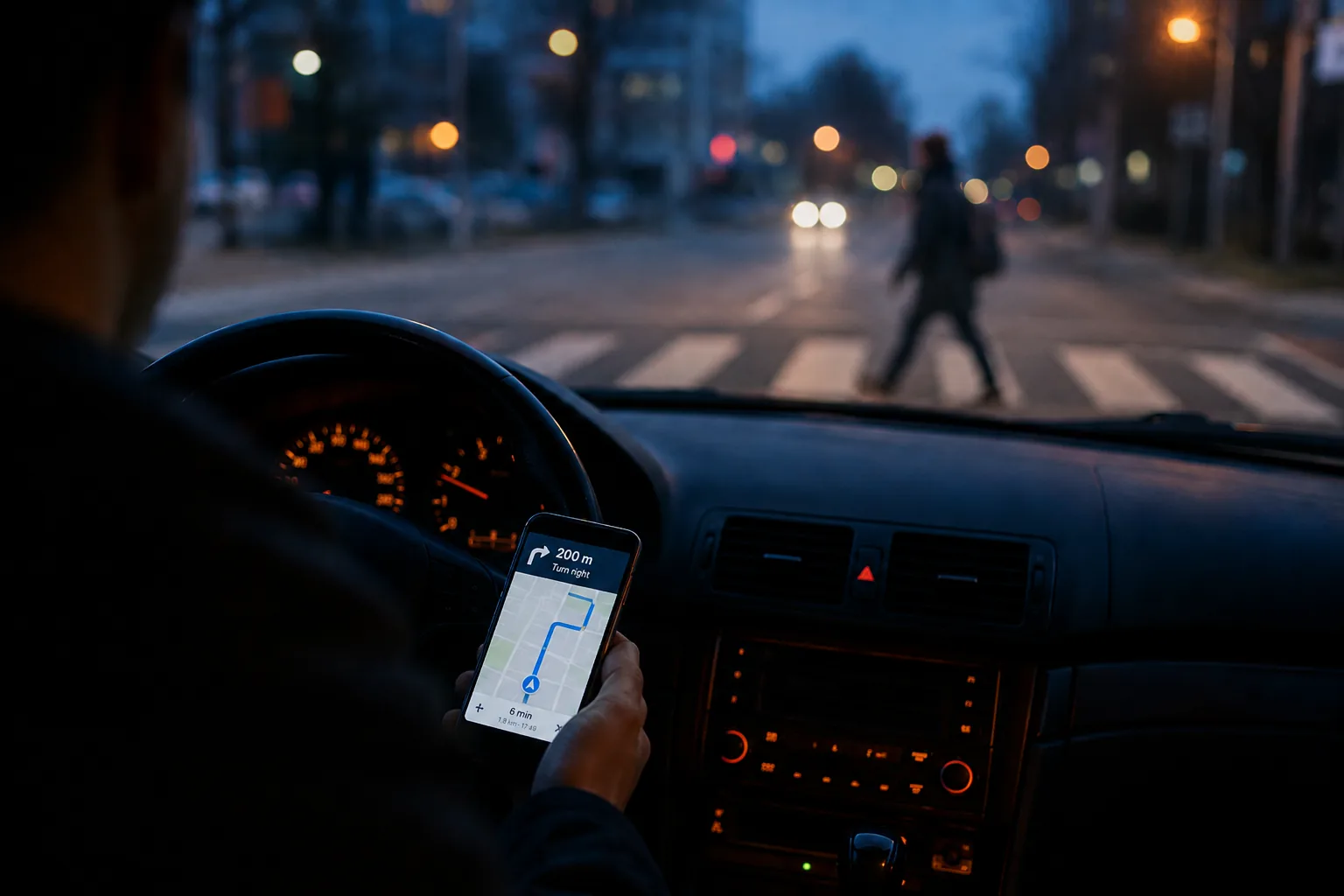
Most San Diego drivers who hit a pedestrian were doing something with a phone when it happened. They will not admit it, and the police report will not say it, but the proof is usually still there, sitting in the driver’s call log, text history, or the navigation app they were tapping when they should have been looking at the crosswalk. The case is winnable. It just has to be built around evidence the defense would rather you never ask for.
This guide explains what California law treats as distracted driving, why distracted drivers hit pedestrians in such consistent patterns, the evidence that proves the driver was on a phone, and the deadlines and preservation steps that decide whether that evidence still exists by the time a lawyer gets involved. If you or a family member was struck by a distracted driver, a San Diego pedestrian accident attorney can move quickly to preserve the proof while you focus on recovery.
The Short Version
If you only have a minute, here is what matters most:
- California bans handheld phone use behind the wheel. Holding a phone, texting, scrolling, or watching a screen the driver can see is illegal under several Vehicle Code sections.
- “Distracted” is more than the phone. It also covers eating, grooming, infotainment screens, navigation tapping, passenger conversation, and anything that takes a driver’s eyes, hands, or mind off the road.
- The proof is mostly in the driver’s phone, not the police report. Phone records, app activity, and vehicle telematics show what the driver was actually doing.
- A citation helps but does not win the case. Plaintiffs still have to prove the distraction caused the crash. That is built through reconstruction, witness testimony, and the driver’s own digital trail.
- Evidence disappears fast. Phone carriers may overwrite location data within 30 to 60 days, and vehicle event-data recorders cycle even faster. A preservation letter has to go out in days, not months.
- Do not give a recorded statement. The driver’s insurer will call you while you are still in pain. Talk to a lawyer first.
What California Law Calls Distracted Driving
California treats distracted driving as several different violations, not one. The three sections plaintiffs’ lawyers cite most often are the handheld ban, the texting ban, and the video-screen rule.
The handheld ban. Under California Vehicle Code section 23123, a driver may not use a wireless telephone unless the call is hands-free. Holding the phone to an ear, dialing by hand, scrolling, or even looking at the screen while operating the car violates the statute. The legislature wrote it broadly on purpose; a driver does not have to be on an active call to be in violation.
The texting and electronic-message ban. Vehicle Code section 23123.5 bans writing, sending, or reading text messages, emails, or any electronic communication while driving. The statute reaches well beyond classic text messaging. Reading a navigation prompt, scrolling social media, swiping a music app, and tapping out an email all qualify. The only safe-harbor uses are voice-activated and hands-free operation.
The video-screen rule. Vehicle Code section 27602 generally prohibits a vehicle from displaying a video screen that is visible to the driver while the vehicle is in motion. Backup cameras, factory navigation, and certain safety displays are carved out, but a Netflix episode playing on a tablet propped on the dashboard is not.
The Vehicle Code is not the only source of duty. California Civil Code section 1714 sets the baseline rule that everyone is responsible for the consequences of their own carelessness. A driver eating a sandwich, putting on makeup, turning to talk to a passenger, or fiddling with a touchscreen can be negligent even when no specific statute names that activity.
Why Distracted Drivers Hit Pedestrians in Such Consistent Patterns
Federal data show the scale. According to NHTSA’s distracted-driving research, distracted drivers were involved in the deaths of 639 nonoccupants (pedestrians and bicyclists) in 2024 alone, and roughly 315,000 people are injured in distracted-driving crashes each year. The CDC defines three overlapping categories of distraction: visual (eyes off the road), manual (hands off the wheel), and cognitive (mind off the driving task). Texting at the wheel involves all three at the same time, which is why it is treated as the most dangerous form.
The patterns that show up over and over in San Diego pedestrian cases line up with that science.
Right turns on red. A driver looking left for oncoming traffic does not see the pedestrian stepping into the crosswalk to their right. Add a glance at the phone and the gap closes in under two seconds.
Left turns at signalized intersections. The driver is watching for a break in oncoming traffic, attention narrows, and the pedestrian in the far crosswalk vanishes. This is the same A-pillar-and-attention failure mode that produces a meaningful share of fatal pedestrian crashes citywide.
School zones and residential streets. Lower speeds give a driver more time to react, but only if their eyes are on the road. A driver reading a text at 25 mph still travels roughly 110 feet during a four-second glance, which is the entire length of a typical crosswalk.
Backing out of driveways and parking spots. Drivers fixed on a backup camera, navigation prompt, or phone do not scan the sidewalk. The legal duty to yield to pedestrians on the sidewalk does not pause for the screen.
Rideshare and delivery patterns. Rideshare drivers must tap the app to accept rides, follow GPS, and confirm arrivals. Delivery drivers tap to confirm drop-offs and scan barcodes. The work itself pulls attention off the road. NHTSA’s pedestrian crash data show pedestrian deaths concentrated on urban arterials precisely where rideshare and delivery density is highest.
Our deeper guide to common causes of pedestrian accidents in California covers the rest of the cause-mix. Distracted driving is the one that has grown fastest over the past decade.
How We Prove a Driver Was Distracted
The most common defense to a distracted-driving claim is denial. The driver will say they were paying attention. The carrier will repeat it. The proof is rarely in their statements; it is in the digital trail.
Phone records and app activity
The cell carrier’s call detail records show calls, texts, and data sessions to the second. App-level records, subpoenaed from the relevant platforms, show exactly which apps were active and when. A text message sent at 4:32:14 p.m. and a 911 call at 4:32:38 p.m. is not a coincidence; it is the case. We routinely subpoena phone records and app data through a person-most-qualified deposition under Code of Civil Procedure section 2025.230 and a document subpoena, and we ask for screen-on time, notifications, and location pings that put the device in motion at the moment of impact.
Vehicle data: the event data recorder and infotainment system
Modern cars store more than people realize. The event data recorder (EDR), sometimes called the “black box,” captures the seconds before a crash: speed, throttle, brake application, steering angle, and whether the driver was wearing a seatbelt. The infotainment system can store paired phone data, recent navigation entries, contact lists, even text excerpts. A forensic image of the infotainment unit is one of the fastest ways to show a phone was paired and active at the time of impact. The vehicle data must be preserved quickly because routine maintenance, towing, and storage at the impound yard can overwrite or wipe it.
Surveillance video and admissions
A phone glow inside the cabin shows up clearly on surveillance video. Businesses, schools, and apartment buildings near the crash often have cameras pointed at the street. The footage usually overwrites on a 7-to-30-day loop, which is why preservation letters have to go out in days. Drivers also admit more than they realize. A roadside admission to a 911 caller, a passenger’s recollection, a social-media post that night about being “on the phone when this guy stepped out,” and the answers a driver gives in a deposition all add up. Our guide on proving liability in pedestrian accident cases covers evidence preservation in more detail.
Crash reconstruction and perception-reaction time
A trained reconstructionist can calculate the driver’s perception-reaction time from skid marks, throw distance, vehicle damage, and posted speed. A reaction time outside the normal 1.0-to-1.5-second range tells the story. A driver who never braked at all almost certainly never saw the pedestrian, and a driver who never saw a person they had a clear line of sight to was looking somewhere else. Pairing reconstruction with phone records is how a “denial” case becomes a “no defense” case.
You usually do not win a distracted-driving case by getting the driver to confess. You win it by getting the driver to deny it on the record, then putting the phone records next to the deposition transcript.
A Citation Helps. It Does Not Win the Case.
A San Diego police officer who cites the driver for violating section 23123 or section 23123.5 hands the plaintiff a real advantage. Under California Evidence Code section 669, violating a safety statute that is designed to protect the class of people the plaintiff belongs to can be treated as negligence as a matter of law. That doctrine, called negligence per se, means the jury starts with the assumption that the driver was careless.
The catch is causation. A plaintiff still has to prove the distraction actually caused the collision. A driver may have been texting and still hit a pedestrian who darted out from a place no attentive driver could have seen in time. The defense will press that point. Building the causation case is why phone records, reconstruction, and sightline analysis matter even when a citation is in hand.
A citation that names the wrong statute, or a police report that simply describes “inattention” without identifying the specific phone use, leaves room for the defense to fight the negligence-per-se framing. The way to lock it in is to develop the phone evidence yourself rather than rely on the officer.
What to Do After You Have Been Hit by a Distracted Driver
The next 30 days matter more than the next year. The evidence that proves distraction is fragile and digital.
- Get evaluated at a trauma center. Pedestrian impacts produce delayed-onset injuries. The most seriously hurt are taken to Scripps Mercy in Hillcrest or UC San Diego Medical Center. Do not skip imaging because adrenaline has you feeling fine.
- Tell the responding officer if you saw the driver on a phone, looking down, or distracted. The traffic collision report’s narrative section is where that observation goes. A specific note will support the citation if one is issued.
- Photograph the inside of the driver’s car if you can. A phone mounted on the dash, a tablet on the passenger seat, an open food container, all of it matters. If you cannot do it, ask someone with you to.
- Get names and numbers of every witness. Bystanders are notorious for moving on within minutes. The companion walking next to you, the driver of the car behind, the person at the bus stop. Names in the first day are worth more than the same names a month later.
- Do not give a recorded statement to the driver’s insurer. They will call within 48 hours, sometimes the same day. The questions are friendly. The transcripts are not.
- Have a lawyer send a phone-preservation letter fast. The driver’s phone records sit with the carrier on a short retention clock. The vehicle’s event data recorder cycles. The infotainment system can be wiped during routine repairs after the crash. Preservation letters go out within days of intake at our firm, not weeks.
- Stay off social media about the crash. Insurers monitor posts. A photo of you smiling at dinner two weeks later will be used to suggest you are fine. Privacy settings are not protection.
The general playbook in our companion guide to steps to take after a pedestrian accident covers the rest of the immediate-aftermath checklist.
The First Demand We Send the Defense
In any pedestrian case where distraction is a plausible factor, the first piece of paper that leaves our firm is a preservation-of-evidence demand to the driver, the driver’s insurer, and, where it applies, the driver’s employer. It identifies the cell number we expect to see in the phone records, the vehicle by VIN, and the specific data we expect to be retained: the EDR download, the infotainment image, the phone’s call and text log, the location data, app activity, and any vehicle telematics. It is not a polite letter. It puts the defense on notice that any later loss of that data is sanctionable.
What the demand does is shift the burden. Once the defense has been told in writing to preserve, any “we don’t have it” answer later becomes a credibility problem rather than a discovery problem. Cases that looked like driver-says, pedestrian-says often become cases where the defense is choosing whether to produce the records or take the hit for not producing them.
The cheapest, most devastating piece of evidence in a pedestrian case is often the driver’s own deposition. Drivers admit fault under oath far more often than people expect. The job is to ask the right questions, with the records already in front of you.
Distraction cases are rarely about catching the driver in a single lie. They are about putting enough small pieces of objective evidence on the table that the driver’s story stops adding up. The phone log says the call ended at 4:32:38. The reconstruction puts impact at 4:32:36. The video shows a phone glow in the cabin. The driver says they had not used the phone in twenty minutes.
How Distraction Affects Your Damages
A distracted driver who is found at fault pays the same compensatory damages as any other at-fault driver: medical bills, lost income, future medical care, pain and suffering, and loss of consortium for a spouse. The bigger question in distraction cases is whether the conduct rises to the level that supports punitive damages.
Punitive damages are not awarded for ordinary negligence. They require proof of malice, oppression, or fraud, typically a conscious disregard for safety. A first-time texting violation does not qualify. A driver with a record of phone-related violations, a driver on the clock for an employer that pressured them to keep their eyes on a dispatch app, or a driver who continued to text after a near-miss minutes earlier can support a punitive claim. We screen for those facts early because they change how the case is positioned and valued. Our deeper guide on compensation for pedestrian accident victims walks through how each category of damages is built.
If the Driver Cannot Be Identified
Distraction often plays a role in hit-and-run pedestrian cases. A driver who has been on the phone is more likely to panic and leave. The legal answer when the driver is never found is your own uninsured-motorist (UM) coverage on any auto policy in your household. That recovery path is not obvious and is often overlooked. Our guide to hit-and-run pedestrian accidents in San Diego covers it in detail.
Talk to a San Diego Pedestrian Accident Attorney
If a distracted driver hit you or someone in your family in San Diego, the case starts with a phone-preservation letter and ends with a phone record that puts the driver where they said they were not. Both ends of that case are easier with a lawyer who has run this play before. A first conversation costs nothing, and there is no fee unless we recover for you.
Hulburt Law Firm is a San Diego personal injury practice focused on catastrophic injury and wrongful death. We have litigated pedestrian cases in San Diego Superior Court for years and know the local intersections, carriers, and adjusters. Call (619) 821-0500 or visit our contact page to set up a consultation.
Request a Free Case Review
Simply fill out the form or call 619.821.0500 to receive a free case review. We’ll evaluate what happened, your injuries, and potential defendants to determine how we can best help you.

Hulburt Law Firm handles serious personal injury and wrongful death cases throughout San Diego County.


