
Can You Sue Caltrans After a California Accident?
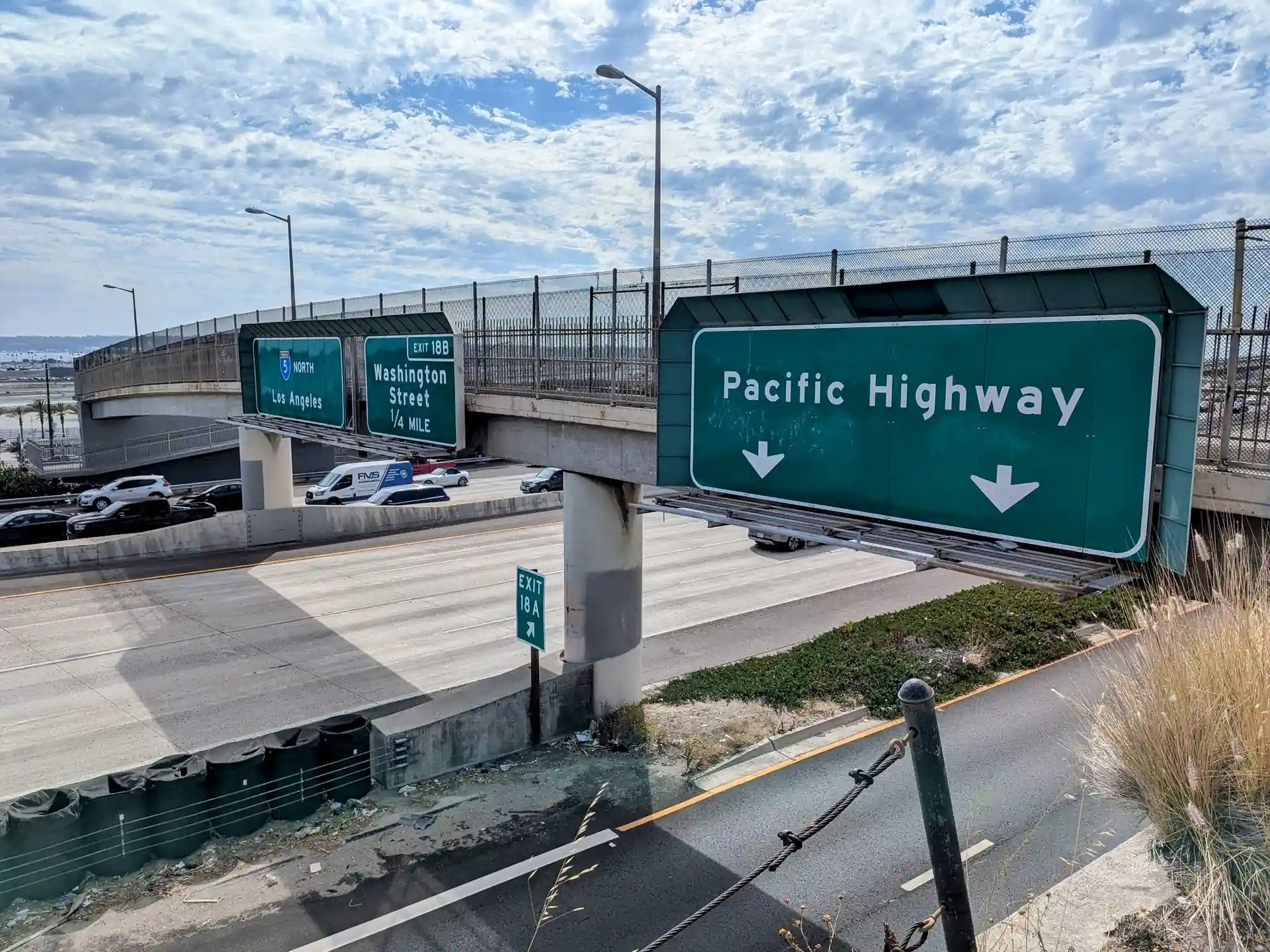
Yes. Caltrans can be held liable when a dangerous condition on a state highway causes serious injury or death. These cases require proof of the roadway hazard, its role in the accident, and the legal basis for holding the state responsible. A government claim generally must be presented within six months, followed by a separate deadline to file a lawsuit.
Hulburt Law Firm’s San Diego dangerous roadway conditions attorneys represent people and families injured by unsafe highways, intersections, crosswalks, and other roadway conditions. We investigate what made the road dangerous, what Caltrans knew, and whether the agency failed to take reasonable protective measures.
Can You Sue Caltrans?
An accident on a state highway does not automatically make Caltrans responsible. A viable claim must connect the injury to a dangerous condition of property the state owned or controlled and satisfy California’s public-entity liability requirements.
The central questions are:
- Did a dangerous roadway condition contribute to the injury?
- Did a Caltrans employee negligently create it, or did Caltrans have sufficient notice to protect against it?
- Does a government immunity apply?
- Were the required claim and lawsuit filed on time?
Government Code section 835 sets the standard for these claims. A negligent driver and Caltrans can both bear responsibility when their conduct and the roadway condition combine to cause harm.
Which Roads Caltrans Controls
Caltrans manages California’s state highway system, including freeways and numbered state routes. In San Diego County, these include I-5, I-8, I-15, I-805, and routes such as SR-52, SR-56, SR-67, SR-78, SR-94, SR-125, and SR-163. Several of these appear in our review of San Diego’s most dangerous roads.
A state route can run through a city on what looks like an ordinary surface street. Responsibility for ramps, intersections, sidewalks, signals, and adjoining roads may also involve another public agency. The exact location and the particular feature that caused the injury both matter.
The investigation should identify the route, nearest intersection, direction of travel, and precise crash location. Caltrans’s right-of-way maps and survey records, together with construction records and agreements allocating maintenance responsibilities, can help establish ownership and control. A road’s name or appearance alone is not enough.
Potential hazards include unsafe crosswalks, obstructed sight lines, defective barriers, shoulder drop-offs, drainage problems, deteriorated pavement, and dangerous construction zones. Our guides to dangerous intersection accidents and pothole liability in San Diego address those conditions in more detail.
What You Must Prove
Under CACI No. 1100, California’s civil jury instruction for dangerous public property, the injured person generally must establish:
- Ownership or control. Caltrans owned or controlled the property.
- A dangerous condition. The property was dangerous when the injury occurred.
- A foreseeable risk. The condition created a reasonably foreseeable risk of the kind of injury suffered.
- Creation or notice. A Caltrans employee negligently or wrongfully created the condition within the scope of employment, or Caltrans had actual or constructive notice with sufficient time to protect against it.
- Causation and harm. The person was injured, and the condition was a substantial factor in causing that harm.
A “dangerous condition” means a substantial risk of injury when the property is used with due care in a reasonably foreseeable way. A trivial defect is insufficient. Government Code section 830 supplies that definition.
For example, showing that a collision occurred near a guardrail does not establish liability. The evidence must explain what was dangerous about the roadway or barrier and how it contributed to the injury. The broader framework is discussed in our guide to suing the government for a dangerous road in California.
Proving Caltrans Knew
When liability rests on Caltrans’s failure to protect against a hazard, notice is often central. Government Code section 835.2 recognizes two forms:
- Actual notice: Caltrans knew the condition existed and knew or should have known of its dangerous character.
- Constructive notice: The condition existed long enough and was sufficiently obvious that Caltrans should have discovered both the condition and its dangerous character through reasonable care.
Relevant evidence can include prior complaints, inspection reports, maintenance records, engineering studies, internal communications, and earlier collisions involving the same hazard.
The California Highway Patrol’s Statewide Integrated Traffic Records System (SWITRS) and UC Berkeley’s Transportation Injury Mapping System (TIMS) help identify collision patterns. Those records require careful review: a nearby crash may involve a different hazard, direction of travel, or roadway configuration.
Prior crashes are one source of proof, not the only one. Complaints, observations, and engineering records may establish knowledge before another person is hurt. Conversely, a general assertion that the road was unsafe does not establish notice of the particular danger. In Kabat v. Department of Transportation, the court rejected a failure-to-warn claim where the plaintiffs failed to raise a triable issue concerning Caltrans’s notice.
Early investigation should also document the scene before repairs, vegetation trimming, or changes to signs and signals alter the evidence.
What Is Design Immunity?
Caltrans often raises design immunity under Government Code section 830.6. This defense can protect an approved roadway design even when an injured person contends that a safer design was available.
Caltrans generally must establish a causal relationship between the design and the accident, discretionary approval before construction or conformity with previously approved standards, and substantial evidence supporting the design’s reasonableness. The framework appears in CACI No. 1123.
An expert’s disagreement with the design does not necessarily defeat immunity. The inquiry includes what was actually approved, whether the accident-causing feature was covered, and whether the roadway conformed to the approved plans. A hazardous construction deviation or maintenance condition may fall outside the protected design.
Design immunity can also be lost when changed physical conditions make an initially protected design dangerous. Under CACI No. 1124, this requires proof of the changed conditions, notice, and a reasonable opportunity to carry out remedial work. Where correction is impracticable or funding is unavailable, the adequacy of efforts to warn can also matter.
These issues require comparing the approved plans with the roadway’s actual condition and history.
Failure to Warn Claims
Yes. Design immunity does not automatically defeat a separate failure-to-warn claim. In Tansavatdi v. City of Rancho Palos Verdes, the California Supreme Court reaffirmed that an agency can remain liable for failing to warn of a dangerous roadway condition even when the physical design is immune.
As explained in CACI No. 1126, the plaintiff must establish that:
- Caltrans had actual or constructive notice of the dangerous condition with sufficient time to protect against it.
- The danger would not have been reasonably apparent to, or anticipated by, a person exercising due care, and a warning was necessary for safe traffic movement.
- The absence of a warning was a substantial factor in causing the injury.
This is often called the concealed-trap exception to warning-sign immunity under Government Code section 830.8. It does not require proving that physical conditions changed after the design was approved.
The warning plans still matter. Tansavatdi left open how immunity applies when officials specifically considered whether to provide a warning. In Stufkosky v. Department of Transportation, the Court of Appeal upheld immunity where the design plans addressed the quantity and placement of deer-crossing signs. The analysis therefore requires examining the approved warnings as well as the underlying hazard.
How to File Your Claim
The Six-Month Claim Deadline
Before pursuing a personal-injury or wrongful-death lawsuit against the state, you generally must present a government claim within six months after the cause of action accrues. In an injury case, that is ordinarily the accident date. Government Code section 911.2 governs this initial deadline.
Do not rely on the two-year deadline commonly associated with California personal-injury lawsuits. Reporting a road hazard or speaking with a Caltrans employee is not a substitute for properly presenting a claim.
Use the Appropriate Filing Process
Claims over $12,500 go through the state’s Government Claims Program, administered by the Department of General Services. This is the route for serious injury and wrongful death claims exceeding that amount. Online filing is available. There is a $25 filing fee, and eligible claimants may request a fee waiver.
Claims of $12,500 or less may be submitted directly to Caltrans using form DOTLD-0274. This process covers qualifying personal-injury, death, and property-damage claims, and has no filing fee. Caltrans instructs claimants to send the signed original and supporting documents to the appropriate district claims office. For San Diego and Imperial counties, that is District 11, 4050 Taylor Street, MS 130, San Diego, CA 92110. See Caltrans’s current filing instructions.
If your injuries are still being evaluated, obtain advice before choosing the lower-value process or accepting a settlement. The $12,500 threshold determines the direct filing route; it should not be treated as a valuation of your injuries. An earlier submission may require additional steps if the claim grows, and a settlement release may prevent further recovery.
If You Missed the Initial Deadline
Late-claim relief may be available, but it is not automatic. A late-claim application generally must be presented within a reasonable time, no later than one year after accrual, subject to statutory exceptions.
If the application is denied or deemed denied, a petition for court relief generally must be filed within six months. If the court grants relief, the lawsuit must be filed within 30 days of the order. These are separate requirements under Government Code section 946.6. Seek legal advice immediately if the initial deadline may have passed.
Deadline to File Your Lawsuit
Presenting a timely claim does not preserve the right to sue indefinitely. Under Government Code section 945.4, the required claim generally must first be acted on or deemed rejected before suit can proceed.
The state ordinarily has 45 days to act on a presented claim, although amendments or a written extension agreement can affect that period. If it does not act within the applicable period, the claim is automatically treated as rejected. Government Code section 912.4 governs that process.
For a timely presented claim, Government Code section 945.6 generally sets the following lawsuit deadlines:
- If a written rejection notice complying with section 913 is personally delivered or mailed: six months from the date of that delivery or mailing.
- If no written notice complying with section 913 is given: two years from accrual, subject to applicable exceptions and extensions.
Silence after 45 days does not itself start the six-month lawsuit deadline. A compliant written notice sent afterward can trigger that period. The notice must satisfy section 913, including its required warning.
Keep the rejection letter and envelope and have counsel calculate the deadline promptly. Do not assume that a perceived defect in the notice gives you more time, or that ongoing settlement discussions extend the deadline.
Hulburt Law Firm
Hulburt Law Firm represents people and families facing catastrophic injuries and wrongful death caused by dangerous roads. We investigate ownership and control, preserve evidence, obtain agency records, work with qualified experts, and prepare cases to address government defenses and persuade a jury.
In Quiroz v. Caltrans, Conor Hulburt served as lead trial counsel and obtained a $28,163,528 jury verdict for a 13-year-old boy who suffered a catastrophic brain injury after being struck while using a dangerous crosswalk. He also handled a settlement involving Caltrans and other defendants for a cyclist struck from behind on SR-67 who suffered a severe traumatic brain injury. These cases are described on our dangerous roadway practice page.
Conor Hulburt accepts a limited number of serious cases so each receives direct attorney attention, careful investigation, and preparation tailored to the facts. We work to uncover what happened, establish responsibility, and pursue a recovery that addresses the lasting effects of the injury or loss.
Call (619) 821-0500 or request a free, confidential case review.
Request a Free Case Review
Simply fill out the form or call 619.821.0500 to receive a free case review. We’ll evaluate what happened, your injuries, and potential defendants to determine how we can best help you.

Hulburt Law Firm handles serious personal injury and wrongful death cases throughout San Diego County.


