
School Bus Accidents in San Diego: Liability and Deadlines
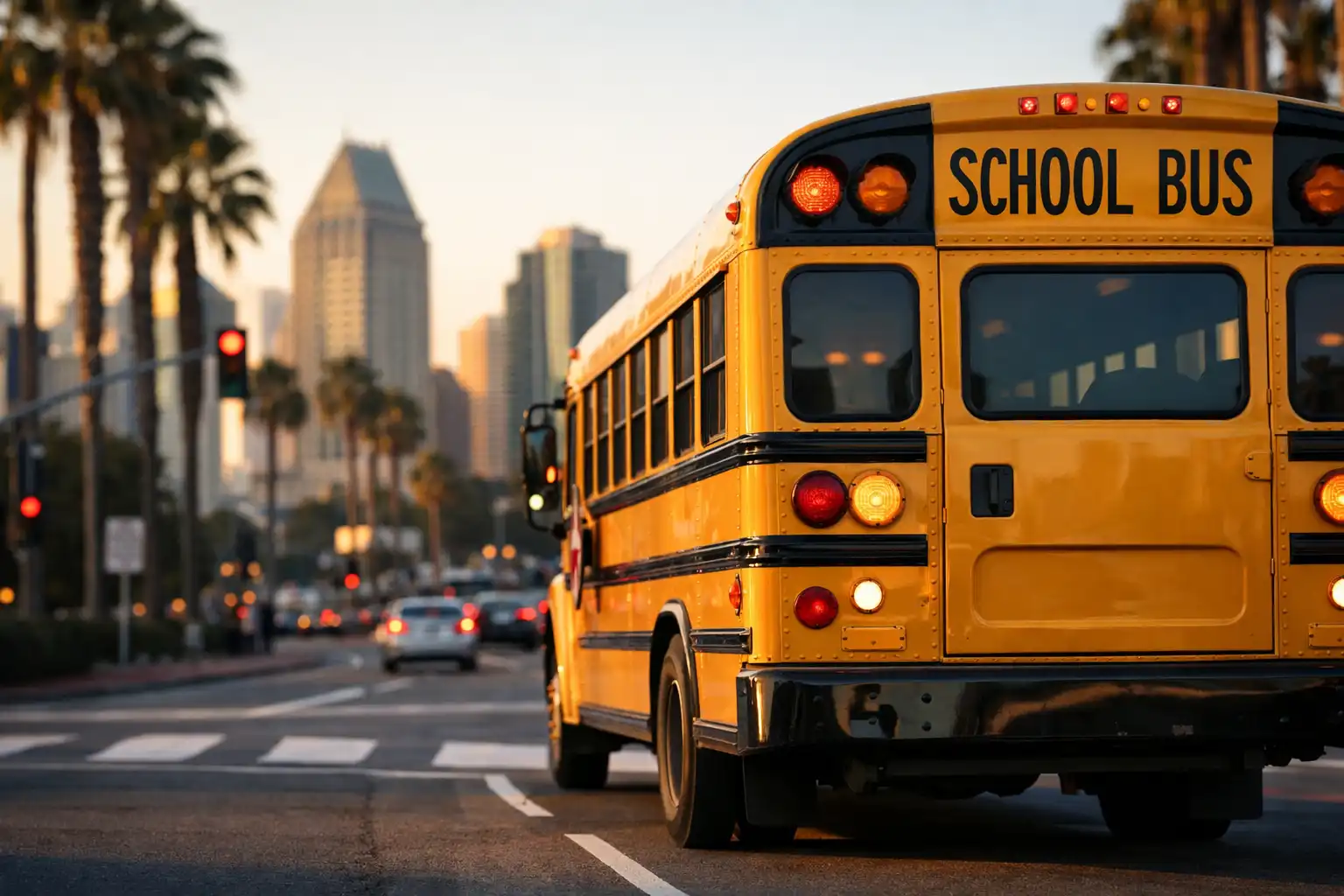
A school bus accident involving a child raises legal issues that do not appear in an ordinary traffic collision.
The responsible party may be a school district, a private transportation company, the bus driver, another motorist, an equipment manufacturer, or more than one of them. A field trip can trigger a statutory immunity that does not apply to ordinary home-to-school transportation. A claim against a public school district can require action within six months, even when the injured child is only five years old.
And if the case settles, the parents cannot simply sign a release and receive the child’s money. California courts supervise settlements involving minors to make sure the settlement and distribution protect the child.
This guide from our San Diego bus accident attorneys explains the rules that matter most after a San Diego school bus accident. For the broader rules governing bus collisions, see our San Diego bus accident claims guide. For how the firm handles injuries to minors more generally, see our San Diego child injury attorney page.
What to Do After a School Bus Accident
Medical care comes first. Children do not always describe pain or neurological symptoms clearly, and some injuries become more apparent in the hours or days after a collision.
Parents should also make sure the incident is reported to the school or district and, when appropriate, law enforcement.
Then the evidence needs to be identified quickly.
Important evidence may include:
- Onboard surveillance video
- Exterior bus cameras
- GPS and telematics data
- Dispatch communications
- Driver logs and route records
- Bus inspection and maintenance records
- The driver’s training and certification records
- The district’s transportation safety plan
- Witness statements
- Photographs of the bus, roadway, bus stop, and surrounding sight lines
- Electronic data from other vehicles involved in the collision
Video and electronic information may be overwritten through ordinary retention practices. A preservation request made early in the case can prevent important evidence from disappearing.
Our guides to what to do after a San Diego bus accident and proving liability in a San Diego bus case discuss evidence preservation in more detail.
Who Can Be Responsible for a School Bus Accident?
The answer depends in part on who operated the bus and how the accident happened.
The School District
A public school district may be responsible for negligence by its employees acting within the scope of their employment.
Government Code section 815.2 generally makes a public entity vicariously liable when its employee causes injury within the scope of employment and the employee could otherwise be held liable.
In a school bus case, potential issues can include:
- Negligent driving
- Unsafe loading or unloading
- Failure to escort a child when required
- Failure to follow the district’s transportation safety plan
- Negligent supervision
- Failure to respond appropriately to known concerns about a driver
- Other negligent acts by district employees
California courts have long recognized that schools owe students duties of reasonable supervision. In Dailey v. Los Angeles Unified School District (1970) 2 Cal.3d 741, the California Supreme Court explained that inadequate supervision can constitute negligence.
In C.A. v. William S. Hart Union High School District (2012) 53 Cal.4th 861, the court also confirmed that a district may be vicariously liable under section 815.2 for negligence by administrators in carrying out hiring, supervision, and retention responsibilities.
In a bus case, that makes the driver’s personnel, training, certification, complaint, and collision history potentially important evidence.
A Private School Bus Contractor
Many school transportation services are provided by private companies under contract with school districts or private schools.
When a private bus company employs the driver, claims may arise directly against the driver and transportation company for negligent operation, training, supervision, maintenance, or other conduct, much as they do against private charter and tour bus operators.
The distinction between a public district and a private contractor also matters for deadlines. The six-month Government Claims Act presentation requirement applies to claims against public entities, not simply because a collision happened on a school bus.
Another Driver
Some of the most serious school bus injuries occur outside the bus.
A driver may illegally pass a stopped school bus and strike a child who is boarding, exiting, or crossing the road.
Vehicle Code section 22454 generally requires a driver approaching a school bus from either direction to stop before passing when the bus is stopped to load or unload children and is displaying its flashing red light signal and stop arm, if equipped.
There is an important exception. A driver on the other roadway of a divided highway or multiple-lane highway does not have to stop. For this rule, a multiple-lane highway means a road with at least two travel lanes in each direction.
The exact roadway configuration therefore matters.
Vehicle and Equipment Manufacturers
A product defect may also contribute to a child’s injuries.
Potential product issues can involve:
- Passenger restraint systems
- Seats and seat structures
- Doors
- Emergency exits
- Tires
- Steering or braking systems
- Cameras and warning systems
- Other safety equipment
When a mechanical failure contributes to the crash or makes the injuries worse, the bus and its components should be preserved for inspection before repairs or disposal.
California School Bus Safety Laws
California has detailed statutes governing school bus drivers, loading and unloading, student escorts, restraint systems, driver qualifications, and district safety procedures.
These rules can help establish what should have happened before an accident.
Loading, Unloading, and Crossing the Road
Vehicle Code section 22112 contains specific procedures for school bus stops.
When approaching a stop where students will load or unload, a driver generally must activate the bus’s amber warning lights beginning 200 feet before the stop when the bus is equipped with them.
When the bus is stopped to load or unload students, the driver must operate the flashing red light system and stop arm as required by the statute.
Before opening the door at a qualifying stop, the driver must make sure the warning system is activated and that it is safe for students to enter or exit.
When traffic is not controlled by a traffic officer or official signal, the driver must also escort prekindergarten through eighth-grade students who need to cross the road where the bus is stopped. The driver must use an approved hand-held stop sign, require the students to cross in front of the bus, and make sure they have crossed safely before moving the bus.
These requirements are especially important when a child is struck while crossing to or from a school bus.
Transportation Safety Plans
Education Code section 39831.3 requires school districts and other covered school transportation providers to maintain a transportation safety plan.
The plan must address issues including:
- Determining when students require an escort
- Procedures for prekindergarten through eighth-grade students boarding and exiting at bus stops
- Boarding and exiting at schools and trip destinations
- Procedures to ensure a child is not left unattended on a bus
- Procedures for designating adult chaperones on school pupil activity buses
After an accident, the written plan should be compared with what actually occurred.
School Bus Safety Instruction
Education Code section 39831.5 requires students transported on school buses or school pupil activity buses to receive instruction concerning emergency procedures and passenger safety.
Among other requirements, prekindergarten through eighth-grade students who receive home-to-school transportation must receive safety instruction at least once each school year.
That instruction includes loading and unloading, driver escorts, safe street crossing, use of passenger restraints when installed, passenger conduct, emergency equipment, and bus evacuation.
Students riding on a school activity trip must also receive specified safety instruction before departure.
The annual instruction must be documented, and the records are kept for one year.
Those documents can show whether required safety procedures were actually taught before an accident.
Driver Licensing and Certification
A school bus driver needs more than an ordinary driver’s license.
Vehicle Code section 12517 requires a driver transporting students on a school bus to possess a driver’s license for the appropriate vehicle class with the required school bus and passenger endorsements.
The driver must also possess the required school bus certificate when transporting students to or from school or school activities.
The driver’s certificate status, training history, medical qualifications, and prior driving record should be examined when driver competence is at issue.
Passenger Restraints
California requires passenger restraint systems on newer school buses.
Under Vehicle Code section 27316, qualifying Type 2 buses manufactured on or after July 1, 2004 and Type 1 buses manufactured on or after July 1, 2005 must have combination lap and shoulder restraints at designated seating positions.
The statute now goes further: by July 1, 2035, every school bus in use in California must be equipped with a passenger restraint system.
Whether the bus involved in a particular collision was required to have belts therefore depends on its type, manufacture date, and the law applicable at the time of the accident.
When Safety Violations Help Prove Negligence
California safety statutes can do more than establish a regulatory violation.
Under Evidence Code section 669, violation of a statute or regulation can create a presumption of negligence when the required elements are established.
Among other things, the violation must have caused the injury, the accident must be the type the law was designed to prevent, and the injured person must belong to the class the law was intended to protect.
This is the doctrine addressed by CACI No. 418, Presumption of Negligence Per Se.
A driver who fails to follow section 22112 before a child crosses the road, for example, presents a very different liability case from a simple disagreement about whether the driver was “careful enough.”
The written safety rule provides the starting point. The evidence then has to establish the violation and connect it to the injury.
Field Trip and Excursion Immunity
A school bus case can change dramatically if the injury happened during a school field trip or excursion.
Education Code section 35330(d) provides that people participating in an authorized field trip or excursion are deemed to have waived claims against the school district, a charter school, or the State of California for injury, accident, illness, or death occurring during or by reason of the trip.
For out-of-state trips, the statute separately requires signed waiver statements.
The statutory immunity can create a major obstacle to a claim against the district itself.
But its scope matters.
Section 35330(d) identifies the district, charter school, and State of California. It does not, by its terms, give the same protection to every private party involved in the trip.
Depending on the facts, claims may still exist against:
- A private bus company
- A private bus driver
- Another motorist
- A vehicle or component manufacturer
- Another negligent private party
Ordinary transportation between home and school is also different from a field trip or excursion authorized under section 35330.
Determining exactly what transportation was occurring, who operated the vehicle, and who caused the accident is therefore essential before concluding that field-trip immunity ends the case.
Dangerous Bus Stops and Public Property
Not every school bus case begins with negligent driving.
A child may be injured because the bus stop itself places students in a dangerous location with inadequate sight distance, unsafe crossing conditions, or another hazardous feature.
When a public entity owns or controls the property, Government Code section 835 provides a potential basis for liability for a dangerous condition of public property when the statutory requirements are met.
These cases can involve questions about:
- Stop placement
- Sight distance
- Traffic speed
- Road geometry
- Crosswalks
- Signals
- Lighting
- Vegetation or other visual obstructions
- Prior collisions or complaints
- Whether the entity knew or should have known of the dangerous condition
Design immunity under Government Code section 830.6 can also become an issue.
The California Supreme Court’s decision in Tansavatdi v. City of Rancho Palos Verdes (2023) 14 Cal.5th 639 confirms that design immunity does not automatically eliminate every separate failure-to-warn theory involving a concealed dangerous condition.
Our guide to suing a government entity over a dangerous roadway explains these claims in greater detail.
The Six-Month Deadline Applies to Injured Children
This is one of the most important rules for parents to understand.
Being a minor does not pause California’s six-month Government Claims Act deadline.
Government Code section 911.2 generally requires a claim relating to personal injury to be presented to the public entity within six months after the claim accrues.
Normally, Code of Civil Procedure section 352 tolls certain statutes of limitations while a plaintiff is under 18.
But subdivision (b) expressly provides that section 352 does not apply to claims against public entities or employees when Government Claims Act presentation is required.
The six-month clock therefore runs even when the injured person is a young child.
A parent or guardian needs to act on the child’s behalf. The same rule governs the six-month government claim deadline in child injury cases of every kind, not only bus collisions.
Missing Six Months Does Not Automatically End a Minor’s Claim
California gives minors an important form of relief, but it is not ordinary tolling.
If the six-month period is missed, Government Code section 911.4 permits an application to the public entity for leave to present a late claim.
The application generally must be made within a reasonable time not exceeding one year after the claim accrues.
Government Code section 911.6 provides mandatory relief in specified circumstances involving minors.
If the injured child was a minor throughout the original six-month claim period, subdivision (b)(2) requires the public entity to grant a timely late-claim application.
Subdivision (b)(3) addresses a person who was a minor during only part of that period and requires relief when the statutory timing requirements are satisfied.
The One-Year Limit Is the Trap
Minority does not stop the one-year period for making the late-claim application.
Government Code section 911.4 expressly counts the time spent as a minor when calculating that year, subject to separate statutory exceptions that generally involve other circumstances.
That means parents should not assume that a child’s claim can simply wait until adulthood.
If the family has missed the initial six months, the late-claim procedure should be evaluated immediately.
What If the Public Entity Denies the Late-Claim Application?
If the public entity denies the application, or fails to act within the statutory period so that it is deemed denied, Government Code section 946.6 permits a petition to the superior court for relief.
The petition must generally be filed within six months after the late-claim application is denied or deemed denied.
For qualifying minors, section 946.6 contains mandatory relief provisions paralleling those in section 911.6, provided the statutory requirements are met.
If the court grants relief, section 946.6 requires the lawsuit to be filed within 30 days after the order.
These are separate deadlines. Missing one can prevent a family from reaching the merits of the underlying injury case.
Our guide to the six-month claim deadline after a San Diego bus accident explains the Government Claims Act process in more detail.
Claims Against Private Defendants Follow Different Deadlines
A school bus accident can involve a public school district and private defendants at the same time.
That creates two different calendars.
The six-month Government Claims Act deadline may apply to the school district or another public entity.
A claim against a private bus company, another driver, or a product manufacturer ordinarily follows California’s civil statute of limitations instead.
Code of Civil Procedure section 335.1 generally provides a two-year limitations period for personal injury claims.
For claims subject to section 352(a), minority ordinarily tolls the civil statute of limitations while the injured person is under 18.
Parents should not use that longer private-defendant deadline when calculating the deadline against a school district.
The safest approach is to identify every potential defendant early and calendar each deadline separately.
A Child’s Settlement Requires Court Approval
Settling a child’s injury case is different from settling an adult’s claim.
A parent cannot make the child’s claim permanently binding simply by signing the same type of release an adult plaintiff would sign.
California requires judicial supervision of compromises involving minors. Our child injury page explains how a judge approves a child’s settlement in any type of case.
Who Acts for the Child?
When a minor is a party to a lawsuit, Code of Civil Procedure section 372 provides that the child appears through an appropriate guardian or conservator of the estate or through a guardian ad litem appointed by the court.
The guardian ad litem is commonly a parent, but the court’s concern is the child’s interests.
A conflict can require someone else to serve.
Potential conflicts may arise when:
- A parent was involved in causing the collision
- A parent has a competing claim to the same limited insurance funds
- Family members disagree about settlement
- The proposed representative has another interest inconsistent with the child’s
Court Approval Applies Even Without a Lawsuit
A minor’s compromise is not limited to cases already in litigation.
Probate Code section 3500 provides a procedure through which a parent with the required custodial status may compromise a minor’s disputed claim before a lawsuit is filed, subject to court approval.
The purpose is to make sure the proposed settlement actually serves the child.
What the Court Reviews
California Rule of Court 7.950 requires a verified petition containing full disclosure of information bearing on the reasonableness of the settlement and proposed disposition of the proceeds.
Depending on the case, the court may consider:
- How the accident happened
- Disputed liability
- The nature and extent of the child’s injuries
- Medical treatment and prognosis
- Future medical needs
- Insurance limits
- Medical expenses and reimbursement claims
- Litigation risks
- Attorney’s fees and costs
- The amount the child will actually receive
- How the child’s net proceeds will be protected
The standard Judicial Council form is MC-350. Qualifying cases may use the expedited procedure under Rule 7.950.5.
An expedited petition can, under the rule, be determined without a hearing if the requirements are satisfied and the court does not decide that a hearing is necessary.
The Judge Reviews the Attorney’s Fee Too
The contingency agreement does not automatically determine the fee paid from a child’s recovery.
Under Rule 7.955, the court applies a reasonable-fee standard when approving attorney’s fees payable from money recovered for a minor.
The court may consider factors including the work performed, the difficulty of the case, the risk undertaken, the result obtained, the amount involved, and the terms of the fee agreement.
This is another reason a minor’s compromise is more than a rubber stamp on a settlement negotiated by the adults.
Where Does the Settlement Money Go?
After approved fees, costs, medical expenses, and other authorized deductions are addressed, the court determines how the child’s money will be held or distributed.
Probate Code section 3611 gives the court several options.
Depending on the circumstances, the court may order:
- Deposit into a blocked insured account
- Purchase of a single-premium deferred annuity
- Appointment of a guardian of the estate
- Funding of a special needs trust
- Transfer under the California Uniform Transfers to Minors Act
- Placement into a court-approved trust
- Other authorized arrangements for smaller recoveries
The appropriate structure depends on the amount, the child’s age, medical needs, disability, public-benefit eligibility, and how the money is expected to be used.
A blocked account generally cannot be accessed without a further court order while the child is a minor.
The settlement therefore belongs to the child. It is not simply money paid to the parents because they brought the claim.
Injuries to Children Require a Long-Term View
The value of a child’s injury case cannot always be measured from the medical bills incurred in the first few months.
Some consequences become clearer only as the child grows.
Brain Injuries
A young child with a traumatic brain injury may initially appear to recover well, only to develop difficulties later as school and social demands become more complex.
Problems can involve memory, attention, executive function, language, behavior, emotional regulation, and academic performance.
Our guide to children and traumatic brain injury discusses why pediatric brain injuries can be difficult to evaluate early.
Growth Plate Injuries
Fractures involving a child’s growth plate can create problems that do not fully appear until later development.
A pediatric orthopedic specialist may need to evaluate the risk of altered growth, limb-length discrepancy, angular deformity, or future surgery.
Educational Needs
Serious injuries may affect:
- IEP services
- Section 504 accommodations
- Classroom assistance
- Speech or occupational therapy
- Tutoring
- Assistive technology
- School placement
Records from before and after the accident can help establish how the child’s functioning changed.
Future Earning Capacity
A seriously injured child has no established career history.
When an injury is likely to affect future employment, vocational and economic experts may need to evaluate the child’s educational path, disability, functional limitations, and likely impact on lifetime earning capacity.
The analysis is necessarily forward-looking.
Comparative Fault Is Different for Children
California’s comparative-fault rules can apply in a case involving an injured child, but a child is not judged by the same standard as an adult.
California’s jury instruction CACI No. 402, Standard of Care for Minors, measures a child’s conduct against what a reasonably careful child of the same age, intelligence, knowledge, and experience would have done under similar circumstances.
Very young children may be incapable of negligence as a matter of law depending on their age and circumstances.
That distinction matters when a defendant argues that a child should have recognized a road hazard, crossed differently, followed an adult instruction more carefully, or taken another precaution.
What About Seat Belts?
Seat-belt issues need to be analyzed carefully.
First, not every California school bus currently on the road was originally required to have a lap and shoulder restraint at every seat. Vehicle Code section 27316 uses manufacture-date requirements and now requires all school buses in California to be equipped with passenger restraints by July 1, 2035.
Second, when a bus is equipped with the required restraint system, California regulations require passengers to use it, subject to specified exceptions.
But Vehicle Code section 27316(c) also provides that a person, school district, or organization may not be charged with a violation of the Vehicle Code or regulations merely because a passenger failed to use or improperly used the restraint system.
That provision should not be overstated. By its terms, it addresses statutory violations. It does not itself resolve every possible civil dispute over causation, comparative fault, or the extent of injuries.
In a serious case, the analysis should begin with whether the bus had the restraint system it was legally required to have, whether it was operational, what safety instruction was provided, the child’s age, and whether restraint use actually affected the injuries.
Talk to Hulburt Law Firm About a School Bus Accident
A serious school bus case can involve several legal systems at once.
A school district may trigger the Government Claims Act. A private transportation company may have a different statute of limitations. Field-trip immunity may protect some defendants but not others. Bus-stop design may create a public-property claim. And any settlement involving an injured child will require special court procedures.
Those issues are easier to address when the evidence and deadlines are identified early.
If your child was seriously injured in a school bus accident in San Diego, our San Diego bus accident lawyers can investigate what happened, preserve the available evidence, identify the responsible parties, and handle the court process required to protect a child’s recovery.
Call 619.821.0500 or message us through our contact form for a free, confidential case review.
There is no fee unless we recover compensation for your family.
Request a Free Case Review
Simply fill out the form or call 619.821.0500 to receive a free case review. We’ll evaluate what happened, your injuries, and potential defendants to determine how we can best help you.

Hulburt Law Firm handles serious personal injury and wrongful death cases throughout San Diego County.


